










































Listening to Communities in Insecure Environments
Global Public Policy Institute (GPPi)
"In insecure environments, where humanitarian staff have limited opportunities for face-to-face interactions with communities, achieving accountability to affected populations is more complex and often requires a mix of approaches. Community feedback mechanisms can be a valuable tool to strengthen community engagement and to improve the quality of humanitarian programming."
This resource paper is part of the Secure Access in Volatile Environments (SAVE) research programme, which is funded by the United Kingdom Department for International Development (DFID). This 3-year research programme aims to contribute solutions for providing effective and accountable humanitarian action amid high levels of insecurity. The project involves global- and field-level analyses in 4 focus countries; this report presents the main research findings and key lessons on community feedback mechanisms in insecure settings in Afghanistan, South Central Somalia, and Syria. The research involved consultations with crisis-affected communities, aid agencies, and donors, as well as a review of relevant documentation and literature.
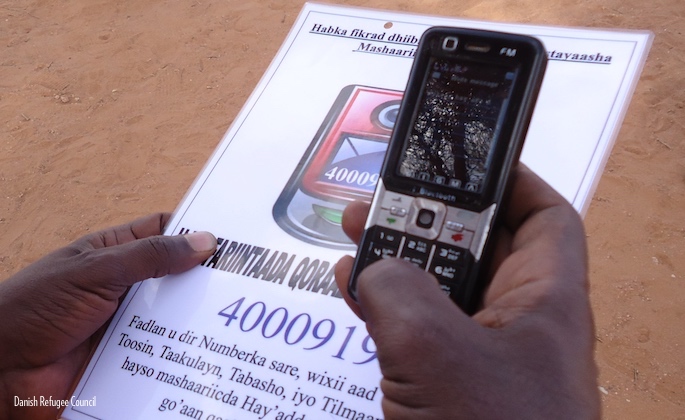
The study found that, despite similarly high levels of risk to humanitarian operations and corresponding access constraints, existing feedback processes are "remarkably different" in Afghanistan, South Central Somalia, and Syria. Aid agencies use different media to collect and respond to feedback, and the number and density of formal feedback channels varies between the 3 contexts. In Afghanistan, most agencies rely on informal conversations with local community representatives. In South Central Somalia, formal phone-based feedback mechanisms such as hotlines and SMS (text messaging) platforms are much more prevalent. In Syria, communication with affected communities mostly happens through local agencies and local councils - both face-to-face and through online communication platforms such as WhatsApp. These different feedback landscapes reflect different socio-cultural environments, as well as different expectations from donors to establish mechanisms.
Despite the differences in available feedback mechanisms between the 3 contexts, the views from communities consulted were found to be remarkably similar and skeptical. A large-scale SAVE survey with crisis-affected communities showed that the majority has never been asked for their opinion about the aid they received from aid agencies. In Somalia, the country with most formalised feedback systems, only 4% of the Somali respondents said they were consulted. This indicates that a higher number of formal feedback mechanisms does not automatically lead to better communication with communities - especially when systems are not properly publicised and maintained. Furthermore, crisis-affected people criticise agencies for relying too much on local community representatives, for not involving them when planning projects, and for a lack of follow-up after providing feedback. They would like to have regular face-to-face communication with not only aid representatives, but also with independent actors that are not directly associated with programme implementation in order to talk freely about sensitive issues such as corruption. People consulted also stressed the need to talk about general concerns that are not related to specific agencies.
Most humanitarian staff also expressed dissatisfaction, including that their mechanisms do not deliver the type and volume of feedback that the agency expected. Many aim to find out about corruption and aid diversion by partners or local representatives, but such complaints remain rare. Agencies report that they do regularly receive useful feedback about programme quality - another key objective of feedback mechanisms - but mainly through their face-to-face channels. Most incoming feedback concerns day-to-day operational matters.
SAVE contends that setting up functioning feedback mechanisms in insecure areas does not require new or radically different approaches. Rather, agencies should make use of existing guidance and adhere to documented good practice. In addition, the research identified the following lessons:
- Efforts should be undertaken to make communication more inclusive: Instead of only consulting "key informants", agencies should actively seek the views of those without power and inform them about their rights and entitlements. Targeted community outreach with field staff or, where access is constrained, through carefully selected third parties can help gather perspectives of a more representative sample.
- Face-to-face feedback channels are most valuable, but require formal procedures to ensure follow-up and learning: Agencies that are close to the ground are best positioned to lead communication efforts. A more systematic approach with sufficient capacities and procedures is needed, however, to ensure that feedback is recorded, analysed, and responded to.
- Inclusive communication involves multiple, different feedback channels: Face-to-face contact by local field staff or implementing partners needs to be complemented with other communication channels in order to connect crisis-affected people with international agencies and donors without field presence. Agencies need to involve affected communities when choosing and designing these mechanism(s).
- Agencies should enable two-way communication instead of only extracting information: To receive meaningful feedback, agencies need to invest in making communities aware of available feedback channels and inform them about their rights and entitlements.
- Where multiple agencies are present, more collaborative communication with communities is required: From a community perspective, joint or inter-agency feedback mechanisms are less confusing and more user-friendly. Still, such systems remain rare, since agencies are often not willing to share (sensitive) information with others and because of the initial costs involved. While a comprehensive common feedback project may not always be realistic or desirable in all contexts, agencies should take steps towards greater collaboration - for instance, through joint standards on feedback mechanisms.
- Donors should shape feedback practice more actively. To avoid duplication and to promote wider utilisation of feedback, donors should provide incentives for agencies to meet good practice standards and to participate in joint initiatives. Moreover, demanding feedback is only effective if donors create an atmosphere in which agencies feel comfortable to also share the negative feedback they receive.
SAVE website, January 3 2017; and email from Lotte Ruppert to The Communication Initiative on January 4 2017. Image credit: © Danish Refugee Council
- Log in to post comments