










































ICT for Education: Five Years of Learning
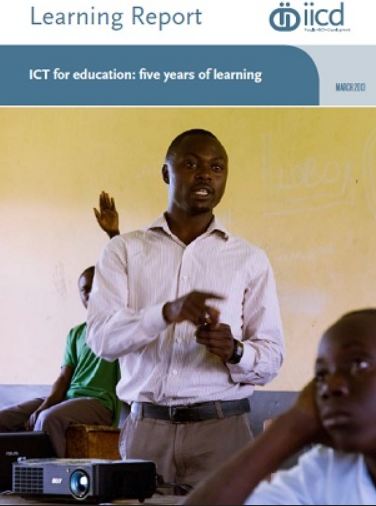
This 12-page report shares lessons learned by the International Institute for Communication and Development (IICD) from working with education partners in 12 developing countries to use information and communication technology (ICT) to bring about sector-wide improvements in education. According to the report, ICT can help improve the quality of education and access to it, especially in remote areas. Digital learning materials and ICT-assisted teaching methods can be created, accessed, and shared among teachers and students alike. This strengthens curricula while also fostering an inspiring working and learning environment. ICT tools can improve school management and administration as well, enabling headmasters to track personnel and expenditures and more closely monitor student performance.
According to the report, IICD has developed a unique approach to strengthen public services in developing countries - an "ICT-led social innovation process." In education, such a process brings together a range of stakeholders to set priorities for improvements. Together, stakeholders design how their organisations could use ICT to empower staff and students to raise the quality and relevance of education. IICD employs a participatory, multi-stakeholder approach to address structural problems, involving government representatives, school administrators and managers, teachers, parents, and local communities in project formulation. Partners take full ownership of the initiatives and activities with support from IICD.
This publication provides a selection of lessons learned in the five educational services that IICD provides:
- Creating and upgrading educational materials: A primary IICD focus is training teachers to develop their own learning tools using ICT. This approach ensures local ownership and more relevant and usable materials. Alongside teachers' own self-developed materials, there is a growing online availability of learning tools, including books, videos, and games.
- Improving teacher competencies: IICD's work is increasingly centred on the transformative potential of ICT in combination with pedagogical skills. For example, teachers can improve their method of instruction by using videos for self-assessment, and they can engage their students through interactive games. Training in basic ICT skills and ICT-assisted learning familiarises teachers with the different types and uses of digital materials. Training is equally important to introduce ways of integrating ICT into usual classroom routines, so that newly acquired skills can be immediately applied.
- Improving school management:According to the report, manual administration in schools takes time that could be better spent supervising and teaching. Use of computer software for administration also improves accuracy, for example, of students’ grades and attendance figures. Digitisation of school administrative systems is a relatively low cost. It therefore offers a ‘quick win’: administrators and teachers pick it up easily, and it is often a first step towards the more challenging use of ICT in teaching. Since 2011, IICD has supported projects to monitor teacher and student performance, often with the use of mobile phones.
- Strengthening Youth Employability:Integrating ICT skills into vocational training is a key area of IICD support. Occupations such as carpenter, tailor, and welder are the backbone of many communities. Local availability of such vocations is especially important in developing countries where manufacturing industries are emerging. ICT skills are valuable in most jobs, and integrating ICT into vocational curricula improves the relevance of schooling in any area. Business skills, like marketing, administration, and accounting, as well as life skills and career development, are all aspects of vocational training that can be improved with ICT support. IICD focuses its capacity development on instructors at vocational training institutes.
- Integrating ICT into policy and strategy: IICD advises national education ministries on ICT for Education policies. IICD also supports strategy development in ICT for Education at the regional and organisational levels. Their experiences in grassroots education projects feed into inputs to policy development at the regional and national levels. IICD also connects local experts and ICT champions with higher level policy developers, stimulating policies that are based on local expertise.
In conclusion, the report adds that IICD focuses on involvement of local communities, parents in particular, in children's education. ICT, especially mobile telephones and SMS platforms, open new communication channels between parents and schools, providing feedback mechanisms to improve the quality and relevance of schooling.
International Institute for Communication and Development websiteon December 20 2013.
- Log in to post comments