










































Zebras4Life-Test4Life
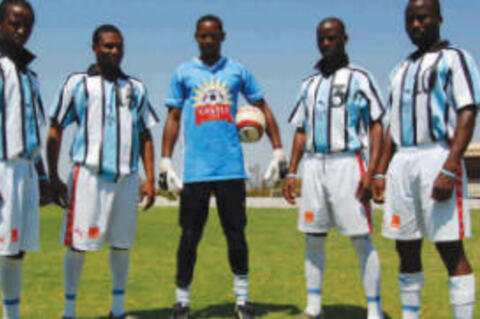
Football players from the Zebras national team travel throughout the country with counsellors from the Tebelopele voluntary counseling and testing (VCT) centres. They make appearances in rural areas and in towns, at various events, in schools, and at soccer matches, to show men that there is no shame in going for an HIV test. Players interact with crowds and some go for HIV tests as a way to encourage others. According to the organisers, Zebras football players have visited more than 30 villages and over 2,000 people have tested for HIV since the pilot roll-out of the Zebras4Life campaign.
Another complementary HIV campaign by Tebelopele is the Go Blue campaign, which works to provide VCT services at more client-friendly places, such as near shops, hang-out spots, and transit hubs, in addition to its 16 permanent centres and regular mobile outreach. As part of a ward-based VCT model, the organisation has set up tents where 100 of its counsellors undertake activities. The effort especially seeks to increase the number of men and out-of-school youth using VCT services. Organisers say that those who test with Tebelopele receive one of the popular Zebras4Life-Test4Life wristbands. Clients are also encouraged to wear the wristband to show support for the national teams and their personal commitment to living a long, healthy, and productive life.
HIV/AIDS
According to the organisers, men are often considered to be in a stronger position in their relationships with women, and they are important in ensuring that their families go for HIV tests or encouraging their partners to join national initiatives such as the prevention of mother-to-child transmission (PMTCT) programme. Health care workers estimate that up to 35% of the 1.7 million people living in Botswana now know their HIV status. However, that meant 65% of the population still do not know their HIV status, particularly men because they are under-represented at the testing centers. The organisers state that this is part of the reason why this campaign opted to draw on the participation of sportsmen like football players.
The Botswana Minister of Youth, Sports and Culture, Moeng Pheto, said that a reduction of new infections is key to the country's quest for "no new infections" by 2016. Another intended population of the testing campaign is out-of-school youth because they are vulnerable to problems such as street crime, sex work, substance abuse, sexually transmitted infections (STIs), and HIV/AIDS. The Minister added that, through sport, HIV/AIDS messages are disseminated to large numbers of people of varying backgrounds and ages.
According to the organisers, through 43 events in 33 different locations, Zebras4Life-Test4Life has empowered 4,090 people to know their HIV status. These events resulted in approximately a 300% increase over historical testing demand. Moreover, 58% of those tested were men, which is an increase of 10% compared to regular efforts.
Ministry of Youth, Sports, and Culture, National AIDS Coordinating Agency (NACA), Botswana Department of Sports and Recreation, Botswana Football Association (BFA), United States (US) Peace Corps, BOTUSA, Orange, and Tebelopele (U.S. Ambassador's HIV/AIDS Initiative).
Centers for Disease Control and Prevention/BOTUSA website on March 5 2009 and April 26 2010.
Comments

Mobile HCT
Great program idea. Thanks CI
- Log in to post comments