










































No Monkey Business Puppet Shows

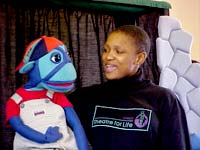
No Monkey Business plays run for 35 to 45 minutes and are presented in English, Afrikaans, Zulu, Xhosa, Sotho, and Tswana. Performed in schools, the shows are designed to be energetic, interactive, vibrant, and colourful and are structured into short narrative segments which are linked with participatory songs.
The No Monkey Business Series consists of the following plays:
No Monkey Business: Inside Out : This play incorporates a whole range of life skills issues – basic health, hygiene, illness, understanding HIV, medicines and ARV therapy. Mac Monkey has a severe cold but is afraid to tell his caregiver Thandi because he is afraid of doctors. He tries to hide away but his best friend Vanda Vulture, somewhat of a hypochondriac herself, tells on him. Thandi takes Mac to Doctor Hippo who explains to Mac exactly why people become ill, what germs are, and how to look after his body to keep himself healthy in the future.
Later, much improved after his doctor’s visit, Mac and Vanda meet their friend Lindi Leopard. But when Lindi hears that Mac is recovering from a cold, she tells him that unfortunately she can't play with them that day. Lindi is HIV+ and Mac's cold could make her even sicker. Mac and Vanda, confused about germs, dirt and illness, run away from Lindi to wash their hands. A disappointed Thandi, with Lindi’s help, then explains about HIV and how some sicknesses are different, and how one gets it.
Mac feels very guilty about the way he acted and, in a gesture of goodwill, offers Lindi the medicine that Doctor Hippo gave him to cure his cold, despite Vanda’s deep misgivings. Unfortunately, after taking the medicine Lindi starts to feel dizzy and very, very sick. Mac gets a huge fright and calls Thandi, who puts things right, explaining how Lindi's medicines, her ARV's, control her HIV and how they reacted badly with Mac's cold medicine. Thandi reminds the friends that you only take medicines from people you know and trust like parents and doctors, and that you never share medicines.
Sex as a possible mode of transmission for HIV is not discussed with this age group. The focus is rather on an understanding of HIV, relationships with people who may be HIV+, and the basic principles of good health. In addition, sensitively, and without worrying the audience, the show raises the issues around terminal illness, and the fear and discrimination that are associated with it.
No Monkey Business: Can't Touch This: This production focuses on the issues surrounding physical abuse and physical boundaries. Mac is incredibly excited because his uncle, Bobby Baboon, is coming to visit, and he knows these really great games, and fun things to do. But Bobby’s games get a little too ‘rough’, and Mac begins to feel uncomfortable, so he talks with Vanda, and they begin to feel that something isn’t quite right so they decide to talk to Thandi.
This show addresses ‘Good and Bad Touching’, and ‘Good and Bad Feelings’, and strengthens the idea of trusting in your own feelings. The children are given practical solutions for how to act and what to do when things feel 'wrong', fostering the concept of ‘It’s My Body’ and preparing for physical responsibility and awareness. In addition, sensitively, and without threatening their perception of family, the show raises the issues around what to do when a trusted person or family member makes them feel bad, and in doing so, addresses the feelings around ‘True and False Guilt’.
The aim of the show is to leave the child with a positive view of themselves, the confidence to trust their feelings, and clear guidelines on what to do if they feel threatened or unsure.
No Monkey Business: Us & Them : This producation deals with accepting diversity, tolerance and co-operation. Mac, Vanda and their friends at school never play with Tommy Turtle because he’s a reptile, and everybody knows that "reptiles don’t make nice friends because they’re different". But then, one day in the forest, when sneaky old Clarence Crocodile tries to trap and eat them, the only way our friends can escape to safety is if they learn to work together and help each other.
This show examines the very difficult issues of acceptance and working together. It looks at how we see others, how we see ourselves, and how, although everyone is different, that doesn’t mean they're bad or wrong. While dealing primarily with self-image and tolerance the show also encourages the view that everyone has value, irrespective of their different beliefs, looks, or even way of talking. The intent is to foster the concept of "I’m OK, you’re OK" and prepare the ground for co-operation and unity.
The aim of the show is to leave the child with a positive, healthy sense of self and of others, with the understanding that everyone is special in their own way, and how our differences make us stronger.
In 2010, arepp:Theatre for Life is running three performance teams in Primary Schools, which are touring Gauteng, KwaZulu Natal, Mpumalanga, and the Eastern and Western Cape provinces.
Each of the arepp:Theatre for Life shows is specifically designed for the targeted age group to foster identification and emotional recognition. The shows incorporate the current music, the sayings and the ‘attitude’ of that age group, and address the audience on their level, in their home language, with stories from their context.
Each performance is followed by a facilitated peer discussion in an open and non judgemental forum, to encourage debate, and further the cognitive personalisation, problem solving and contextualising of the issues presented. An educator's workbook on how to utilise the arepp:Theatre for Life show as part of the Life Orientation curriculum is distributed for re-enforcement, and to aid in follow-up and support.
According to arrep: Theatre for Life, after their shows, learners should be able to:
- identify and solve problems and make decisions using critical and creative thinking;
- communicate effectively;
- show responsibility towards the environment and the health of others;
- demonstrate an understanding of the world as a set of related systems by recognising that problem solving contexts do not exist in isolation;
- understand and accept themselves as unique and worthwhile human beings;
- use skills and display attitudes and values that improve relationships in family, peers, and community;
- respect the right of people to hold personal beliefs and values;
- demonstrate value and respect for human rights;
- practice acquired life and decision-making skills; and
- demonstrate the values and attitudes necessary for a healthy and balanced lifestyle.
HIV/AIDS, Health, Children
arrep: Theatre for Life is an "Applied Theatre" organisation which has been operating nationally in South Africa since 1987. Using live, dramatic theatre and puppetry presentations, it creates productions that travel to schools nationwide, providing sexuality and social life-skills education to school-going youth, for the promotion and development of resilient self-efficacy.
arrep: Theatre for Life website on August 11 2009 and email received from Brigid Schutz on July 26 2010.
Comments

very helpful. I truly
very helpful. I truly believe in the power of puppets and this program seems to be very well thought out.

- Log in to post comments