










































People's Knowledge and Participatory Action Research Book
"It explores how a person's race, class, gender, sexuality, health status or disability, a lack of formal training, or a different mode of expression, can all prevent their insights from being accepted as potentially valid. It introduces participatory action research, which allows greater equality between such people and professionally trained experts in the research process."
From The People's Knowledge Editorial Collective (co-published by Practical Action Publishing and the Centre for Agroecology, Water and Resilience (CAWR), Coventry University as an e-book), this resource aims to address some of the tensions between traditional and more radical participatory and action-oriented approaches to research used in order to achieve social and environmental justice. The contributing authors, who are mainly non-academics, share their perspectives on the production and validation of knowledge. They offer strategies for how knowledge might be co-produced in a spirit of mutual learning and respect. They also outline some approaches to building future alliances to create a "people's knowledge" that treats equally the professional researcher and expert-by-experience. This book might be of interest to those engaged in participatory and action approaches to research in particular, including in the fields of: community development, health and medicine, the environment and development, anti-racism, human rights, and gender studies.
Noting and describing how processes of discrimination, which is described here as apparently endemic in research carried out at universities and a wide range of other research institutions, the book explains that approaches such as participatory action research (PAR) and the principle of doing research inclusively (Nind, 2014) put people from the non-dominant groups in society at the centre of the research process. PAR recognises that we are all able to utilise a range of methodologies to investigate, analyse, reflect on, and come to terms with new knowledge. Furthermore, these processes of inquiry have the potential to help us overcome the forces that oppress us. "Approaches such as PAR can, when conducted properly, unearth inherent tensions around representation, identity, power, and the nature of knowledge itself."
Some of the questions explored in the chapters following the introductory material include:
- "What kinds of difficulties arise when people from non-dominant backgrounds or oppressed groups in society work with professional researchers to achieve positive social change?
- What changes will be required to ensure that new knowledge and understanding is generated, in a spirit of respectful dialogue between people whose collaboration takes place on an equal footing?
- How can we work together to imagine future initiatives and alliances that could bring about an authentic 'people's knowledge'? These initiatives would privilege neither the professional researcher nor those whose expertise comes from their life experience, neither white people nor people of colour, neither women nor men, and so on."
The 11 core chapters include:
- Learning at the University of Armageddon - Anonymous contributors
- Making connections in the 'white-walled labyrinth' - Mayra Guzman, Cedoux Kadima, Grace Lovell, Asha Ali Mohamed, Ros Norton, Yosola Olajoye, Federico Rivas and Alpha Thiam
- Examining our differences - Asha Ali Mohamed, Asma Istwani, Beatriz Villate, Emilia Ohberg, Eva Galante, Fatma Mohamed, Ijaba Ahmed, Hinda Mohamed Smith, Lucy Pearson, Mayra Guzman, Salma Istwani, Shanti Sakar, Susanna Hunter-Darch and Tamanna Miah
- Cultivating an anti-racist position in post-race society - Jasber Singh
- Poems - Chris Jam
- A puzzling search for authenticity within academia - Lucy Pearson, Javier Sanchez Rodriguez and Asha Ali Mohamed
- Community media and cultural politics on Tyneside - Hugh Kelly with Graham Jeffery
- A civil rights activist reflects on research - David Clay
- LIVErNORTH: combining individual and collective patient knowledge - Tilly Hale
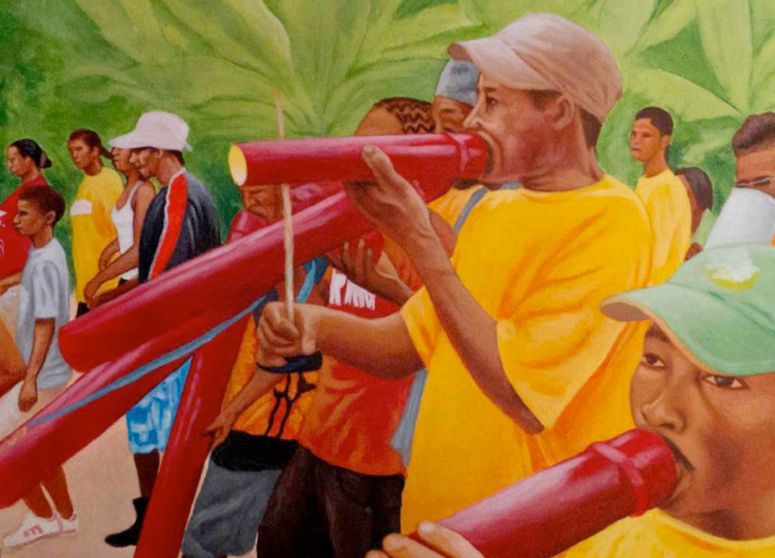
- The original citizen scientists - People's Knowledge Editorial Collective with paintings from Haiti by Michel Lafleur
- Signposts for people's knowledge - Tom Wakeford
Many of the authors who have taken part in the initiatives described in the first few chapters are from backgrounds that contain multiple elements of disadvantage or oppression. "As well as supporting learning amongst people without formal research training, we hope that this book serves as a resource to allow professional researchers, particularly those from dominant groups in society, to reflect on their own practice....Only by entering into closer dialogue can professional researchers and those involved in grassroots-led campaigns or social movements generate useful knowledge."
159
Mesh website, February 27 2017 - sourced from Slimline C4D Network Twitter Trawl: 20 - 26 February 2017. Image credit: Rara band in Jacmel, Haiti. From photograph by Richard Fleming, 2015. Original painting by Michel La fleur.
- Log in to post comments