










































People's Voices Project
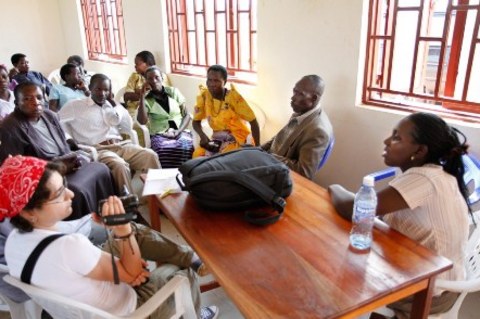
The People's Voices project, launched in September 2011, seeks to empower local people and communities to monitor district service delivery through a combination of different information and communication technologies (ICTS)-based tools and traditional media, as well as identify and describe a number of cross media services that can be used to promote citizens´ participation in political decisions and civic activities. Led by the Women of Uganda Network (WOUGNET), the project brings together researchers and students from Linnaeus (Sweden) and Makerere (Uganda) Universities and is supported by the Swedish Program for ICT in Developing Regions (SPIDER).
According to WOUGNET, their expectation is that the research component of the project can be used to demonstrate ways to make governmental services more innovative, transparent, and cost-effective, as well as to encourage citizens to become more engaged and goal-focused for the common good of their society. The ICT infrastructure available in the community i.e. mobile phones, community radios, televisions, and internet could be used to facilitate reporting cases of bad governance and poor service delivery.
Working in 5 districts - Amuru, Gulu, Oyam, Kole and Apac – the first phase of the project focused on building ICT capacity. This included orienting the participating Voluntary Social Accountability Committees (VSAC) on how to use the supplied mobile phone to send SMS messages to report bad governance and poor service delivery to the appropriate authority. They also learned how to use a camera for taking pictures in order to capture evidence of their concerns. A number of participating women acquired their own phones and used them to report cases of poor service delivery.
A web platform has been created and is being populated with reports on issues of poor service delivery that happen in the project areas in the five districts. Along with the web platform, WOUGNET is also using traditional media, such as radio, to inform the public about the project. Other planned dissemination activities include:
- contributions to national and regional events (seminars, articles in newspapers, planning meetings etc.) in which the project’s activities and results will be presented;
- a final poster and a flier summarising the project idea, research design, and results;
- using social media applications (e.g. Twitter, Facebook and a YouTube channel) to disseminate the results of the project;
- at least one scientific article will be published at international scientific conferences with a focus on ICT4D;
- two students from the International Master programme on “Social Media and Web Technologies” at Linnaeus University will be writing their final master thesis connected to this project.
Governance, Citizen Participation, ICTs
Women of Uganda Network (WOUGNET) is a non-governmental organisation initiated in May 2000 by several women's organisations in Uganda to develop the use of ICTs among women as tools to share information and address issues collectively.
Women of Uganda Network (WOUGNET), Linnaeus University (LNU), Makerere University (MAK), Swedish Program for ICT in Developing Regions (SPIDER).
People's Voices website and WOUGNET website on November 1 2012.