










































ICT in the Classroom for Quality Education: Strengthening Learning and Teaching Methods in Under-resourced Schools in Developing Countries
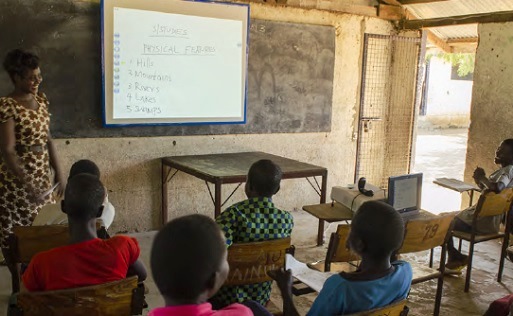
"IICD believes that equipping teachers with pedagogical tools and access to information can bring about large-scale social changes in entire educational systems. Many of the gaps in education in developing countries can be bridged with the help of ICTs and enhanced capacities for creating, sharing and using information and materials."
This 12-page position paper shares perspectives from the International Institute for Communication and Development (IICD) about using information and communication technologies (ICTs) within the education system to improve quality teaching and learning. Based on 20 years of experience, a key lesson learned is that simply equipping classrooms with innovative technologies is not enough. IICD's "social innovation process" uses a holistic approach that involves various stakeholders (teachers, principals, school managers, parent teacher associations, etc.) in both identifying challenges and planning solutions, while also building their capacities to use ICTs in their own work.
According IICD's experience, quality and professional development of teachers is central to quality education for children, and ICTs can provide both continual professional development and tools for learning. "Furthermore, building ICT capacities of teachers can lead to equipping students with critical 21st century skills, such as digital literacy, critical thinking, collaboration, communication and problem solving."
IICD recognises that there is no "one size-fits-all approach". For this reason, IICD offers a range of integrated ICT solutions that aim to holistically overcome challenges and change classroom dynamics. Each of their solutions is made up of four parts: 1) Equip: equipping schools with locally appropriate ICT tools, 2) Train: training local stakeholders on the effective use of these tools, 3) Create: content experts (teachers) create and adapt materials appropriate to the local situation, and 4) Enable: ensuring an enabling environment for the solutions and for implementers, with support from all important stakeholders.
The paper goes on to explain how IICD applies this approach to achieve the following different outcomes:
- Making education relevant with locally generated content;
- Increasing engagement of students and teachers with interactive learning tools;
- Easing classroom work with digital tools and skills; and
- Developing teacher practices through ICT-enabled peer-to-peer paedagogical training.
Related to the above impact areas, the report offers example solutions from Bolivia, Peru, Kenya, Malawi, and Ethiopia, each using different ICTs depending on the context. These include interactive whiteboards, laptops and tablets, video, projectors, mobile phones, the internet, radio, digital offline libraries, and computer labs. For instance, in order to ease classroom work (one of the outcomes mentioned above) related to overcrowded classrooms, the report offers an example from Malawi, where class sizes can reach up to 150 children. Here IICD piloted the use of LearnTabs and TeachTabs, android tablets developed by IICD, which allow teachers to easily reach all students while they work individually or in small groups. "The larger TeachTab acts partially as a server, able to share information with and monitor the smaller student LearnTabs and giving the teacher control over the whole classroom." Both teachers and students are trained in the use and maintenance of the devices, and teachers are trained on how to use the tablets to design and present content.
- Log in to post comments