










































The Dynamics and Sustainability of Community-led Total Sanitation (CLTS): Mapping Challenges and Pathways
Institute of Development Studies (Mehta), STEPS (Movik)
From the STEPS Centre at the Institute of Development Studies (IDS), this Community-Led Total Sanitation (CLTS) document analyses the CLTS approach pioneered in Bangladesh and then spread to other countries in Asia and Africa. It looks at the interaction of socio-technical-ecological systems to produce outcomes, discuss sustainability, and explore scale-up.
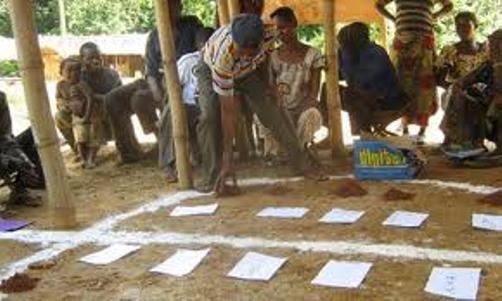
From the Introduction: "CLTS emphasizes community action and behaviour change as the most important elements to better sanitation. CLTS focuses on enabling the local community to analyze the problems of fecal-oral routes of disease spread, and of finding locally appropriate, rather than externally prescribed, solutions. Through exercises such as transect walks, mapping of open defecation sites, and the various routes of disease spread (e. g. through flies and animals), as well as calculation exercises aimed at drawing villagers attention to the amount of feces they are ingesting, powerful emotions of shame and disgust are triggered, A process is ignited where people are moved into action, drawing on local resources and knowledge to construct sanitary facilities that fit their particular needs and desires, within the constraints of household priorities and resources.....The paper is organized as follows: The first section deals in detail with the idea of dynamic systems, teasing out the ways in which socio-technical-ecological systems interact to produce particular outcomes. The subsequent section deals with perceptions of Sustainability, before going on to explore the implications for governance and scaling-up."
The paper presents the following among its findings about CLTS:
- The CLTS approach is linked to goals of poverty reduction and social justice - promoting CLTS is more difficult in situations of inequality and social diversity. The following characteristics favour the adoption of CLTS: small, homogeneous groups; shared cultural norms and values; and strong traditions of collective action.
- Generating a drive for each community to build its own facilities, utilising local technologies and knowledge, means tapping cultural and religious practices that favour adoption of CLTS. Power and gender relationships within communities can be re-fashioned to advantage and open up new spaces for intra-community negotiation.
- CLTS contributes to facilitating a change in actors’ perceptions of socio-ecological system dynamics - what the relationship is between sanitation, disease, and the immediate environment.
- Local social marketing depends on local technically and ecologically sound designs, entrepreneurial skills, the appropriation of low-cost designs, and attention to behaviour change as a motivator.
- Monitoring and evaluation needs to be strengthened. Measurements tend to look at the actual impact in terms of changed sanitation practices and technologies and/or community empowerment. There is a need to encourage adaptive learning and knowledge sharing to enhance resilience.
The authors recommend the following:
- In choosing measuring tools for a CLTS approach, it is suggested to "design for diversity" using social appraisal.
- "Paying greater attention to the dynamics and power relations of communities, as well as the cultural and religious norms shaping attitudes and mindsets, calls for awareness and pragmatism rather than purist stances."
- To have the desired impact of improving sanitation practices, there must be collaboration between government and non-governmental organisations (NGOs) and c0ommunities."What often happens is that NGOs take on a role of a parallel government, and a key challenge of the CLTS approach is how to bring different actors together and to scale up the scattered successes so that the concept of CLTS gains a critical mass.... In order to promote stability and resilience there is a need to conceive of a long-term institutional base that acts as hub for advocacy, networking and experience sharing - both successes and failures.... A core lesson to emerge from the Indonesian case of integrating CLTS into national policies in order to scale up was that it needs to be aligned with already existing programmes."
The CLTS website, October 3 2011.
- Log in to post comments