










































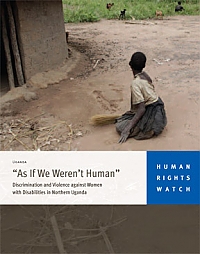
As If We Weren’t Human: Discrimination & Violence Against Women with Disabilities in Northern Uganda
Human Rights Watch
This report, based on research carried out by Human Rights Watch, describes frequent abuse and discrimination against women and girls with disabilities in Northern Uganda. It argues that women and girls with disabilities are not being afforded equal human rights and are not able to access public services or get basic provisions, both in internally displaced persons (IDP) camps or in their own communities.
Researchers conducted 71 interviews with women and girls with disabilities and their families, as well as 90 interviews with representatives of international, national, and local non-governmental organisations, United Nations agencies, and government officials. The research found that women with disabilities in northern Uganda face high levels of stigma and negative attitudes from people within their communities, resulting in the denial of basic rights such as food, clothing and shelter. Women and girls with disabilities also lack access to government services and programmes due to the way these programmes are structured - for example, one programme that provided iron sheets for housing required that people first build the house walls themselves.
According to the report, women and girls with disabilities also encounter obstacles to full participation in the community. This includes low literacy levels due to lack of schooling, limited access to sign language interpretation, physical accessibility, and negative attitudes of both community members and officials. They also face challenges to economic self-sufficiency, high levels of physical and sexual abuse, and are often denied access to justice, as well as access to property. Access to health care, including maternal and reproductive health services, is also lacking. This is due to negative attitudes of health care workers, physical barriers such as lack of transportation to health centres, as well as a lack of accessible services at hospitals.
According to the report, the vast majority of organisations working in northern Uganda do not have specific programmes on disability, and without reflection on the needs of people with disabilities, programmes can negatively impact their rights. For example, offers of houses and latrines for people with disabilities are available only to those willing to return to their homes, rather than set up more permanently in the internally displaced people (IDP) camps. These incentives may disadvantage women with disabilities who want to stay in the camps. Also, authors say that despite efforts to disseminate information widely, women with disabilities seem to lack information or have incorrect information about available services due to mobility and/or exclusion from the community.
The report states that there is limited evidence of the government's efforts to respond to the needs of women with disabilities in the return, settlement, and relocation process, although a programme to provide special grants to support income-generating activities to persons with disabilities was recently launched.
The report includes a broad range of recommendations. For example, government should incorporate the perspectives and rights of women with disabilities into existing sensitisation programmes on voting, community participation, health care, HIV/AIDS, access to justice, and sexual and gender-based violence. The report also recommends that government should also take measures to fight stigma and discrimination through awareness raising campaigns about the rights of persons with disabilities, particularly women. Information on how to respect the rights of women with disabilities should be incorporated into existing trainings with service providers. At community decision-making or sensitisation meetings, the report recommends ensuring active engagement by women with disabilities by offering support for blind women to get to meetings, providing sign language interpretation, and encouraging everyone to participate.
The report also states that there is a need to undertake efforts to inform women with disabilities about mainstream government programmes and services and encourage their participation. This may include arranging appropriate transportation and providing sign language interpretation. This also means removing physical barriers, for example making health centres, police stations, etc. accessible by having ramps, accessible beds and toilets, sign language interpreters and information in Braille. Health workers and police should be trained in basic sign language, and targeted services, such as home health care visits or outreach services, should be made available for those with limited mobility.
The report also encourages humanitarian organisations to partner with disabled persons’ unions to disseminate accurate, accessible information about the return, settlement, and relocation process and services. It also suggests they work together with the local authorities to collect data on the numbers of women with disabilities reporting cases of sexual and gender-based violence, including what kind of disability they have, in order to identify the scope of the problem and possible solutions and interventions.
Human Rights Watch website on January 10 2011.
- Log in to post comments