










































Traditional Media in Kenya, Rwanda, Tanzania and Uganda: Reporting on Online Violence Against Women
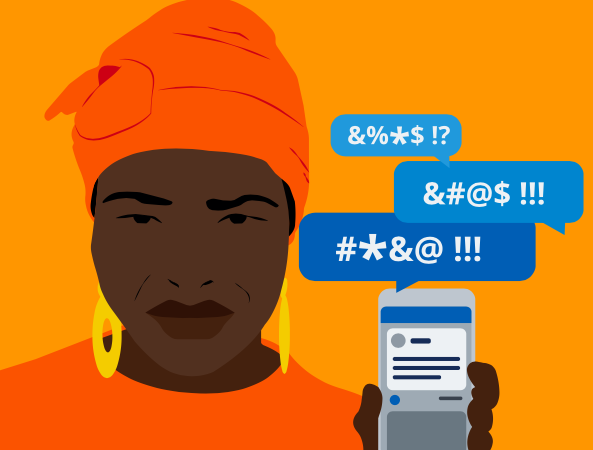
"Although OVAW [online violence against women] is a significant obstacle to achieving full gender equality and violates women's rights, it receives far less attention and counteraction compared to offline violence."
This report, published by Deutsche Welle (DW) Akademie, presents a detailed account of the nature of traditional media reporting of online violence against women (OVAW) in four countries - Kenya, Rwanda, Tanzania, and Uganda. The report shares the findings of a media content analysis and interviews and provides recommendations for media training and advocacy with the goal to improve the online safety of women. The purpose of the research is to generate credible evidence that will help develop the DW Akademie's media training and online safety interventions.
OVAW is described in the report as referring to any act of violence that is committed, assisted, or aggravated using information and communication technology. It can take on various forms, including cyberstalking, non-consensual sharing of nude images, body shaming, and insults. As explained in the executive summary, "Online violence is a continuation of women's experiences of offline violence, although often with more devastating consequences: Cyberspace allows violent incidents to go viral, prolonging the trauma of survivors while providing opportunities for multiple perpetrators to gang up and launch more and worse attacks across various platforms. OVAW incidents often spill over from private online spaces (such as WhatsApp) into public spaces (such as Facebook). Depending on the perceived severity of the incident or the prominence of the survivor, traditional media platforms (TV, radio, and newspapers) expose OVAW incidents to even greater audiences and trigger public discussion both online and offline. Of course, videos, photos, or remarks related to the incident do not just disappear from the internet and can still be found long after, in formats such as GIFs and memes. Some survivors may never be able to fully leave the experience behind."
Media coverage of OVAW is considered essential to combat this form of violence, as the mass media, especially in the four countries included in the study, plays a crucial in agenda-setting: "It not only introduces topics into the public domain but also suggests their importance, defines the quality of discourse, and influences change. The frequency and prominence of media coverage on any subject often stand in direct proportion to the level of public awareness."
The research combines a media content analysis of 138 media reports on 13 OVAW incidents as published or broadcast by 77 media outlets with interviews with 70 stakeholders, including OVAW survivors, alleged perpetrators, and law enforcement agencies. The 13 incidents represented five types of OVAW, which were body shaming, cyberbullying, non-consensual pornography, cyberstalking and surveillance, and cyber harassment. The content analysis looked at a number of issues, including whether an OVAW story was placed on the front page or not, what formats were used to report the story (news, opinions, or gossip and entertainment), how guilt was attributed, how survivors and perpetrators were characterised, what sources were used, and how OVAW was framed in the media reports.
The findings section of the report details study results in two broad categories: The first set of findings are observations that could be made directly from the media reports and explained using data gathered in interviews with key informants. The second set of findings are issues that could not be directly observed from the media reports but that arose from reflections of the research team in combination with interviews.
The findings from the content analysis show, for example, that OVAW coverage follows clear and rigid patterns. All 138 media reports studied covered only seven aspects: occurrence of the OVAW incident; public reaction to the incident; OVAW survivors' responses; pursuit of justice; consequences of the OVAW incident; attribution of blame for the incident; and other issues (e.g., responses to OVAW incidents by survivors' families and mentions of OVAW incidents in broader human rights articles). What all reports are usually missing is a discussion of why and how OVAW is committed, what laws prohibit OVAW, and what measures exist to combat this kind of violence.
Overall, the study results show that media reporting on OVAW in East Africa can be harmful to the victims. Many media outlets use attention-grabbing headlines and sexualised images that focus on the victim's nudity or actions rather than that of the perpetrator. Furthermore, the study reveals that some media outlets in East Africa do not fully understand the seriousness of OVAW. Journalists often trivialise incidents, and their reporting does not meet ethical standards. This situation can lead to victim-blaming, which adds to the victim's trauma and shame.
From interviews with various respondents, the following five observations were made:
- Newsroom attitudes play an important role in OVAW coverage. In a typical newsroom, a variety of attitudes held by reporters and editors compete in defining the relevance of OVAW incidents for media coverage.
- Some OVAW survivors have developed a degree of tolerance for OVAW, which might be detrimental to efforts to eliminate online abuse. For instance, one survivor told the research team that there is an acceptable degree of stalking beyond which an incident should be reported.
- The majority of editors and reporters have not received any specialised training on reporting OVAW. Some have been trained in reporting VAW in general.
- Editorial teams barely enforce ethical standards, which promotes poor reporting of OVAW. In addition, some media houses exploit loopholes in media regulatory laws to continue their poor reporting.
- OVAW that affects media practitioners themselves is not actively addressed by media houses.
In line with the findings, the report proposes a series of interventions for media practitioners such as reporters and editors, women at risk of OVAW, and civil society organisations (CSOs) facilitating safer online experiences for women. They fall within two categories:
- Media training - Recommendations, for example, call for more ethical and sensitive reporting of OVAW. Media outlets must avoid victim-blaming and stigmatisation, use sensitive language when reporting on victims and alleged perpetrators, and refrain from trivialising incidents of OVAW and from sexualising incidents involving nudity.
- Advocacy initiatives - Recommendations here outline a number of advocacy initiatives intended for women online, media outlets, CSOs, potential OVAW perpetrators, and legal practitioners. For example, advocacy strategies should be designed to reach media outlets by influencing editors and columnists to take a stand against OVAW and to generate creative content on the issue. Efforts also need to be made to generally give women strategies to effectively respond to OVAW and to create awareness among potential perpetrators of the negative impact of online violence in order to deter abusive behaviour. In addition, media regulation can play a crucial role in holding digital platforms accountable for the content they post, including offensive remarks related to OVAW.
DW Akademie website on September 26 2023. Image credit: © Marc Löricke/DW