










































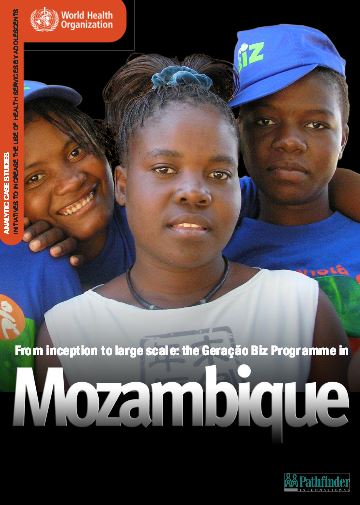
From Inception to Large Scale: The Geração Biz Programme in Mozambique
Pathfinder International
A joint publication of the World Health Organization (WHO) and Pathfinder International, this 52-page case study describes a multisectoral adolescent sexual and reproductive health (ASRH) programme implemented by the Government of Mozambique with financial support from the United Nations Population Fund (UNFPA) and technical support from Pathfinder International since 1999. Written for programme and project managers at national, district, and local levels, this case study is intended to provide an example of how to design and implement a multisectoral programme that is intended to be scaled up from the beginning.
The Geração Biz ("busy generation") programme has 3 main components: clinical youth-friendly health services (YFHS), in-school interventions, and community-based outreach. At the core of the programme is youth participation; the programme supports a cadre of approximately 5,000 peer educators, who are trained to reach youth in their schools and communities with information on services, life skills, and contraception.
Changes in SRH and HIV knowledge have been tracked through ASRH and HIV knowledge, attitude, practices and behaviour (KAPB) studies conducted in 2003 and 2005 in Maputo City and Zambézia, Gaza, Tete, and Maputo provinces. Specific sample findings include:
- Knowledge of contraceptive methods increased, and knowledge of abstinence as a protective method increased from 20% in 2003 to 44% in 2005. Respondents' access to information through peer educators increased from 43.8% in 2003 to 65.6% in 2005.
- The belief that childcare is exclusively a female task dropped from 38.8% in 2003 to 24.8% in 2005, and the belief that it is the female's responsibility to prevent pregnancy dropped from 23.7% to 15.5%.
- Use of contraceptive methods during the first sexual experience increased from 35.7% to 60.2%. Consistent condom use even when "in love" increased from 70% to 83%. Among respondents, 38% had undergone VCT in 2005, compared to 11% in 2003. Of those who were tested, those who reported a positive test dropped from 57% in 2003 to 18.6% in 2005.
In 2004, the programme conducted a youth client satisfaction study in 14 YFHS facilities in Maputo city and Gaza and Maputo provinces. Trained peer educators conducted 1,400 interviews. The study revealed overall satisfaction with the services offered (e.g. 98.1% of clients in Gaza reported that services were "excellent" or "good"). Selected communication-related recommendations from the study include:
- Incorporate more discussion about abortion, sexually transmitted infections (STIs), gender-based violence, and sexual abuse within the context of service visits, even if clients do not request it. Subjects such as the use of condoms for dual protection, sexual pleasure within relationships, and negotiation skills also need to be explored more during youth client visits.
- Increase routine screening or discussion of gender-based violence within any service visit. Specialised training in dealing with clients who have experienced gender-based violence can help bolster a provider's comfort with discussing such sensitive and difficult issues.
- Involve community leaders in efforts to mobilise young people to seek services when needed.
- Conduct an analysis of materials available in the waiting rooms to verify the types of messages as well as the number and attractiveness of materials.
- Deploy more in- and out-of-school peer educators to work in the waiting areas of the YFHS sites.
Some results from an external evaluation, 2004:
At the request of UNFPA, a group of consultants conducted an external evaluation in October 2004, focusing on Maputo city and the provinces of Maputo, Tete, Zambézia, and Cabo Delgado. Information and data were collected through a review of programme documents, a review of monitoring data and research findings, interviews (including focus groups) with stakeholders and beneficiaries, and observation of services and programmatic interventions.
Regarding the delivery of services, most designated YFHS facilities have trained providers that "appear to be comfortable in their work, able to relate well with their young clients, who, in return find them respectful, caring, and able to deal with their needs". Although YFHS received generally favourable reviews, some weaknesses were identified. For instance, there was concern about confidentiality and whether referral providers (e.g. voluntary counselling and testing (VCT) providers) had been oriented in youth-friendly communications.
Youth visits were found to have steadily increased. For example, youth visits in Maputo city increased from about 11,800 in 2000 to over 24,000 in 2003.
In general, the evaluation concluded that Geração Biz was a well-known and respected programme with good potential for sustainability and expansion and that there was evidence that the programme had had a significant impact on young people's knowledge, attitudes, and behaviour. Geração Biz's multisectoral approach was credited with contributing to improved communications and interactions among government institutions and sectors. In addition, the capacity-building and technical assistance related to ASRH (including HIV) competencies, management skills, internal policies, strategic planning, and public policy development was viewed by the three sectors as useful and relevant to the achievement of programme goals.
Lessons learned related to capacity-building and sustainability:
- By designing a programme that fits within government mandates and is situated within different government sectors, programme sustainability is increased.
- By working with the government to develop and adopt programme tools and policies, their use will continue beyond the project period. For example, the Ministry of Health has adopted the Geração Biz training manual, while content from the in-service training has been institutionalised into pre-service training for nurses.
- Continuous investment in capacity-building has enabled a sizeable group of qualified staff to take on key positions within government, national, and international organisations.
- Investing in capacity-building of good trainers is essential. In the future, trainers' roles could be expanded to include advocacy and supervision.
Lessons learned related to multisectoral programmes:
- Well-functioning multisectoral programmes increase service use more than programmes that concentrate only on improving health services. Referrals from the adolescent corners, teachers and peer educators in schools, as well as from peer educators operating in the community, have significantly contributed to increases in service use. In addition, using peer educators in the waiting areas of clinics helps ensure that young people receive sufficient SRH information and feel comfortable accessing the facility.
- Bringing together a range of stakeholders elevates the influence of an issue (e.g. ASRH) but demands clarity in the definition of roles and responsibilities and a strong ability to coordinate the various stakeholders involved.
- Differences among agencies' work styles, approaches, and mandates must be respected and valued.
- Increased involvement of top-level decision-makers is needed at the central, provincial, and districts levels so that they may be convinced of the importance of the programme.
- Improved monitoring systems benefited the programme as a whole and improved the sharing of information both within and between sectors.
- Peer educators are critical to programme efforts, as they help attend to youth clients in the clinic, create a good environment, and help attract new clients.
- Effective coordination between the health coordinators and peer coordinators working in schools and the community has led to increased motivation of peers.
Lessons learned related to scaling up:
- Designing a programme for scale-up right from the beginning accelerates the speed of implementation.
- Developing tools, curricula, approaches, and guidelines that can be used as the programme expands to new sites facilitates rapid implementation and ensures more consistent results.
- Monitoring, evaluation, and operations research allows for more cost-effective and rapid implementation.
- Capacity-building through on-the-job technical assistance in management and technical content is key to ensuring qualified human resources as the programme expands.
- Selected programme sites can serve as models for developing new protocols and systems that can then be applied throughout the programme.
- International and provincial experience exchange can lead to greater learning and application of best practices.
- A dynamic programme response to challenges, a culture of curiosity and willingness to learn, and a flexible design and approach that allows for change greatly facilitate scale-up.
- As the number of YFHS sites is scaled up in a given province, the number of referral sites must also be augmented.
Lessons learned related to youth involvement:
- Youth involvement is essential from the beginning to ensure that services are designed in a way that resonates with them and that services continue to meet their various needs.
- The programme has influenced how people perceive HIV and accelerated the acceptance of people living with HIV (PLHIV) in general and young PLHIV in particular.
- When equipped with the appropriate skills, young people are capable of influencing policy, providing different types of services and support (e.g. as peer educators or home-based care providers), and mobilising the community. Partnerships with adults that provide mentoring and direction enhance youth participation.
Lessons learned related to service delivery:
- Ongoing training in ASRH is needed to address staff transfer and turnover.
- Provider training is essential in the implementation of YFHS, although training by itself is not sufficient. Ongoing supervision is needed to support provider attitudinal change and address challenges as they arise.
- Young people often come to a facility with more than one SRH need; it is therefore important that providers are able to meet a range of needs in one visit.
- Integrating VCT for HIV and other HIV care and support services can serve as an entry point for young men to come to YFHS facilities.
An excerpt from the Conclusion follows:
"Geração Biz is one of the few multisectoral programmes to be national in scale. While there is still room for increased coverage within the provinces, all 11 provinces of the country are now part of the programme. Utilization of YFHS is quite high compared with many other programmes operating in sub-Saharan Africa - in large part because it is supported by complementary components that seek to change behaviour, including care-seeking behaviour.
...The vitality of the youth movement that has been nurtured under Geração Biz is an integral part of the programme. Young people not only participate in the programme design, implementation and evaluation but also identify new areas that are of importance and advocate for the programme to respond to these needs. The recent forum held between youth activists and the United Nations General Assembly Special Session (UNGASS) to address issues of HIV treatment and care is a striking example. Young people planned and conducted the forum on their own, demonstrating that they can be leaders in solving their own issues. They discussed the government report to UNGASS, producing a parallel report showing the youth point of view, and addressed challenges in achieving UNGASS targets and objectives in relation to youth needs. Two young people also joined the Mozambican mission to attend the UNGASS 2006 meeting.
...Overall Geração Biz serves as a model for other governments and organizations in terms of scale-up, its multisectoral approach, and the use of public-sector SRH services."
Pathfinder International website, March 4 2010.
- Log in to post comments