










































A Way to Justice: Engaging Men for Women's Rights and Gender Transformation - Film and Discussion Guide
Image
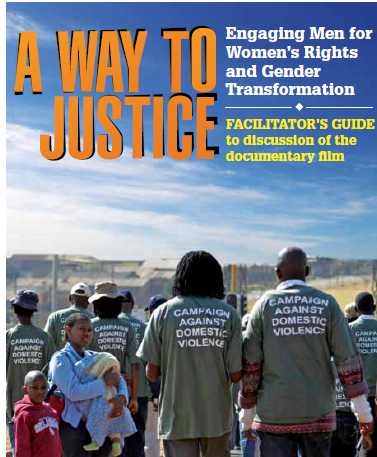
SummaryText
Produced by Sonke Gender Justice Network and the MenEngage Alliance, this film and discussion guide was produced to raise awareness and dialogue around violence and HIV/AIDS, their relation to gender inequality, and how men and women are increasingly engaging men and boys to confront these problems. The film comes with a guide to help facilitators to lead discussions about issues raised in and by the film.
The film focuses on men and women who have struggled against gender-based violence, the HIV/AIDS pandemic, and the impact of conflict and civil war, including the problems faced by displaced populations. Focusing on four personal stories from Africa – with an additional eight interviewees as analysts – the film follows each person through terrible times to each one's eventual triumph, as they confront and transcend the forces that have wreaked havoc with their and their nation's life. The personal stories are about:
The film focuses on men and women who have struggled against gender-based violence, the HIV/AIDS pandemic, and the impact of conflict and civil war, including the problems faced by displaced populations. Focusing on four personal stories from Africa – with an additional eight interviewees as analysts – the film follows each person through terrible times to each one's eventual triumph, as they confront and transcend the forces that have wreaked havoc with their and their nation's life. The personal stories are about:
- David Tamba, a Sierra Leonean, who ran away from civil war, whose wife was gang-raped by rebels, and who spends a decade in refugee camps.
- Pascal Akimana, who as an 11-year old Burundian child flees both his father’s and his country’s violence, only to find even more violence across the border in the Democratic Republic of the Congo (DRC), where soldiers batter him senseless and rape his younger sister.
- Jennifer Gatsi, a Botswana-Namibian woman who grows up with a father who beats her mother nightly, and is then forced to wed a violent husband who infects her and two small children with HIV.
- Trevor Davies, a Zimbabwean photojournalist, whose career focus blinds him to the dire struggle of a son who dies of AIDS.
- How to use the facilitator's guide and DVD
- Introduction
- Africa, AIDS, Violence, and Gender
- Sharing the stories
- The Film: summaries and questions
- Resources
- Acknowledgments and funding
Languages
English
Source
Email from Dean Peacock to Soul Beat Africa on October 17 2011 and Akimbo website on December 13 2011.
- Log in to post comments