











































Using Puppetry to Educate Children on COVID-19 and Sexual and Gender-Based Violence (SGBV)
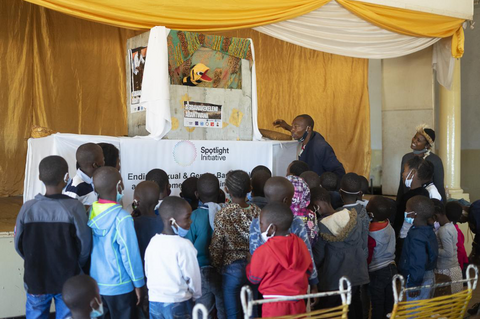
"Engagement of local theatre groups has resulted in community buy in."
In the context of the COVID-19 pandemic, in October 2020, Vuka Afrika Performing Arts Trust began conducting social mobilisation and community engagement awareness using theatre for development to reach schoolchildren in 12 districts of Umzingwane and Bulilima, Zimbabwe. The puppetry shows, which are being carried out in partnership with the United Nations Children's Fund (UNICEF) Zimbabwe, are designed not only to shape children's understanding and behaviour to prevent the spread of COVID-19 but also to educate them on sexual and gender-based violence (SGBV), which is the focus of the global Spotlight Initiative through which the activities are being carried out. The project was designed to coincide with the phased reopening of Zimbabwean schools, previously closed due to the pandemic, with all pupils expected back in school in November 2020.
Theatre and puppetry are being used here as a tool to communicate messages on SGBV and COVID-19 prevention to children at an impressionable age (between 3 and 12 years old). The puppetry is meant to engage children in an entertaining, artistic medium, thereby fostering the development of imagination, creativity, and observation skills in the children.
Director/Producer Jingo James Mkwindidza explains that, to make their messaging more effective, Vuka Afrika builds the capacities of local theatre groups who are well versed with the cultural and social norms of a particular area. He says Vuka Africa also offers technical support on theatre performance. They first conduct auditions; local theatre groups who are qualified then undergo 3 days of training. Vuka Afrika Performing Arts then orients them about the project and asks what kind of SGBV happens in their area. They pick up their own storylines and contextualise them for the audience.
One show began with a greeting, "salibonani abantwana" (Ndebele vernacular for "hello children"), as the puppet Tutu, a happy, friendly, wise, and enthusiastic lizard, slowly emerged from a booth and wandered around the stage. Tutu told the children why it is important to eat fruits and stay healthy, and explained why it is important to behave well. For a brief moment, Tutu disappeared behind the booth; moments later, an old pot-bellied man emerged, singing as he walked towards the children gathered to watch. The children clapped and danced as Tutu reappeared, also joining the fun. The pot-bellied man called out to one of the kids in the audience, "why is it important to wear a face mask?" In response, the student explained to his peers why a mask provides protection against the spread of COVID-19. Others spoke up to add that proper washing of hands with soap and running water, sanitising hands with alcohol-based hand sanitizers, and social distancing remain critical in preventing the spread of COVID-19. There was more dance and song, as the children were educated on SGBV and the "red" zones of their bodies. They were told that if anyone touches their red zones, rapes them, or violates any of their rights, they should immediately tell the police. "Touch, touch, don't touch my body", the children recited as they moved to the front of the room to join the pot-bellied man and Tutu.
Mkwindidza, quoted above, explains how social norms are a part of the communication strategy underlying the performances: "When we use puppetry among children to convey messages on SGBV and Covid-19 the impact we expect is the development of a frame of thinking that resonates with an upstanding young citizen. We are seeking to inculcate in them the idea that a good boy or girl is one that washes hands, wears a mask and practices social distancing, and that a clever boy or girl is one that does not allow him or herself to be touched in the 'Red' don't touch zones." The approach, he further points out, plays upon what most children in Zimbabwe are taught to aspire to be: "good children". He continues: "Our impact is in how they internalise what they need to do to become 'good'....[I]n the puppet show we dramatise what being good means, and the implications of being bad..."
In addition, the project includes a local outreach component beyond the schools. Vuka Afrika brought together stakeholders to act as resource people and to share their experiences in the communities. The stakeholders were drawn from: the Police Victim Friendly Unit; Ministry of Women Affairs, Community, Small and Medium Enterprises Development; Ministry of Health and Child Care; and the Ministry of Youth, Sport, Arts and Recreation. Vuka Afrika oriented and co-created drama presentation teams of 5 community facilitators across the 12 districts, amounting to 60 community cadres that are facilitating theatre for development community dialogues on SGBV and COVID-19 risk communication. The support from UNICEF further enabled the production of information, education, and communication (IEC) materials, which will be used to conduct additional activities at the community level.
Children, COVID-19, SGBV
One of the children in the aforementioned show, 10-year old Tinotenda Musharo, said she will spread the message to her friends and classmates who could not attend the theatre and puppetry session. Craig Sibanda, a Grade 5 pupil, commented, "I want more of such educative dramas. I hope Tutu returns next time so my friends who are not here can also learn. We are going back to school soon and I learnt a lot about how to stay safe from Covid-19."
An officer within the Police Victim Friendly Unit, Thukani Ngwenya, who coordinated the children in the show referenced above, explained how puppetry and theatre boosts social and behaviour change in the children: "We have been teaching them about COVID-19, how to properly wear masks, but the addition of the puppets and theatre today captured their imagination. We expect positive results."
A global, multi-year partnership between the European Union (EU) and the United Nations (UN) to eliminate all forms of violence against women and girls by 2030, the Spotlight Initiative in Zimbabwe is designed to reach 11 million beneficiaries directly and indirectly through an integrated package of interventions across 6 pillars, including: legislative and policy frameworks; institutional strengthening; prevention and social norms; delivery of quality essential services; data availability and capacities and supporting the women's movement. Co-chaired by the UN Resident Coordinator's office and the Ministry of Women Affairs, Community, Small and Medium Enterprises Development, the Spotlight Initiative also has a national civil society reference group to promote stakeholder accountability and civil society engagements. The overall goal is to facilitate training activities to support the strengthening and upskilling of community structures, mechanisms, and institutions toward the ultimate aim of ending SBGV.
Vuka Afrika Performing Arts and UNICEF, with the Police Victim Friendly Unit; Ministry of Women Affairs, Community, Small and Medium Enterprises Development; Ministry of Health and Child Care; and the Ministry of Youth, Sport, Arts and Recreation. Partners in the Spotlight Initiative include: United Nations Development Programme (UNDP), UNICEF, UN Women, the United Nations Population Fund (UNFPA), the International Labour Organization (ILO), and the United Nations Educational, Scientific and Cultural Organization (UNESCO) - with EU funding.
"Using puppetry to educate children on Covid-19, SGBV", by Roselyne Sachiti, October 23 2020; and Spotlight Initiative website - both accessed on October 28 2020. Image credit: © UNICEF Zimbabwe/2020/KB Mpofu
- Log in to post comments