










































Using the Community Conversation Approach to Tackle Gender Inequalities - Learning Brief
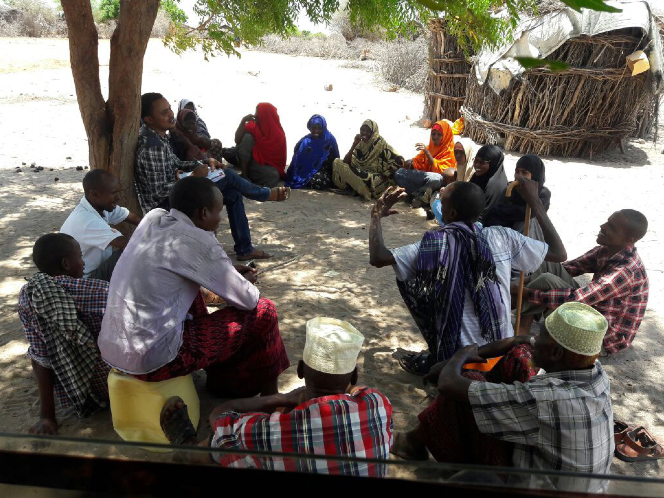
"With the extensive gender inequalities that exist in the AGI-K project implementation sites in Wajir, there was need to involve the entire community in identifying issues that contribute to gender inequalities, with specific emphasis on adolescent girls aged between 11-14 years."
This learning brief serves to highlight some of the lessons learnt from the community conversation approach implemented in 2016 as part of the Adolescent Girls Initiative-Kenya (AGI-K). AGI-K is delivering multi-sectoral interventions, targeting violence prevention, education, health, and wealth creation, to adolescent girls aged 11-14 in two marginalised areas of Kenya. This learning brief is one of three focusing on key areas of best practices and lessons learnt. These briefs aim to share learning with specialists and civil society learning networks, and are meant to help inform future design and management of adolescent girls' programmes in hard-to-reach, marginalised communities.
As defined in the brief, "Community conversations are a socially transformative approach that galvanizes communities to address the underlying causes of underdevelopment and vulnerability. It provides a platform where a cross section of the community members including local administrators, religious leaders, parents, teachers, community health workers, young men and women, converge and reflect on the challenges faced by the girls. They further identify steps to take to resolve these challenges and draw action plans that will eventually lead to a change in attitude, values, beliefs and practices that impede adolescent girls from realizing their full potential or well-being."
The paper describes some of the key learning points emerging from project implementation. For example, due to delays, community conversation implementation was somewhat rushed, which meant that a section of the community members still did not understand the need of facilitating girls' to access interventions such as health and life skills and financial education implemented through the safe spaces component of the project. Also, the project used criteria to select community facilitators based on level of education in order to, among other things, save on training time. It therefore locked out semi-illiterate community members and also meant that many of the selected facilitators (teachers and local administrators) were people who already had other commitments and were sometimes absent from the village. In addition, although joint sessions (conversations with both male and female community members) are necessary to promote cohesion between the two genders, the project showed that traditional values and practices led to the discussions being dominated by men, as their female counterparts seldom made contributions.
Based on these experiences, the brief makes the following recommendations:
- Community conversations implementation should be given ample time to allow the communities to understand the concept and benefits of thoroughly following the process at their own pace.
- Community conversations should precede other interventions, as a clear understanding of the impact of their beliefs and attitudes allows communities to fully support other programme interventions without being incentivised by an external entity.
- Community facilitators should be selected on the basis of their availability and commitment as opposed to their level of education or exposure.
- Generally, stipends should not be provided for community conversation facilitators. However, in some contexts, like AGI-K's Wajir site, it is necessary to provide the facilitators with stipends in order to safeguard their reliability in conducting the community conversation sessions.
- In contexts where socio-cultural barriers limit free expression by certain gender groups, it may be appropriate to have separate conversation sessions organised for male and female community members before joining them later to share their groups' ideas. This is likely to encourage active participation by women in the community conversation groups.
Save the Children Resource Centre website on October 9 2017.
- Log in to post comments