










































Teacher Development with Mobile Technologies Project
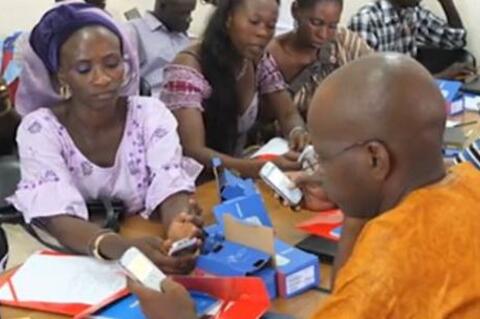
Launched in March 2012, the Teacher Development with Mobile Technologies Project leverages mobile technologies to support student learning in mathematics in Senegal. Intended as a pilot, the overall goal of the project is to demonstrate effective and scalable ways of using mobile technologies to develop the capabilities and support teaching practices of primary school teachers to deliver curricula in the areas of mathematics, science, and languages. The project is being implemented by the United Nations Education, Science, and Cultural Organisation (UNESCO) in partnership with Nokia, Sonatel, and by two local partners, Réseau Africain de Formation à Distance Sénégal (RESAFAD) and Centre Régionale de Formation de Personnels de l’Education de Dakar (CRFPE).
According to UNESCO, a number of pilot projects have attempted to use mobile technologies to enhance the role of teachers in developing countries. However many of these pilot projects have not moved beyond the pilot phase of attempting to engage in system-wide use of mobile technologies to enhance teacher development. They served mainly to test ideas on a small scale. This project proposes to consider ways in which mobile technologies can be integrated with national teacher training systems in ways that can improve the quality of their teaching practice.
As part of the project, organisers are working to:
- design and pilot test the mobile phone supporting functions to enhance teacher development;
- develop short training courses, supporting resources, and interactive functions that are appropriate for the commonly used mobile phone in the local context;
- explore the institutionalisation mechanism to provide sustainable content development;/li>
- develop a local mobile phone–based resources centre or portal to provide subscription, downloading, and consultation service; and
- explore peer coaching or mentorship programmes between selected pre-service teachers and the targeted in-service teachers.
The first step for the project was to tailor a mobile-based mathematics application developed by Nokia to match the national curriculum. The partners then trained approximately 100 teachers to use the application with 8 to 11 year-old students. The technology allows students to master mathematical concepts in a dynamic digital environment that can be accessed from virtually any mobile phone. Students can work on practice problems at home, in school, or from any other location at any time. Detailed information about the progress of groups of students as well as individual learners is stored on remote servers and immediately available to instructors.
The first group of teachers and the implementation team from Pikine were trained at a three-day workshop in Dakar, Senegal in Nokia Mobile Mathematics, the technology used for the project. Education and mobile learning experts, teachers, and local team members explored how to harness mobile technologies for teacher development from pedagogical and technical perspectives. They also planned the next steps, including monitoring and evaluation strategies for the project.
Participants contributed feedback and ideas on how to use the tool and to incorporate it into the curriculum. UNESCO also visited some of the pilot schools and met with the local operator Sonatel-Orange to discuss a possible partnership aiming at making the service access free for the teachers and learners.
Education
United Nations Education, Science, and Cultural Organisation (UNESCO) Nokia, Sonatel, Réseau Africain de Formation à Distance Sénégal (RESAFAD) and Centre Régionale de Formation de Personnels de l’Education de Dakar (CRFPE).
UNESCO website, UNESCO website and UNESCO website on December 9 2013.