










































Social Learning for Adaptation: A Descriptive Handbook for Practitioners and Action Researchers
Image
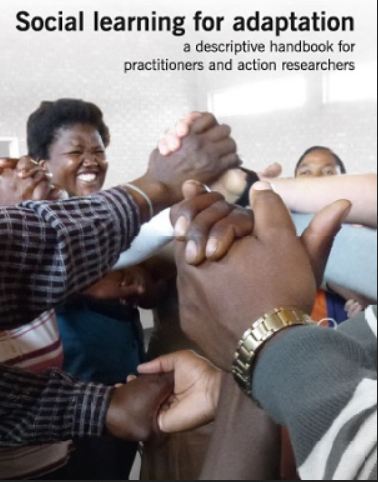
SummaryText
This handbook presents the experience of a participatory social learning process that evolved to support individual and community level adaptation to a variety of stressors, such as climate change, affecting rural people in South Africa. It was developed as part of a four-year broader scientific research project, led through Rhodes University, on vulnerability and adaptation, with a focus on knowledge building.
As stated in the handbook, social learning is an adaptive process and therefore "the most critical factor emerging through the experience of this social learning process is how facilitators see their roles and their relationships with participants. It is essential to strive for a balance between responsiveness and guidance, achieved through an approach that is open, based on a principle of seeking equality, and one that is fully prepared to follow a path different from the one that may have originally been envisaged. This adaptive approach embraces the concept of co-learning, and was one of the objectives of the social learning processes embarked on in this project."
The handbook includes perspectives on how social learning can be used as part of a participatory process for social change. As part of this process, participants experience a shift in understanding, either from new knowledge or at deeper levels, for example shifts in worldviews or values. Another example is of “people taking greater responsibility for their own development, and essentially shifting their assumptions about what the community was able to achieve on its own, without government assistance. It is this deeper form of learning that this handbook seeks to support, although surface-level learning in the form of raising awareness remains a fundamental part of achieving this."
The authors believe this handbook will be useful for non-governmental organisation practitioners who work with communities and seek to build critical capacities, researchers who are interested in processes of action research, social change and co-learning, and government employees who are mandated to support communities in their efforts to collectively overcome hardships.
The handbook includes the following chapters.
As stated in the handbook, social learning is an adaptive process and therefore "the most critical factor emerging through the experience of this social learning process is how facilitators see their roles and their relationships with participants. It is essential to strive for a balance between responsiveness and guidance, achieved through an approach that is open, based on a principle of seeking equality, and one that is fully prepared to follow a path different from the one that may have originally been envisaged. This adaptive approach embraces the concept of co-learning, and was one of the objectives of the social learning processes embarked on in this project."
The handbook includes perspectives on how social learning can be used as part of a participatory process for social change. As part of this process, participants experience a shift in understanding, either from new knowledge or at deeper levels, for example shifts in worldviews or values. Another example is of “people taking greater responsibility for their own development, and essentially shifting their assumptions about what the community was able to achieve on its own, without government assistance. It is this deeper form of learning that this handbook seeks to support, although surface-level learning in the form of raising awareness remains a fundamental part of achieving this."
The authors believe this handbook will be useful for non-governmental organisation practitioners who work with communities and seek to build critical capacities, researchers who are interested in processes of action research, social change and co-learning, and government employees who are mandated to support communities in their efforts to collectively overcome hardships.
The handbook includes the following chapters.
- Chapter 1: Introduction
- Chapter 2: Getting started
- Chapter 3: Co-developing an understanding of the context in which people live, and the challenges that they face
- Chapter 4: Changing the conversation toward understanding existing activities, aspirations, and strengths in the community
- Chapter 5: Building on community strengths and breaking down barriers to adaptation
- Chapter 6: Some concluding thoughts
Publication Date
Languages
English
Number of Pages
118
Source
weADAPT website on March 31 2014.
- Log in to post comments