










































Resilience Handbook: A Guide to Integrated Resilience Programming
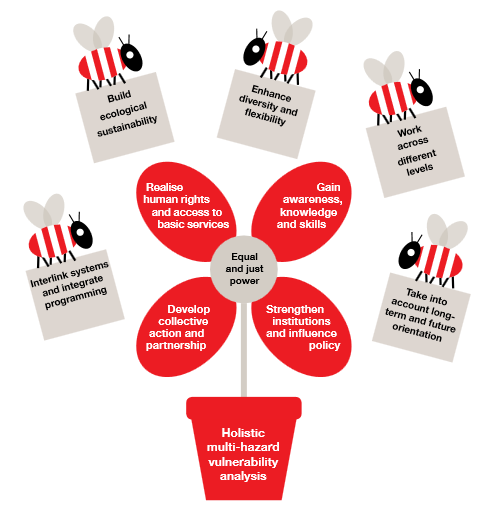
From ActionAid, this handbook aims to help readers think, plan, and implement their work in a way that supports the reduction of people's vulnerability and contributes to the building of their resilience to a range of hazards, shocks, stresses, and threats. Taking a holistic view, resilience building as defined here not only views disaster, conflict, and climate change as threats to human rights and development; it widens the focus to include natural resource degradation, epidemics, political oppression, and economic crises. As a concept, it promotes a rounded analysis of the issues, and an integrated approach to dealing with them.
The handbook provides programme and policy staff with a framework for resilience that can be applied in different programme environments. Integrating principles of effective programming and good-practice examples, it explains the rationale for using a resilience lens and details ActionAid's Resilience Framework. Chapter 2 provides information on how to analyse different programming areas using ActionAid's participatory methodology, "Reflection-Action". Chapter 3 provides guidance, tools, and resources on how to bring resilience thinking and practice into different programming areas to achieve integrated resilience programming.
As noted here, resilience thinking is increasingly becoming coupled with the principles of "transformation", which emphasise the importance of power relations between, for example, men and women, the economically rich and poor, the young and old. "By supporting people living in poverty and exclusion, we build power from below, thus challenging the status quo around dominant groups. Our resilience approach aims to fundamentally transform the unequal power structures that keep people vulnerable to shocks and stresses." Along these lines, the framework emphasises that "[e]nhancing knowledge, reflection, and learning and developing skills are progressive steps towards transformational resilience, which entails individuals and communities becoming aware of the 'power within' them to challenge inherited ways of thinking, assumptions and biases, as well as recognising and negotiating power structures. Building resilience is dependent on innovation, which requires that resilience initiatives include activities such as shared and peer-to-peer learning, knowledge exchanges, and skills transfer that allow new ideas to be generated. Tapping into local knowledge and practices, and combining this with modern scientific knowledge, also helps to produce lasting context-specific solutions."
The handbook builds on ActionAid's Human Rights-Based Approach (HRBA) and its Resilience Framework [PDF]. The 8 core principles of ActionAid's HRBA include: putting people living in poverty first and enabling their active agency as rights activists; analysing and confronting unequal power; advancing women's rights; working in partnership; being accountable and transparent; rigorously monitoring and evaluating to evidence ActionAid's impact and critically reflecting on and learning from it; ensuring links across levels (local, national, regional, and international) to address structural causes of poverty; and attempting to be "innovative, solutions-oriented...[as we] promote credible alternatives."
The handbook has been developed for, and with, programme and policy staff - in particular, Local Rights Programme (LRP) staff - to support them in applying the resilience "lens" to ActionAid's overall work. While the handbook's primary audience is staff responsible for the implementation of ActionAid's programmes, it is also designed to be a resource for all ActionAid staff and partners, key community stakeholders, and other like-minded organisations, as well as local and national governments.
66
ActionAid website, November 14 2016
- Log in to post comments