










































Putting Citizens' Voice at the Centre of Development: Challenging Shrinking Civic Space Across Africa
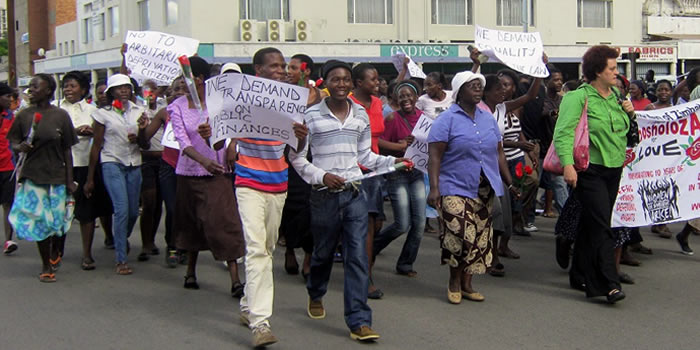
"Civil society across Africa has played a central role in the continent’s history and development since independence. However, the hard fought gains on citizen voice and democratic participation are being reversed by worsening restrictions on civic space. The consequences of this have not only been felt by the activists, social movements and civil society groups that face the sharp end of undue restrictions, but by society at large. Without CSOs [civil society organisations] and the independent voices they represent, the ability to address abuses of power and build responsive, accountable institutions is severely constrained.”
This policy brief aims to highlight the issue of closing civic space in Africa and is based on detailed research commissioned by Oxfam from the International Centre for Not-for-Profit Law (ICNL). The research focused on six countries - Ethiopia, Kenya, Somalia, Rwanda, South Sudan, and Uganda - and identifies broader trends related to civic space, as well as recommendations for creating an enabling environment for meaningful civic action.
As explained in the brief, the African Union (AU) has set out a clear vision through agenda 2063 which states that "Africa will be a continent where the institutions are at the service of its people. Citizens will actively participate in the social, economic and political development and management." The vision is one "where the continent’s citizens are front and centre in defining their development agenda and where Africa’s resources benefit all Africans. A critical enabler of this vision is citizens’ right to organise and their ability to speak out against poverty, inequality and injustice."
However, as pointed out, these commitments that protect civic space are being eroded as many governments across the region characterise civil society more as political opponents than organisations making a positive contribution to social change. "...there is an alarming and growing trend of citizens’ fundamental rights to assembly, association and free speech being restricted.”A range of governments are (mis)using new and existing laws to limit the creation of legitimate civil society organizations (CSOs), restrict their operations, and control their funding. Since 2012, 136 restrictive laws have been introduced worldwide, 29 of those have been in Sub-Saharan Africa."
The paper highlights how governments are firstly regulating CSOs through burdensome registration requirements, vague administrative procedures, and legislation, making it increasingly difficult for CSOs to register or receive funding. "Globally, more than a third of all restrictive laws introduced or adopted since 2012 have related to the foreign funding of CSOs. This can greatly hamper CSO work, compromise their financial viability and effectively be a way to starve CSOs and activists of the resources needed to operate."
Another reason why CSO activity is being increasingly restricted is the rise of extremist groups, militarised responses to insurgency, conflicts in fragile states, and transnational crime, which has led to a dominance of the security agenda in many contexts. Increasingly, governments across the region have reacted to the threats posed by violent extremists by asserting more control over civic space. For example, in Ethiopia and Kenya, laws grant government officials broad powers to curtail rights in the pursuit of countering violent extremism. In mid-2015 in Kenya, the NGO [non-governmental organisation] Bureau deregistered and froze the accounts of several organisations, including leading human rights advocates Haki Africa and Muslims for Human Rights (MUHURI), apparently based on allegations that they are tied to violent extremists.
Furthermore, restrictions on CSOs are brought about by a trend towards redefining the role of the state in a way that puts forward a strong ideological commitment towards the "developmental state", which prioritises political cohesion/unity and economic progress over human rights and democratic governance. According to this ideology, dissenting voices are a threat to national interests. When civil society criticises government policy, they are often labelled ‘anti-development’, ‘anti-national’, or ‘politically motivated’.
As stated in the conclusion, "[A]s economic inequality and social exclusion rise across the continent, there is a critical need for civil society to have the space necessary to engage in constructive dialogue with government and other stakeholders. Without a vibrant civil society capable of articulating and acting on citizen aspirations, governments deny their nations an important partner to interrogate policy, co-create solutions to development challenges and improve citizens’ quality of life. Challenging vested interests and resolving some of the most intractable challenges the continent faces - rising inequality and political capture of state resources, increasing instability, youth unemployment, adapting to changing climate, amongst others - requires citizens’ voices to be heard and civil society to be part of crafting solutions. This requires governments to put in place an enabling framework for civic action and to value the contribution civil society makes."
The paper calls on the AU and AU Member states to put its commitments to affirm the rights of citizens and civil society into practice and recognise civic space as a key enabler not just of AU Agenda 2063 but for the realisation of all human rights. It offers recommendation for the African Union, national governments and AU member states, and civil society. The following are just a selection:
To the African Union:
- The African Union Council of Ministers should adopt a strong decision to protect civic space and citizens’ participation in all AU Member States and in AU organs and policy processes. This includes reversing recent decisions excluding civil society from AU Summits, ensuring full participation of civil society moving forward, and leading by example for all member states to follow.
To national governments / AU member states:
- Review national laws that regulate civic space and ensure they are in line with AU and international standards. Any repressive laws or policy regulating civic space should be urgently scrutinised, amended, or repealed.
- Establish national procedures and platforms to facilitate meaningful consultation and participation of civil society in all policy development and implementation processes.
To civil society – national and international – across the continent:
- Constructively engage with policymakers and government officials proposing evidence-based solutions to public policy challenges.
- Engage in civil society self-regulation mechanisms where appropriate and enhance internal accountability and effectiveness.
- Maximise advocacy opportunities offered by regional and continental bodies by developing sustainable frameworks of engagement and strengthening internal capacity to engage with these fora.
Oxfam website on April 20 2017.
- Log in to post comments