










































Putting Participation at the Heart of Development - A Civil Society Perspective on Local Governance in South Africa
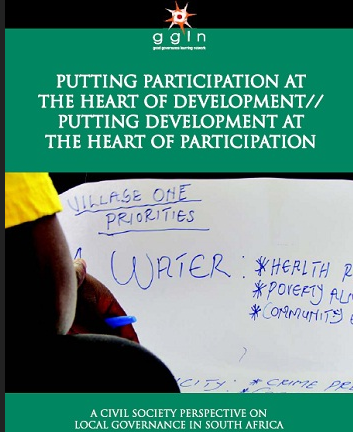
This 121-page publication, published by the Good Governance Learning Network (GGLN), comprises a collection of essays intended to explore alternative conceptions, approaches, and methods for shaping a vibrant, pro-poor system of local governance and democracy in South Africa. It was published not to offer solutions or answers to systematic problems, but to highlight what the authors deem to be innovative approaches, and ultimately argues that participatory governance needs to be substantive, both in terms of process and with respect to outcomes, thus the key call of the publication is to "put participation at the heart of development/put development at the heart of participation."
According to the executive summary, the 2011 municipal elections recorded the highest voter turnout rate in municipal elections in South Africa since 2000; yet, the local sphere of government has also felt the brunt of popular discontent. Dissatisfaction with the delivery rate and quality of housing and basic services has been the main driver of protests across the country, but increasingly governance-related factors have been highlighted. In many instances, participatory local governance has become devoid of substantive meaning and lacks influence on planning, resource allocation, and implementation. The practice in many municipalities is seemingly one of "going through the motions" and ensuring compliance with the legislative requirements which, ironically, were designed to facilitate substantive public participation in terms of both process and outcomes.
This publication offers a number of insights and methodologies related to community-led initiatives for engagement with the local state, and for local development, collaborative planning, social accountability tools, and other models for community involvement. The contributions are based on existing practices and emerging areas of work of member organisations of the Good Governance Learning Network (GGLN).
The first set of papers focus primarily on autonomous civil society initiatives for social mobilisation and engagement with the local state. This includes narrating a number of examples of community-led initiatives which offer citizens structured and innovative ways of engaging the local state and monitoring its performance. These spaces are designed to be co-operative rather than confrontational and are intended to be viewed by local municipalities as development partnerships.
It is also noted that social media has significant potential as a tool for enhancing accountability, communication, and social mobilisation. However, while social media has been used effectively to facilitate communication and/or engage the state, there are also notable risks associated with it. Equally important is the underlying value system and a commitment, not just to the letter, but especially to the spirit of participatory local democracy, which cannot be institutionalised beyond inculcating a public service ethos notion of a pro-active citizenry, actively and rightfully involved in decisions and development initiatives in their communities. With respect to South Africa, progress has been made in e-government, digital solutions for streamlined government services, and, to a lesser degree, in e-governance, developed by the state as a two-way digital system to improve accountability and feedback. However, social media remains an under-explored tool in the autonomous engagement by civil society organisations with the state.
Several papers argue that ‘networked spaces’ are a critical addition to participatory development. Existing spaces for engagement have a number of limitations that prevent genuine deliberation and knowledge sharing to inform pragmatic solutions supported by government officials and community members alike. This suggests the need for the creation of networked spaces that are explicitly designed to navigate these tensions and contradictions in order to build communities of practice which produce novel and co-produced solutions to specific problems facing communities. The authors argue that such spaces are crucial to ensure that participation leads to tangible developmental outcomes as they enable mediated processes of contestation, negotiation, priority setting and tradeoffs.
Participatory budgeting is also an underexplored tool in the South African context, yet it has the potential to transform socio-economic and development conditions within a municipality in a manner that realistically prioritises local needs in the context of limited resources. It is both a technical and political tool which involves issues of power, accountability, and empowerment. Participatory budgeting denotes a significant paradigm shift, away from a technocratic approach to budget preparation and monitoring to a participatory process involving local communities.
Good Governance Learning Network on July 6 2012.