










































Participatory Radio Campaigns and Food Security: How Radio Can Help Farmers Make Informed Decisions
Farm Radio International
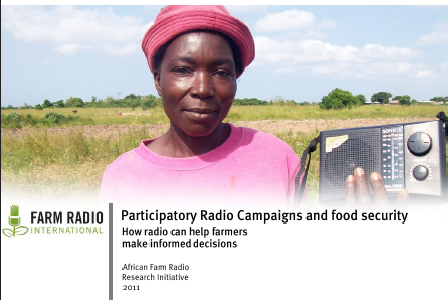
This 86-page report presents and discusses key findings from an in-depth evaluation of 15 participatory radio campaigns (PRC) conducted in round-two of the African Farm Radio Research Initiative (AFRRI). AFRRI was a 42-month action research project implemented by Farm Radio International (FRI) in partnership with World University Service of Canada (WUSC), and with the support of the Bill & Melinda Gates Foundation, designed to test the effectiveness of participatory radio campaigns to enhance food security. Working with partner radio stations in five African countries (Tanzania, Uganda, Mali, Ghana, and Malawi) AFRRI created a series of farm radio programmes designed to educate farmers and enable them to improve their agricultural practices. According to the report, approximately 40 million smallholder farmers were served by the radio programmes, and if the survey findings are applied across the potential audience, it is estimated that 20 million learned about the promoted agricultural improvement, and 10 million adopted one or more of a wide range of improved farming innovations.
The report explains that along with the participatory radio campaigns, the AFRRI programme included testing new information and communications technologies (ICTS) to improve two way communication between audience and radios, as well as a five-station pilot initiative which used radio to enhance existing marketing information services (MIS). Active listening communities (ALCs) were engaged in AFRRI and the PRCs from the beginning. They were consulted about the improvements to be featured in the PRC, were involved in monitoring and providing feedback, and members of these communities were often interviewed for the programmes. AFRRI also surveyed farmers in passive listening communities (PLCs). In order to verify that the PRCs were partly or largely responsible for the change in practice, AFRRI conducted the survey in non-listening control communities (CCs).
The following are some of the key findings:
- PRCs have unprecedented success in motivating smallholder farmers to take up improved farming practices - In communities where farmers were actively engaged in producing the PRC, 39% of farmers adopted the improved farming practice featured in the PRC. In communities where farmers could simply listen to the PRC programmes and had no active involvement with the broadcasters, 21% took up the improvement. On average, only 4% of farmers in control communities took up the practice. AFRRI proved that a campaign developed with the participation of a limited number of communities can result in a radio show that is popular and effective – even in communities with no direct involvement in planning, monitoring or contributing their voices to PRC programmes.
- PRCs encourage farmers to try something new, and help farmers become knowledgeable about improved farming practices - The PRCs shared a great deal of information about new agricultural practices. Some of this information came from experts, but a lot of it was shared by knowledgeable and experienced smallholder farmers. A knowledge quiz was administered upon conclusion of the PRC. In ALCs, 70% of farmers scored well on the knowledge quiz and over one-third of farmers demonstrated detailed knowledge of the promoted improvement. In PLCs, over half scored well on the quiz and 21% showed detailed knowledge. This was about three times higher than the number of farmers with comparable scores in non-listening control communities. Further, AFRRI learned that the more frequently farmers listen to PRC episodes, the more knowledge they gain.
- PRCs motivate men, women, young, old, poor, and better-off smallholder farmers to adopt improved farming practices - PRCs had considerable success in motivating women to adopt improved farming practices. In ALCs, 39% of female farmers adopted the promoted improvement (compared with 40% of male farmers in the same communities). AFRRI also demonstrated the effectiveness of PRCs to reach young farmers, reinforcing the ability of these campaigns to help farmers improve their food security throughout their lives. In ALCs, 44% of farmers under the age of 20 reported taking up the promoted improvement (compared with 42% of 20-40 year olds, and 34% of farmers over 40).
- PRCs have a long-term impact, with promoted improvements being practiced by smallholder farmers at least a year after the radio campaign ends - One year after the airing of the final episode of the first round of PRCs, 42% of farmers in ALCs were still practicing the featured improvement. In PLCs, 27% of farmers continued the improved farming practice.
- All types of radio stations can produce effective PRCs, if they have the proper training and support - AFRRI partnered with different types of radio stations: community, commercial, associative, and public radio stations. The outcome evaluation survey found that all were able to carry out effective PRCs. The key is to work with stations that are trusted by smallholder farmers and willing to commit to the whole participatory, farmer-centered process.
The report concludes by stating that over the three-and-a-half-year period of AFRRI's PRC project, the initiative worked with 25 radio stations in five countries to research, design, broadcast, monitor, and evaluate 49 PRCs. Approximately 40 million smallholder farmers were served by these radio campaigns. They learned about a wide range of improved farming practices, and were able to introduce these innovations in their own operations, including the following: disease-resistant varieties of cassava, modern apiculture methods of animal enclosure, composting, mulching, intercropping, controlling pests with neem extract, improved varieties of upland rice, shea nut production and processing, and other agricultural improvements.
In the process, the capacity of radio stations to design, deliver, and evaluate farm radio programming that makes use of new ICTs to increase interaction with listeners and boost the reach and accessibility of their services was strengthened. As a result, farmers will continue to benefit from higher quality farm radio services into the future. According to the report, the findings of this initial study indicate that PRCs can be used to scale-up agricultural initiatives. This can contribute to helping millions of farmers to understand, evaluate, make informed decisions about, and adopt agricultural practices that advance their food security goals.
Farm Radio Weekly, February 20, 2012 on July 13 2012.