










































Participatory Monitoring, Evaluation, Reflection and Learning (PMERL) Manual
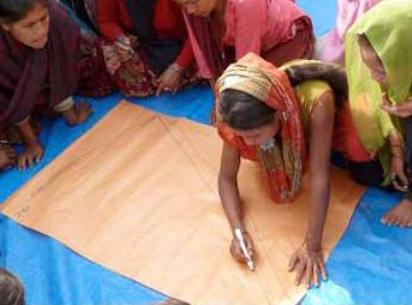
"Community-based Adaptation (CBA) to climate change enables climate vulnerable people to plan for and adapt to the impacts of climate change."
The goal of CBA is to build the resilience of vulnerable individuals, households, communities, and societies. The PMERL Manual supports a methodology that can help measure, monitor, and evaluate changes in local adaptive capacity within vulnerable communities for better decision-making on CBA. It has been developed by CARE in partnership with the International Institute for Environment and Development (IIED). It is written for programme managers, field staff, local partners - both government and non-governmental organisations (NGOs) and communities.
CBA is a 'community-led' or 'community-driven' approach to adaptation driven by a range of different pressures - or drivers - of vulnerability. CBA also addresses social drivers of vulnerability, including gender inequality and other factors related to social exclusion.
"By presenting a participatory methodology for developing and monitoring against CBA indicators, [this manual] provides a new platform for local stakeholders to articulate their own needs, which is a fundamental part of building and strengthening adaptive capacity. The PMERL methodology also responds to the need for continuous feedback and joint learning and communication in order for CBA to be flexible in light of the challenge of uncertainty. When monitoring and evaluation (M&E) is carried out in a participatory fashion it enables an ongoing dialogue with and within communities as part of the promoted continuous learning and reflection process."
The manual is presented in three sections:
- Section 1: Key concepts - Describes the key concepts used in CBA and participatory M&E.
- Section 2: Designing a participatory PMERL strategy for CBA - Describes the PMERL process in detail. It begins by showing where the PMERL process fits in with the overall CBA programme cycle and when it should be initiated. It then takes practitioners through how to develop a PMERL system step-by-step from design, through to data collection, analysis, and use, linking each step back to the various steps of the CBA programme cycle, particularly the planning one.
- Section 3: Tools and methods for PMERL - Presents a selection of different tools that can be used for each stage of PMERL development. Many of these tools will be familiar to community development practitioners, who have been involved in Participatory Rural Appraisal (PRA) processes. Yet, the tools included in this manual have been adapted to the climate change context and for use in PMERL.
88
Email from Tamara Plush to The Communication Initiative on June 28 and July 18 2012.
- Log in to post comments