










































No Yawa Youth Project
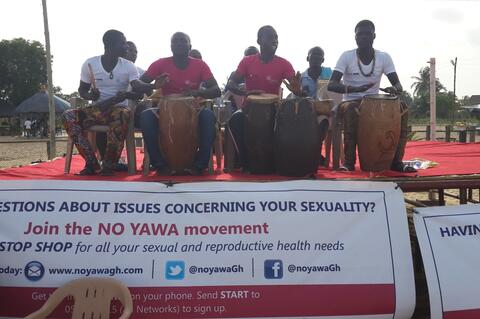
No Yawa is designed to address the high unmet SRH needs of Ghana's youth by improving awareness, behaviours, and access to services. The intervention was developed because it was found that "while there is a high degree of generalised awareness of family planning and reproductive health, there appears to be a declining degree of detailed, accurate knowledge that would put people’s minds at ease, and drive improved SRH behaviours, including increased uptake and use of modern contraception. This indicates a clear need for programmes that target youth with appropriate SRH and FP (family planning) messages, products, and services."
To increase the availability and accessibility of commodities (Fiesta and Kiss Condoms, Lydia’s range of female contraceptive methods), No Yawa implemented large mass-media campaigns to drive youth to continue adopting contraceptive products that help them stay protected from sexually transmitted infections (STIs) and unwanted pregnancies. These campaigns are supported by the work of No Yawa people in the field. By July 2015, No Yawa, through its community programme, reached over 285,000 youth through face-face interpersonal communication (IPC) and referred 275,000 women to nearby clinics to take up a family planning method. In addition, No Yawa SRH messages reached over 19,283 students from 109 schools from the ten administrative regions of Ghana.
Since the start of this programme in 2013, No Yawa also successfully distributed 35 million condoms, 4.9 million cycles of oral contraceptive pills, almost 1 million emergency contraceptive pills, and 926,000 injectable contraceptives to sales outlets throughout the country.
In order to improve access to services, No Yawa is working with clinics and private health providers to develop No Yawa Youth Friendly Centers. These centers receive training, equipment, and follow-up support. They also benefit from being associated with the No Yawa brand, so that youth can easily identify them and are listed on the No Yawa website clinic finder page. In 2014, No Yawa through its YFS (youth friendly services) channels - MSIG clinics, BlueStar franchisee clinics, No Yawa’s mobile outreach teams, and GHS sites - reached 79,189 young people with SRH services.
To encourage even more youth to access these services and make positive choices, No Yawa includes a wide range of awareness raising and youth-focused BCC activities:
- The MarieCall national call centre was established to provide information and to counsel and refer youth for appropriate services. Young people can call the No Yawa's hotline number and receive advice from trained, knowledgeable, and youth-friendly operators. In 2014, 17,583 youth called this hotline with their questions and need for advise.
- Social Media: Youth can register for the No Yawa SMS platform to get useful tips and hints sent to their mobile phones free of charge (as of September 2015, 141,000 young people were receiving weekly text and voice messages). Youth are also able to access information on the No Yawa website about issues such as sexual health rights, how to have healthy relationships, and what contraceptives are all about. They can also post questions and read answers on the No Yawa facebook page(which, as of September 2015, had 32,000 likes).
- No Yawa also has a pool of trained peer educators from universities, senior high schools, and communities who engage their fellow peers on SRH issues. They use channels such as games, room-to-room engagements, debates, seminars, and musical programmes. They also refer clients to the various accredited No Yawa clinics throughout the country, including No Yawa clinics on some of the university campuses.
- No Yawa is raising awareness through digital storytelling. In June 2014, a group of young people from across Ghana attended a four-day workshop, led by the Center for Digital Storytelling’s Silence Speaks programme, to tell stories about sexual health. The youth shared their experiences, made audio recordings of these personal narratives, captured still images and video clips, and assisted with the editing of these materials into short videos. The young people who participated told personal stories of surviving and thriving in the aftermath of economic hardship, difficult relationships, teenage pregnancy, sexual assault, and sexually transmitted infections. The stories offer youth-friendly information, open up sensitive topics, and illustrate the need for improvements in adolescent sexual health services. Silence Speaks developed a discussion guide to accompany the stories, which are being shared by MSI staff and partners and No Yawa peer educators to encourage open conversations about adolescent sexuality, in school, community, and clinic settings Click here to watch the videos on YouTube.
- In December 2014, the "No Yawa" theme song was launched. This joint production by GMA and Black Avenue Records features several Ghanaian music celebrities such as: Samini, Shata Wale, D Black, Joey B, Efya, Asem, Trigmatic, Sherifah, and Yfm's Caroline. The song was produced to provide another medium for communicating the No Yawa messages and brand. Click here to listen to the song.
Youth, Reproductive health
The initiative was created to address the unmet sexual and reproductive health needs of young people in Ghana. "Adolescents and youth in Ghana are faced with incomplete and inaccurate sexual and reproductive health (SRH) information, leading to deep misconceptions about sexuality, and engendering inappropriate sexual behaviours. Meanwhile, an unresponsive public health system is contributing to high unmet need for contraceptives, unplanned pregnancies, unsafe abortions and resultant deaths; suggesting that many young people are not empowered or lack knowledge to exert their sexual and reproductive rights."
DKT International, Marie Stopes International Ghana (MSIG), Grameen Foundation, Embassy of the Kingdom of the Netherlands in Ghana, and the Center for Digital Storytelling’s Silence Speaks Programme.
Email from Leonard Gobah on June 12 2015, NoYawa website, Modern Ghana website, and Story Centre website on July 7 2015, and email from Kevin Hudson on September 28 2015.
- Log in to post comments