










































Learning Together Across Generations: Guidelines for Family Literacy and Learning Programmes
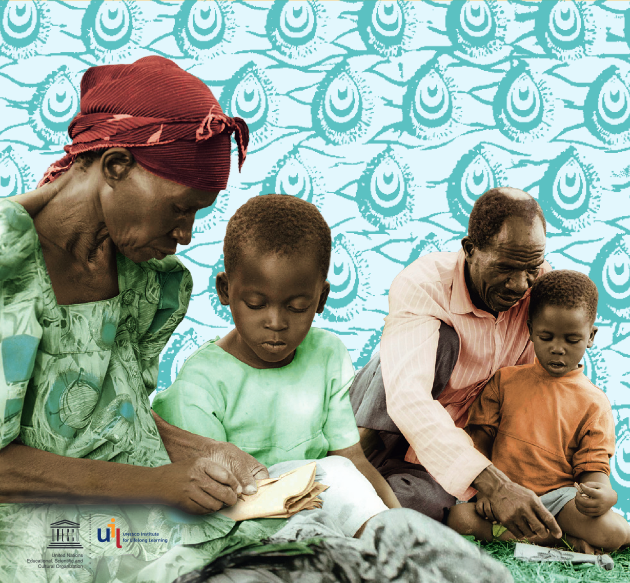
"Family learning has the potential to develop and strengthen a culture of learning in families and communities. It often goes beyond teaching literacy and numeracy, equipping learners with the life skills and tools to engage positively with their community through lifelong learning opportunities." Arne Carlsen, Director, UNESCO Institute for Lifelong Learning
This resource pack, published by the United Nations Educational, Scientific and Cultural Organization (UNESCO) Institute for Lifelong Learning (UIL), offers evidence-informed guidance on how to develop, implement, monitor, and evaluate a pilot family learning programme, stressing, in particular, the value of an intergenerational approach in addressing the learning needs of disadvantaged families and communities. The pack includes: an introduction to the concepts of ‘family literacy’, ‘family learning’ and ‘intergenerational approaches to learning’; detailed guidelines for setting up and piloting a family literacy and learning programme; and examples of materials and tools that can support activities.
As explained in the guide, “[F]amily literacy and family learning are approaches to learning that focus on intergenerational interactions within families and communities. This, in turn, promotes the development of literacy, numeracy, language and life skills. Family learning recognizes the vital role that parents, grandparents and other caregivers play in their children’s education. Furthermore, it values and supports all forms of learning in homes and communities. It seeks to break down artificial barriers between learning in different contexts: in formal or non-formal settings in schools or adult literacy courses, on the one hand, and in informal home and community environments, on the other. Very often, the desire to help children with schoolwork motivates parents or caregivers to re-engage in learning themselves and improve their own literacy, numeracy, language and other basic skills. For this reason, family literacy and family learning initiatives support adults, whose own education has been limited for various reasons, in helping their children with learning. The focus of family literacy and family learning is therefore on both children’s and adults’ learning.”
The guide has been developed for stakeholders who are interested in piloting a family learning programme. These stakeholders include policy- and decision-makers, governmental departments and institutions, non-governmental and civil society organisations, community leaders, teachers, educators, facilitators and learners, among others. Although the pack is designed mainly for the sub-Saharan African context, the pack has resulted from a process of identifying and analysing promising practices and from consulting resource persons from selected family literacy and family learning programmes in all world regions.
The Guidelines are divided into three sections:
Introduction - A theoretical introduction clarifying the concept of intergenerational and family learning. The section answers questions such as:
- What are ‘family literacy’ and ‘family learning’?
- Family literacy or family learning?
- Why implement intergenerational approaches to learning?
- What evidence supports family literacy and learning?
- How are family learning programmes structured and implemented?
- What are the success factors in family literacy programmes?
- What are the issues, challenges and barriers family literacy and learning programmes face?
- Making it work
Part 1 - Guidelines - - This section offers a set of guidelines supporting potential providers in planning and delivering a pilot family learning programme. It looks at:
- Context, Situation, and Learning Needs Analysis
- Cross Cutting Principles (such as human rights, culture, gender equality)
- Participants
- Partners and Partnerships
- Funding
- Programme Aims, Outcomes and Indicators
- Porgramme Structure
- Programme Management
- Trainers and Facilitators
- Programme Content
- Monitoring, Evaluation and Research
- A checklist for providers starting a pilot family learning programme
PART 2 - Material and Activities - includes examples of materials and activities that can be used in family learning programmes, and looks at what kinds of learning activities and material are most effective.
English
139
UNESCO Institute for Lifelong Learning (UIL) website on May 29 2017.