










































Learning from Experience: Rights and Governance Advocacy in the Water and Sanitation Sectors
Freshwater Action Network (FAN)
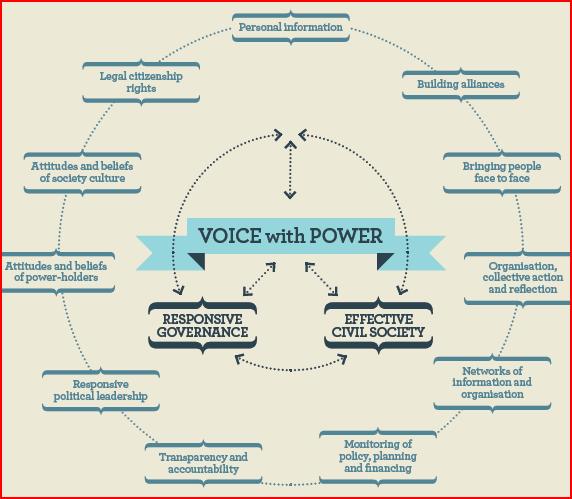
"The relationship between voice, power, citizenship and governance is complex. In order to be able to engage effectively, citizens and their communities need access to information, an understanding of power relations, skills in advocacy and negotiation, strengthened knowledge of rights, policies and practice as well as support to develop their confidence."
From Freshwater Action Network (FAN) and WaterAid, this report includes case studies and examples of water and sanitation programming. As part of this partnership on rights and governance advocacy, FAN and WaterAid are leveraging the expertise of local civil society organisations (CSOs) and networks: 28 partners from 14 countries. The programme's aim is "[t]o increase the capacity, resources and voice of civil society 'policy communities', including marginalised groups, to participate in effective and inclusive evidence-based dialogues with decision-makers in the water and sanitation arena and build pressure to secure pro-poor service delivery." This aim is broken down into 4 outputs:
- Strong and well-functioning CSOs and CSO networks capable of influencing the design, implementation and evaluation of effective water, sanitation, and hygiene (WASH) policies at all levels - "Capacity building has taken place at organisational, local, state and regional levels, employing a variety of approaches including training, exchange visits, peer support, strategy, planning and reporting guidance, as well as various types of meetings and workshops...In terms of sustainability, large networks with broad memberships have more credibility and legitimacy with governments, donors and citizens, making their advocacy more effective while reducing risks to individual members and making it easier for governments and donors to focus their engagement....[B]eing networked ...enables quick access to information to capture otherwise lost opportunities. For example, GTF [Governance and Transparency Fund] partners and other FAN network members were able to quickly learn about the opportunity to share their work on rights-based approaches and rights advocacy in consultations at the United Nations Human Rights Council hosted by the Independent Expert on rights to water and sanitation. Those who were chosen to participate and were supported by the Independent Expert to travel to Geneva and testify, noted that the relevant information came to them cascaded through the FAN network of networks..."
- CSOs, including those representing marginalised groups, are effectively engaging in decision-making processes affecting the WASH sector - Two case studies are provided:
- Society for Advancement in Tribes, Health, Education and Environment (SATHEE) - Working in the Indian state of Jharkhand on WASH governance issues, SATHEE supports the formation of cadres who spearhead activities in the village. Capacity building for cadre members is designed to empower them (and, through them, communities) so that they can transform the local power structures and create their own platforms for problemsolving and planning. A strong emphasis is put on transparency, and cadres are responsible for keeping the community up to date on their work and any water and sanitation issues. To support their efforts to be inclusive, SATHEE has created materials in the local language and in Hindi. These are intended to form the basis for discussions between cadre members and community members as well as between cadres and government officials. SATHEE has also developed a tool for the preparation of water and sanitation plans at community level with both an inclusive process for all community members and with scope for convergence between different government programmes.
- FANCA - In Central America (Costa Rica, Honduras, Nicaragua, and Guatemala), FANCA supports communal water boards (CWBs) to develop their own capacity to raise the voices of CWBs and to support them in promoting gender equity within their leadership. "FANCA believes that empowering women and strengthening local organisations is not enough to provide solutions to WASH issues, nor to enable constructive engagement with policymakers....FANCA believes that investing in more capacity building is necessary, not just in governance and accountability issues but also in evidence gathering, proposal formation and sophisticated advocacy techniques."
- Informed and empowered people are better able to demand accountability and responsiveness from governments and service providers in the WASH sector - "In order to support people acquiring information and being empowered to use it, partners have encouraged the use of a variety of effective policy and legal instruments, tools and methods in their governance work". Details are provided here about projects that have used the rights to water and sanitation to empower citizens and influence policy, drawn upon the Right to Information Act (RTI) in India, the National Rural Employment Guarantee Scheme (India), public hearings and community score cards developed in Ghana, policy briefs and citizens' report cards in Uganda, and national learning forums held in Kenya.
- Governments and service providers are more accountable to (willing and able) citizens and end users in the WASH sector - "CBOs [community-based organisations] and CSOs can facilitate citizen access to the information that will enable them to hold local governments and service providers to account. They can also undertake independent analysis of policies, budgets and implementation processes in order to recommend changes that will benefit poor people without access to WASH services....Programme partners would also like to see governments creating and institutionalising formal mechanisms for the participation of all community members, especially those usually excluded, as well as NGOs [non-governmental organisations] and other stakeholders in policy and budget development, planning and monitoring....The main approach that GTF partners take in terms of working with governments is constructive engagement involving praise and encouragement as well as criticism and demands....Part of this engagement is multistakeholder dialogues....The title and exact form of these dialogues varies from country to country but in essence they all bring together multiple stakeholders including CBOs or community representatives and government officials, to discuss issues, share information and perspectives and agree [upon] solutions."
The final section of the resource details cross-cutting learnings in the areas of citizen empowerment and "service versus rights". One lesson: "Across the programme, at the community level, immediate results can be seen in terms of people becoming more self-confident and willing to speak freely to local authorities - demonstrating their understanding that as citizens they have rights and entitlements....Even as they make progress, many partners remain frustrated with the fact that rights and governance advocacy is a long-term process for which, in spite of this programme, they lack truly long-term support."
Freshwater Action Network (FAN) website, January 30 2012; and email from Isabella Montgomery to The Communication Initiative on April 5 2012.