










































Grassroots Comics by Disabled People
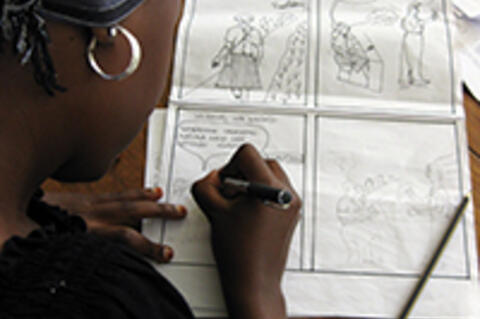
Shivyawata arranged four grassroots comics workshops in Mwanza for the local branches of Tanzania Association of the Deaf, Tanzania Albino Society, Tanzania Association of the Physically Handicapped, and Tanzania Association of Mentally Handicapped. Fifty-one participants attended the workshops. According to the organisers, most of the participants were disabled, although in the case of the Association of Mentally Handicapped, mainly family members participated.
Each five-day workshop covered the basics of drawing, in particular drawing people, facial expressions, perspective, and landscapes. Participants then learned to construct a story with a theme, focus, and message, and to consider their audience (readers). Finally, the stories were made into comics. On the last day participants learned how to organise their own workshops.
According to World Comics Finland, the stories mainly reflected the real life experiences of the participants. Most of the comics made in the workshops dealt with issues related to basic rights, such as the right to education, health care, and employment, as well as difficulties related to family and relationships, infrastructure, and political participation. The concept of comics seemed quite difficult for many participants in the beginning, but when they saw their final work they recognised the potential to communicate through comics. Some participants were illiterate, but organisers say their commitment and engagement with the project was often higher than those who were literate.
As part of the workshop, participants put together a distribution plan for their comics. Those in wall poster format were distributed to schools, government and city offices, hospitals and health centres, courts, bus stops and stations, ferry terminals, and markets. During the distribution, participants collected feedback from the community via interviews with passers-by, doctors, teachers, and city officers. The reactions were mainly positive, with readers indicating that the messages were understood. The comics were also photocopied and made into an exhibition.
According to an evaluation conducted after the workshops, participants felt the comics were an easy, fast, and inexpensive way to educate the community about disabled people's issues. They hope to train others through their organisations to make comics. Some also noted that comics can be used in lobbying the government about disabled people's rights, as well as to educate disabled people. Many readers stressed that it is also very important to distribute the comics to villages, where people are not aware of disabled people's issues. They suggested distributing them in ward and village meetings and at different events. Schools were also considered good places for comics as children like to read and will pass the information to their parents. It would also decrease the discrimination of disabled children in schools.
Disability, Rights
According to World Comics Finland, grassroots comics can be used as a low-tech communication tool for activists. Activists, who have very little or no experience of drawing, can in a few days learn how to produce grassroots comics. Grassroots comics have been used by organisations to focus on different issues, such as racism, sexual harassment, girl child rights, school drop-outs, HIV/AIDS, sanitation, and right to education.
Shivyawata Mwanza, World Comics Finland, Abilis Foundation
World Comics website on August 13 2010.
Image: Participant in the workshop for the Deaf in Mwanza, by Sanna Hukkanen.
- Log in to post comments