










































Family Planning Around Environmentally Sensitive Regions in Madagascar

"The fact that our group has earned the Ankoay honor and that we are currently engaged in the Ankoay Doré program has given an additional measure of enthusiasm and sense of responsibility to our club. This has resulted in our club being recognized as a communication leader in our village and has also opened several opportunities for us to work with government agencies and other local organizations. For example, the National Government requested our support during national education days devoted to the Madagascar Action Plan." ~ Youth from Analamanga region (located on the central plateau of the island)
This report evaluates the process of an integrated population/environment programme designed to engage, educate, and promote behaviour change among young people in Madagascar with a view to transforming them into frontline leaders in the fight against HIV/AIDS. As detailed here, in January 2005, the United States Agency for International Development (USAID)/Madagascar requested that the Health Communication Partnership (HCP) assist the National AIDS Control Committee (SE/CNLS) of the Government of Madagascar to develop a behaviour change communication (BCC) strategy for HIV prevention among youth and young adults. The Ankoay, or Eagle, approach was launched in April 2005 through the National Scouting Federation, which unites 6 scouting organisations. The Ankoay approach includes some 25 activities that employ experiential learning techniques to build young people's capacities to develop life skills such as in communication, forming relationships, and learning how to resist peer pressure, as well as to acquire values concerning gender equity.
Achievements of Ankoay (through December 2007):
- Over 2,170 youth groups have engaged in the programme.
- 1,500 groups have been certified Ankoay; 150 of them have continued on to the level II Ankoay Doré programme (see below).
- Approximately 652,000 young people have been educated in their communities.
- 4,000 young people participated in voluntary HIV testing.
- There has been active promotion of the Ankoay model by five ministries (Health, Youth, Water, Education, and Environment), the CNLS, and dozens of international and national non-governmental organisations (NGOs).
- There has been extensive free radio, TV, and press coverage of specific skill-building activities, use of the Ankoay Youth Passport, role playing, and community outreach at dozens of Ankoay celebrations.
- The approach has been adapted by the private sector. For example, the Canadian mining company QMM is piloting a modified Ankoay approach in schools adjacent to their project region.
- An interactive website has been created.
The SE/CNLS assessed Ankoay after one year of implementation, judging it a national "best practice". As a result, in August 2007, through additional funding from USAID/Madagascar, the Academy for Education Development (AED) launched Ankoay Doré, a series of level II activities designed for youth groups that had successfully completed the Ankoay programme. The initial Ankoay Doré approach added hygiene activities to HIV prevention. In early 2008, with funding under the AED-managed Communication for Change (C-Change) Program, the Ankoay Doré model was expanded further to include hygiene, adolescent reproductive health (ARH), and environmental activities. Ankoay Doré involves youth in community development and peer mentoring using a mix of individual and collective activities to engage youth as leaders of national efforts to improve health and environmental sustainability.
Specifically, the Ankoay Doré programme was piloted in 7 regions (Analamanga, Vakinakaratra, Amoron'i Mania, Haute Matsiatra, Ihorombe, Anosy, and Atsinanana) of Madagascar. From October 2007 to March 2008, 3 workshops were held with partners to share best practices related to hygiene, environmental protection, and ARH/FP and, subsequently, to design activities and set the goals of the Ankoay Doré programme. The Ankoay Doré kit (activity guide, complementary booklet, brochures, honors, certification kit) was developed. Then, following the launch in April 2008, 3 training-of-trainers (TOT) Ankoay Doré workshops were held. This facilitated the training of 93 Ankoay Doré instructors for 150 youth groups of 20 to 30 youth each in 6 regions of Madagascar. In addition to these 4,500 young people, approximately 25,000 other youth and community members were reached through community outreach with hygiene, ARH, and environment protection activities. Approximately 5,000 young people underwent voluntary HIV screening. Through a separate but related initiative, the Ministry of Health (MOH) trained health workers from 900 health facilities on ARH using Ankoay materials.
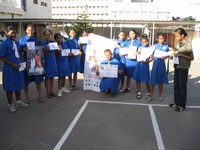
According to this evaluation, "Site visits indicate that youth groups are taking greater community outreach initiatives and assuming higher levels of responsibility than they did before they were certified as 'Ankoay.' This is in keeping with the overall design of the program which anticipates that when a youth group is publicly recognized as a community leader, its sense of collective efficacy will increase and its members will, in turn, demonstrate greater confidence when organizing community-based activities. [Furthermore,] dozens of groups have organized 'mini-festivals,' half-day development fairs, and celebrations that focus on adolescent reproductive health (including HIV and AIDS prevention games), demonstrations of water purification and correct hand washing, and skits that highlight steps to protect the environment, such as alternatives to slash and burn farming and the importance of recycling."
In early March 2009, C-Change signed a four-year Associate Award that establishes additional funding from USAID/Madagascar to assure the sustainability of the Ankoay and Ankoay Doré programmes through September 2013. The Associate Award outlines approaches for continued collaboration with environmental programmes. C-Change also plans to carry out a formal quantitative and qualitative evaluation of the Ankoay model in 2010. The evaluation instrument will be designed to capture the impact of the intervention, provide insights into synergies between the programme themes, and explore how and to what extent the intervention has contributed to a shift in individual behaviour and social norms.
- Log in to post comments