










































Driving Change Through Rural Radio Debate in Uganda: Evaluation Report
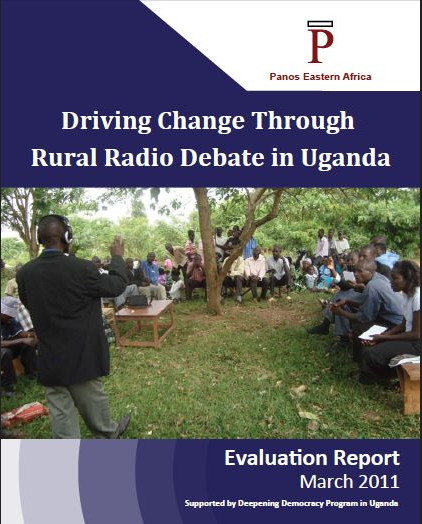
This 100-page mid-term evaluation report shares findings of an assessment of the Rural Radio Debate (RRD) Project implemented by Panos Eastern Africa (PEA) since July 2009. Part of the "Deepening Democracy" programme, PEA supports 20 radio stations to hold debates in communities on development, governance, and political process topics that are generally selected by the communities themselves. In January 2011 PEA commissioned an independent evaluation with four areas of focus: to assess the methodology and its potential, to assess the results so far, to examine the topics for debate emerging from the communities, and to identify any challenges in implementation. This evaluation was designed to feed into the preparation of a proposal for a second phase of the project. The overall conclusion of the evaluation is that significant progress is being made towards achieving the project’s objectives.
The mid-term evaluation findings are outlined as follows:
Profile of the debates
Summary information was available on over 350 debates held in the period December 2009 to January 2011. Nearly one third of the debates were about local services and infrastructure issues. Health was the most common topic, followed by education, roads, and water and sanitation. These topics are considered very pertinent to the project’s purpose, since they enabled communities to understand better how services are delivered and to hold the providers accountable. 61 debates were on election-related topics, fulfilling part of the project's purpose of empowering citizens to participate more meaningfully in the 2011 national and local elections. 50 were on general governance and accountability issues. 57 were on social/cultural issues such as heavy drinking or teenage pregnancy. These topics included many that are largely outside government's responsibility, and the debates often resulted in increased awareness by the communities and individuals within them of their own role in finding solutions to problems.
Evaluation of the Rural Radio Debates methodology
The mid-term evaluation suggests that the concept fits well with current understanding of good governance, which sees good governance as requiring not only capable government – the supply side - but also citizens actively demanding good governance and holding power-holders accountable – the demand side. The concept is highly relevant for Uganda, where independent local radio stations exist as potential partners for communities in holding power-holders accountable, and a local government structure down to village level offers potential channels for community influence and demand.
Results and impact
According to the evaluation, there is evidence of positive results for achieving the project objectives and demonstrating that the RRD methodology is effective in achieving its intended purpose. For example:
- When community members are asked at the end of debates what they have gained from it, the first response recorded in reports is usually "We have made our voices heard." For most rural individuals and communities the experience of expressing their concerns at a level where they will be heard beyond the immediate neighbourhood is a new one. The fact that the voices may be broadcast is highly valued, and is probably the incentive for many people to speak out.
- As well, some stations have noted that, whether from participating in person or from hearing broadcasts, people are gaining skills – sticking to the point, not repeating what others have said, and moving the topic on from personal anecdotes and complaints to solutions.
- There are clear signs that through the debates power-holders are responding to communities’ needs and demands – whether reluctantly because exposure forces them to, or voluntarily because they see the power of the radio debates to enrich relationships between the people and elected representatives or officeholders.
- In general, in the run-up to the 2011 elections, radio partners observed that candidates were expressing a greater commitment to media and transparency.
- Five of the eight stations visited during the evaluation identified strengthened links with the community as one of the important results of the Debates project.
- Project partners appreciated a number of different skills and insights they or their staff had gained. One was knowledge and appreciation of rural communities, which as urban-based news reporters they had lacked before.
Implementation Constraints and Challenges
Four areas are identified where resolving issues at this stage would contribute to a stronger next phase of the project:
- Partner radio stations: the methodology is demanding in terms of staff time and skills. Some stations have been able to implement the project to a very high standard, but for others it is a stretch and they have been holding fewer debates than planned, and sometimes of less good quality. PEA needs to reflect on whether there is any way of giving additional support to the weaker partner stations without creating dependency.
- Training for radio station staff and regional editors: a training methodology and different training inputs should be consolidated. Initiatives already begun to strengthen the ongoing training support should be intensified, which might include an increased role for the regional editors, and/or separate in-house training courses. Training needs of the regional editors should be considered.
- Monitoring and reporting is important for management, accountability and learning. Much has been achieved in the face of a media culture in which project reporting is unfamiliar, but there is further to go. Reporting systems and requirements need to be clearly agreed, understood, and adhered to.
- The Regional Editors are key actors in the project implementation, providing management support for the partner stations, skills-building and problem-solving, and acting as channels for information to PEA. While some have provided valuable and appreciated support to stations, others have not, and several have neglected their role as conduit of information and learning to Panos. PEA should look more closely into the reasons for the varying levels of performance.
In conclusion, despite challenges, the overall finding of the evaluation was that it is clear that the project is achieving good results in the short term, while the activity is going on, mostly at local and district level. Eighteen months into the project, these are promising short-term results at the level of project objectives which already contribute to the project's goal and purpose.
Panos website on July 24 2012.
- Log in to post comments