










































Community Dialogues for Healthy Children: Encouraging Communities to Talk
Malaria Consortium
This 30-page learning paper describes Malaria Consortium’s approach to and experience of engaging local communities in integrated community case management (ICCM) in Mozambique, Uganda, and Zambia. Malaria Consortium has been implementing ICCM, an approach where community-based health workers are trained to identify, treat, and refer children under-five with pneumonia, diarrhoea, and malaria, in these countries since 2009. This learning paper looks at some key barriers to the early treatment of sick children and the interventions developed to address them, with a focus on the Community Dialogue (CD) approach. Preliminary findings drawn from the early stages of implementation show that CD has been a very effective way of identifying and filling information gaps, as well as encouraging community analysis and planning.
According to the learning paper, participatory learning and action approaches, and other ways of mobilising the community that are based on knowledge and competency, are reliable and effective ways of engaging people in various projects. They take into account a community's capacity to address its own problems, as well as a set of processes that enable dialogue, analysis, planning, sharing, and evaluation. Malaria Consortium developed a model for triggering regular CDs in communities where ICCM is being implemented. This was done by providing:
- stimulus: giving selected community leaders and community health workers (CHWs) a basic one or two days' training on facilitation skills and a CD toolkit.
- an innovation: giving communities accessible child health services through training, equipment, and supervision of CHWs for ICCM.
- a limited mass media intervention: using radio messages and posters focusing on the availability of CHWs, information about the diseases, and the benefits of seeking medical care early.
Dialogues are chaired by community leaders and co-facilitated by CHWs. Ten simple steps are outlined to organise and lead fruitful community dialogue sessions, comprising three core phases:
- Exploring the topic: questioning assumptions, filling knowledge gaps, clarifying misconceptions.
- Identifying issues: reflecting on personal experiences of childhood diseases’ management and prevention.
- Action planning: agreeing on a few achievable individual or collective actions to ensure prompt, high-quality medical care for young children as well as appropriate ways to prevent these diseases.
Initial feedback indicates that the CD approach is highly appreciated by community-based facilitators, community members, and health centre staff. Because it is grassroots-based, reaching out to communities, it allows 'ordinary people' to interact and reflect on health information within their villages and not at health facilities, where such interactions usually happen. Not all community members have access to radio or a phone to participate in radio phone-in programmes. Others, because of low literacy, can misinterpret posters. Participants are encouraged at CD sessions to express their views, ask questions and tell their own stories and do so freely because the session is facilitated by peers rather than professional health staff.
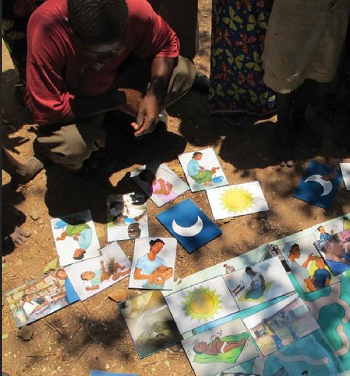
The paper suggests because of low (though variable) health literacy among community members, the community dialogue sessions tend to focus on the 'exploring' phase to fill in information and knowledge gaps, with little time left for identifying issues and action planning. In time, as members of the community gain knowledge and facilitators gain experience in leading dialogues, it is expected that discussions will move progressively towards problem solving. However, the use of visual interactive tools and of local languages seems to enable community-based facilitators – who receive only a basic training – to generate participatory discussions through questioning and sharing of testimonies among care-givers.
The model supports engagement with rural communities, providing them with opportunities to access basic health information on both disease prevention and care. It also provides an opportunity for them to discuss how this information applies to their daily lives. Moving from information to action is not a short or straightforward process, however. It also requires addressing social norms and empowering individuals. Testimonies from CD participants indicate that the availability of local CHWs is not enough to change the ways participants seek medical care, but that community dialogues can be a platform for progressively addressing social norms through discussing common values and learning from peers' experiences.
The learning paper concludes that the Malaria Consortium has developed a flexible community dialogue model using simple visual interactive tools adapted to low-literacy audiences. It focuses on building trust and cooperation through community understanding and support for the CHWs' services, as well as the promotion of early care seeking. However, training and equipping CHWs to provide services are not enough to trigger appropriate use by community members, or to change when and how they seek care. The CD approach is considered critical for triggering community uptake of and support for ICCM services. It is essential that the capacity of local health services, especially at district level, continue to be strengthened in participatory approaches such as CD to allow them to support community-based facilitators. Having received only a basic training, community-based facilitators need both practice and coaching in order to gain the confidence to lead CDs that are both regular and successful.
Email from Sandrine Martin on December 13 2012 and Malaria Consortium website on December 14 2012.
- Log in to post comments