










































E-governance and Citizen Participation in West Africa: Challenges and Opportunities
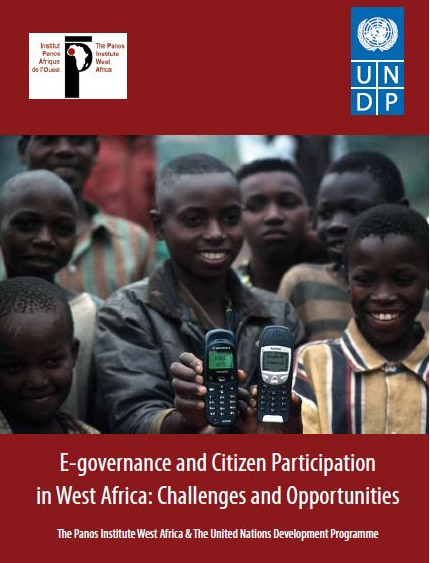
The United Nations Development Programme (UNDP) in partnership with the Panos Institute West Africa (PIWA) carried out this exploratory study to gain a better understanding of e-governance practices in the region, focusing in particular on citizen participation. The study aims to pave the way for future action and to document problems in this field. The study focuses on six countries: Burkina Faso, Cape Verde, Cote d’Ivoire, Ghana, Nigeria, and Senegal and includes an introduction to e-participation challenges in West Africa, case studies of initiatives in this area, and guidelines and recommendations for improving participation in West Africa through Information and Communication Technologies (ICT.)
The main objectives of e-governance considered in this report are:
- Access to information;
- Service provision that facilitates greater transparency and effectiveness;
- Local governance and decentralisation;
- Dialogue between government and non-governmental stakeholders;
- Sharing knowledge and training.
The publication argues that since e-communication has advanced considerably in Africa, and it offers speed, cost reduction, and wider reach, it is now crucial for the work of the public sector, for civil society organisations, and for governments. (The latter uses them for intra-governmental communication and for providing services and communicating with citizens.) Therefore ICTs enhance citizen participation by enabling citizens to interact better with each other and with their elected officials – in a nutshell, e-participation.
Challenges that arise from increased ICT use include limited and unequal access to ICTs, lack of infrastructure, electronic fraud, and the absence of or inadequate legal frameworks. Furthermore, those factors that would encourage genuine citizen participation in decision-making through technical tools put in place by governments or even civil society itself are not fully instituted and developed. This study also examines factors that limit the implementation of e-participation such as major limitations in human capital; low literacy and school rates; gender inequalities; infrastructure limitations; and the status of democratic governance.
The study proposes some communication-related strategies that may help governments and civil society organisations to address solutions to overcoming some of these challenges. They include:
- Addressing schooling and literacy, especially for women and girls;
- The promotion of national and local languages;
- The promotion of a culture of collaboration and dialogue to improve decision-making processes;
- Public information campaigns that raise awareness about the use of ICT to improve the management and coordination of government activities and all of the institutions linked to the state;
- Public media campaigns to support media and civil society commitments to use ICT in general, and to the channels of participation in particular;
- Promotion of the use of mobile phones in participation as the most widely accessible ICT;
- Support and promotion of research in e-participation; and
- Increase information and awareness about e-governance and e-participation tools that already exist.
Click here to download the English version of this document in PDF format.
The United Nations Development Programme (UNDP) website on April 18 2012.
Comments

IPAO
PIWA this good job!
Keep the flame burning!
- Log in to post comments