










































Multiple Concurrent Partnership (MCP) Community-Based Communication Programme
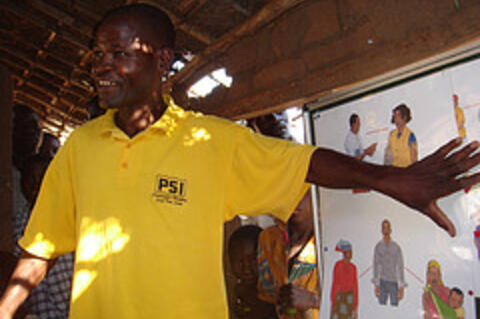
In May 2008, PSI trained 30 community agents in two provinces to conduct interpersonal communication sessions that include community leaders (village chiefs, religious leaders, traditional healers, etc.) to discuss HIV and MCP in their communities. Sessions were carried out in groups of 15-20 adults sitting around a blackboard. Participants were asked to identify the sexual networks in their communities. The community agent: pinned up a figure of a "typical couple"; elicited the group's ideas about how many other partners they might have and which partners those other partners might have; and encouraged open discussion. The agents asked people to help depict the sexual network by adding partners to the blackboard until everyone could see how having one or more extra partners can put everyone at risk of HIV infection. Participants were also invited to get involved in role plays to improve their self-efficacy or confidence to negotiate fidelity, partner reduction, or condom use when they go home.
PSI also developed a 3-year mass media television, radio, and print campaign that extends similar behaviour change messages to more communities. The campaign is entitled "Andar Fora é Maningue Arriscado!", meaning "walking outside (or having sex outside) is very risky!" Launched in March 2010, this campaign is funded by the United States Agency for International Development (USAID) and the President's Emergency Plan for AIDS Relief (PEPFAR), and is being undertaken in collaboration with the National AIDS Council (CNCS), Johns Hopkins University, and two Mozambican partners, the Foundation for Community Development (FDC) and N'weti Health Communication.
HIV/AIDS
With technical and financial support from USAID and PEPFAR, PSI made some adaptations following pre-testing in Gaza and Maputo provinces to improve moderator techniques used during the session. MCP sessions using these new techniques are now being carried out in all provinces of the country. PSI used experience in the community to help develop a mass media campaign to address risk perception around MCP.
USAID, PEPFAR, National AIDS Council, Johns Hopkins University, FDC, and N'weti.
"Reducing Multiple Concurrent Partnerships in Mozambique" Profile [PDF] on March 12 2009; PSI Mozambique website on April 27 2010; and email from Dvora Joseph to The Communication Initiative on May 19 2010.
Comments

dont you have support office
dont you have support office in Malawi?
- Log in to post comments