










































Padare/Enkundleni Men's Forum on Gender

In order to achieve the organisation's objectives, Padare/Enkundleni Men's Forum on Gender seeks to:
- create a forum for men to question and reject gender stereotypes and roles that privilege men and oppress women;
- create a support group for men who are committed to change; and
- enable men to identify and challenge structures and institutions perpetuating gender inequality in their society.
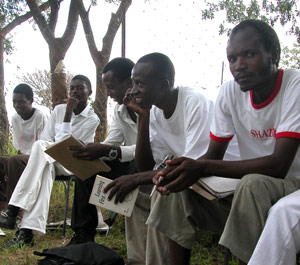
Padare's main strategy involves getting men together to talk in formal workshops or in more informal spaces in schools, pubs, sports clubs, and churches. Here, boys and men are encouraged to talk about the way they have been raised and the disadvantages of patriarchy. They examine assumptions about women and men that have made men oppressive and that prevent meaningful relationships between men and women. The organisers believe that men suffer because of "pressure to project an image that is not naturally theirs and that is not sustainable". This pressure limits both creativity and the expression of man's humanity.
According to Padare, sexuality is an expression of power, control, and violence. By beginning to deal with these expressions of sexuality, they can help prevent HIV/AIDS infections which are exacerbated by these expressions. Padare recognises that notions of masculinity and femininity that encourage multiple sex partners for men, while discouraging frank conversations and education regarding sex, are at the root of the AIDS pandemic. Through the group sessions, the organisation addresses men's perceptions of sexuality and at the same time encourages open discussion about sex. According to the organisation, when men are enabled to speak, for example, about the traditional cultural practice of "dry sex" (which facilitates the spread of the disease) or the commonly held belief that condom use is only for sex with prostitutes, then attitudes and understanding about gender dynamics begin to grow.
There are 17 chapters in Zimbabwe and each chapter chooses a theme and activities relevant to its environment and issues. For example, the University of Zimbabwe Chapter in Harare focuses its activities on men and sexual abuse taking place within institutions of higher learning. Other chapters take on issues such as domestic violence and child abuse.
Padare also uses "social soccer" to sensitise the community on the importance of male involvement in the prevention of gender-based violence, child abuse, and HIV/AIDS. Soccer games are organised for amateur local teams, and Padare uses the matches as an opportunity to educate and change attitudes through drama, pamphlets, and testimonies. Padare also runs a school programme for youth, offering them information on how to avoid contracting or spreading HIV. According to the organisation, the programme reaches youth at a time of life when ideas about gender are still in the formative stages.
In addition to workshops and group work, Padare encourages and supports men who speak out publicly against gender stereotypes and risky sexual behaviours. In an environment where these men are a minority, they create a safe space for men to begin to express their activism and commitment to a different way of being engendered.
Padare also works to encourage male parliamentarians to generate gender-sensitive legislation and helps prepare wills to protect the rights of widows and their children.
In addition, Padare trains young men to share in a task that is typically assigned to women: caring for community members with AIDS. In the Chitungwiza and Mabvuku neighbourhoods of Harare, young men involved in Padare's Out-of-School Programme are providing voluntary home-based care for people living with AIDS. This helps break down gender stereotypes and gives men a chance to experience a nurturing role. According to the organisation, this caregiving by men has another benefit: It gives a break to the women and girls who have long shouldered this workload, often at the expense of their own opportunities for gainful employment or education.
HIV/AIDS, Gender.
Padare was founded by five men in 1995 and now has 1,500 members spread across 17 chapters nationwide.
According to Padare, having multiple partners is seen as a status symbol - a measure of masculinity and success among one's peers. This is reflected in a mix of practices that are fueling the AIDS epidemic in Zimbabwe, such as multiple and concurrent sexual relations, cross-generational sex, polygamy, the "inheritance" of widows by other members of the deceased husband's family, and the pledging of young girls in marriage. Femininity has become associated with weakness and dependence. Especially in rural areas where there is limited access to empowering information and other resources, these notions keep women subordinate and disempowered.
Padare recognises that many boys and men in Zimbabwe learn to accept gender-based violence and sexual risk-taking as appropriate male behaviour and a means to display their manhood. These roles, and the association of masculinity with toughness, male honour, and dominance, are anchored in patriarchal attitudes. In Zimbabwe, as in many places, attitudes about gender and appropriate roles for men and women are acquired at an early age and are reinforced throughout life in tacit and explicit ways. The organisation therefore seeks to challenge this destructive concept of manhood which reinforces the notion that men make all decisions, need many sex partners, and do npt feel comfortable discussing their sexuality.
United Nations Population Fund (UNFPA).
Padare/Enkundleni - The Men's Forum on Gender Case Study [PDF] - from the Southern African Regional Poverty Network (SARPN); and United Nations Population Fund (UNFPA) website on June 30 2008 and December 4 2009.
Comments

It was very good and will love to learn more.please give me your address in Byo.email at lochockie@yahoo.com
- Log in to post comments