










































ACT: An Evidence-Based Macro Framework to Examine How Communication Approaches Can Change Social Norms Around Female Genital Mutilation
Drexel University (Sood, Kostizak, Stevens); Johns Hopkins Bloomberg School of Public Health (Cronin); United Nations Children's Fund, or UNICEF (Lapsansky, Jubero, Kilbane, Obregon)
"The overarching goal is to create a comprehensive yet adaptable framework to examine the effectiveness of communication approaches to address FGM related social norms, which can serve as a guide for programming across countries and contexts."
Female genital mutilation (FGM) is a complex harmful traditional practice that persists due to factors including conventions associated with future marital prospects, traditions that reinforce power structures and afford social capital, and peer pressure. In short, FGM is associated with prevalent social norms. This article offers a social-norms-focused conceptual and measurement framework to assess the impact of social and behaviour change communication (SBCC)-based interventions toward ending the practice of FGM. Specifically, it describes the development of an evidence-based macro framework called "ACT" to measure FGM behaviour and social norms change over time. See Related Summaries, below, for access to the ACT Framework.
To begin, the article provides background on social norms theorising in the context of FGM. The underlying premise is that, if normative beliefs can be changed, behavioural change will ensue, and if behaviour change occurs, then norms will likewise change. Table 1 in the article summarises these overlapping social norms constructs and provides key citations from where these constructs were selected. Three predominant approaches come to the fore in the FGM literature on social norms: (i) social convention theory, whereby FGM is a convention facilitating entry into a social network, in turn granting individuals access to social support, social capital, and power; (ii) the assertion that social norms change requires homing in on and altering the exchange of incentives, transaction costs, and social welfare benefits associated with the practice; and (iii) the conception of FGM as an issue that persists in the face of contradictory and complementary legal, moral, religious, gender, and social norms.
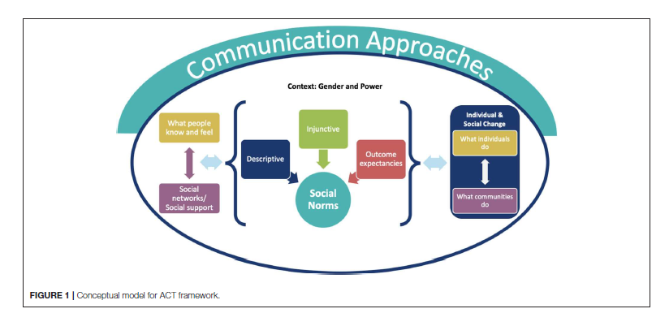
Through activities described in the article (e.g., meetings with social norms and FGM field experts across the world), the ACT framework was refined and developed using an interactive and iterative process. The framework includes a menu of constructs, indicators, methods, and tools that can be adapted according to available resources, the local context, and research limitations. It adopts a social-ecological perspective to change and was constructed using various social norms theories, both in general and specific to FGM. To that end, social norms are at the heart of the conceptual model for the framework (see above), surrounded by their components: descriptive norms (beliefs about what others do), injunctive norms (beliefs about what others think), and outcome expectancies (rewards and sanctions).
ACT is an acronym for the different sections of the framework. Both the "A" and "C" cover the specific constructs that must be measured to examine social norms change; for each construct, indicators and means of verification (quantitative structured interview tool, qualitative and participatory focus group discussion, and in-depth interview guides) are provided. Each indicator is associated with a specific set of questions and qualitative activities, and researchers can select the indicators they want to use depending on their programmatic goals, resource constraints, and evaluation needs. The "T" of the ACT framework refers specifically to the larger monitoring and evaluation (M&E) process. (See Tables 3-5 in the article for the indicators.) The steps are as follows:
- Assess what people...
- Know: The indicators focus on measuring the level of correct, factual knowledge concerning FGM among the population: the types of FGM; the risks of FGM; and the degree to which knowledge of legal, moral, and religious norms is harmonised. The structured interview tool is described.
- Feel: The indicator topics are: reasons why participants feel FGM exists; negative beliefs toward FGM; support of FGM abandonment; intention not to cut daughters; intention to marry uncut women; and self-efficacy to abandon FGM in the face of social pressure. Described here are methods such as the complete the story activity, which uses hypothetical vignettes (either pictorial or verbal stories/scenarios) that participants react to or resolve.
- Do: This is an examination of actual behaviour by measuring the prevalence of FGM and where households fall on the continuum of change. The latter indicator is measured using a composite index (described in the ACT framework package) created from all know, feel, and do indicators.
- Ascertain normative factors: This section provides indicators to measure injunctive norms, descriptive norms, and outcome expectancies (see Table 3). One participatory, mixed-methods tool for examining norms and outcome expectancies is the 2 × 2 tables for social norms, wherein participants work through two 2 × 2 tables that ask about abandonment and continuation of FGM.
- Consider the context, especially gender and power: Two indicators in the ACT framework focus on measuring the level of empowerment women experience: the proportion of women who exercise agency, and the degree that women are a part of decision-making in the family environment. To that end the structured interview tool assesses agency across three areas: mobility, freedom from family domination, and security and contribution to family support. Gender norms indicators are: the percent of the population who hold progressive gender role beliefs, and the percent of the population who hold egalitarian beliefs about men and women. Participants can fill out "gender boxes" by writing the qualities, roles, and behaviours expected of a "typical" woman and "typical" man - both in general and relative to FGM.
- Collect information on social networks and support: Social networks indicators focus both on the degree to which FGM is discussed in general and the degree to which participants discuss the gender norms upholding FGM. In the ACT framework, social support is operationalised in terms of the number of relationships that offer actual social support in the form of information support (advice) and instrumental support (supplies and services) toward FGM abandonment. Participants might be asked to identify different types of people they discuss FGM with at different levels of the social ecological model (family, peer, community, and social). Among these contacts, participants are then probed for who the allies and barriers to communication are and whom they would turn to for support regarding FGM.
- Track individual and social change over time: Output indicators focus on the direct activities of the programme, such as the number of radio shows aired or the number of meetings held with community members. One suggested method provided in the ACT framework for measuring outputs is content analysis, which is a set of techniques to analyse the messages and materials distributed as part of the programme. Short-term outcomes focus on whether, and to what extent, the intended audience actually engaged in the communication activities of the programme (i.e., with the outputs). The structured interview tool contains sample questions for radio, TV, print publications, social media, and interpersonal counseling. Respondents are asked whether they have heard of FGM abandonment through each channel.
- Triangulate all data analysis: This section includes information on how data triangulation is built into the ACT framework as well as why triangulation is important during M&E (e.g., validation of data, enrichment of data, holistic interpretation of data, and fostering a feedback loop). As noted here, participants may be more apt to reveal personal information in the in-depth interview and focus group formats (vs. in a structured interview), where participatory activities can build rapport among facilitators and participants and spark ideas.
As of this writing, the ACT framework is being validated in two countries in Africa where FGM is practiced. Following the validation, several meetings will be held with data collectors, field experts, and others to finalise the tools and framework as a whole. The hope is that "communication efforts to address FGM related social norms will better target the social norms and behaviors of the highest impact in any given context....Aside from its immediate uses, in the long run, this framework will serve as a means to conceptualize and measure the role of communication efforts to address social norms associated with other harmful traditional practices, most notably child marriage, open defecation, and violence against children." A final goal is "to contribute to the field of global communication as a whole by examining the role of communication efforts vis a vis attribution and contribution toward social and individual change."
Frontiers in Communication. 5:29. doi: 10.3389/fcomm.2020.00029.
- Log in to post comments