










































The CORE Group Partners Project in North East Nigeria: Community Engagement Strategies to Combat Skepticism and Build Trust for Vaccine Acceptance
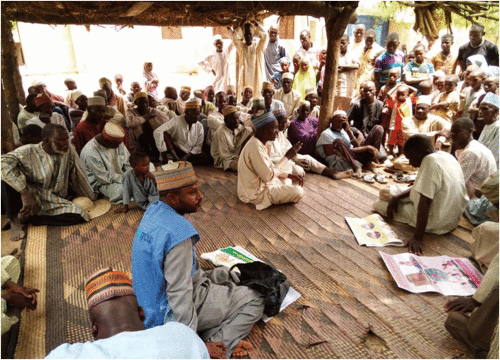
CGPP/Nigeria (Usman); CGPP (Bologna, Stamidis)
"The CGPP has gained the access and trust of these communities by implementing strategies that contribute to stopping rumors before they start and quelling rumors rapidly once they begin to take shape."
In North East Nigeria, anti-immunisation rumours and sentiments have negatively impacted the country's polio eradication efforts. Since 2014, the CORE Group Partners Project (CGPP) has leveraged local-level strategies to help change prevailing attitudes and behaviours by improving immunisation acceptability in difficult settlements in Nigeria's states at high risk for polio. This article, which is part of a series of articles detailing the work of the United States Agency for International Development (USAID)-funded CGPP (accessible through Related Summaries, below), documents the various strategies used to address noncompliance and provides examples of community engagement in Yobe state.
Volunteer community mobilisers (VCMs) are the foundation of the CGPP efforts in Nigeria. As of September 30 2018, there were 2,205 VCMs and 264 volunteer ward supervisors in the 5 high-risk states Kaduna, Kano, Katsina, Borno, and Yobe, covering 598,781 households. All VCMs are women who are selected by and from their local communities and then trained and supervised by the CGPP and its partners. VCMs are assigned households in their community and are responsible for making frequent visits to speak with caregivers about polio immunisation and routine immunisation, aiming to dispel misconceptions and mobilise the caregivers in their communities to immunise their children. They do this by establishing personal relationships with the families they serve, building trust and serving as sources of information. Among their other activities: VCMs regularly track the number of new births in their settlements and attend naming ceremonies (suna), where they administer OPV to the newborn.
A central challenge to these efforts has been posed by Boko Haram, which has launched violent attacks in Northern Nigeria and in the neighbouring countries of the Lake Chad basin region. The fundamentalist Islamic group has targeted and killed polio workers, disrupted polio campaigns, and damaged or destroyed health facilities. As a result, in May 2013, the Nigerian President declared a state of emergency in Yobe, Borno, and Adamawa states. Moreover, Northern Nigeria has historically experienced large-scale rejection of polio immunisation initiatives because of widespread rumours, myths, and religious beliefs. The 2003-2004 polio immunisation boycott in Northern Nigeria fueled further outbreaks of polio. In 2017, an outbreak of monkeypox was rumoured to have been linked to the polio immunisation programme and led to resistance in some communities. In some areas of Northern Nigeria (as well as in Cameroon), some people have erroneously come to believe the polio immunisation can cause sterility in women.
Immunisation coverage has always been low in the North East Nigeria, and Yobe and Borno states have been the most affected by the Boko Haram insurgency. At the time the CGPP began its work in 2014 in Yobe state, the population coverage of the third dose of oral polio vaccine (OPV3) was 27.2%; diphtheria, pertussis, and tetanus (DPT3) coverage was 11.0%; and the coverage of the third dose of pentavalent vaccine was 7.8%, whereas the national coverage levels were considerably higher.
In this context, the CGPP's communication model in Nigeria, in part, emphasises the need to counter suspicion and address myths and misunderstandings by convening community dialogs and compound (neighbourhood) meetings and by conducting face-to-face interactions using CGPP information, education, and communication (IEC) materials. Examples provided in the article illustrate the impact of such efforts to resolve cases of noncompliance in Yobe state; in one case, the effect of word of mouth was instant: the very next day after a 90-minute session, 58 of 102 children from 35 households obtained their polio immunisation.
In April 2018, the CGPP joined the government and other polio eradication partners such as the United Nations Children's Fund (UNICEF) to launch the African Vaccination Week under the umbrella theme of "Vaccines work. Do your part!" The CGPP supported message development for use in IEC materials, and it generated awareness and understanding through advocacy and social mobilisation activities.
The CGPP has also recognised the critical role of men as decision makers in the communities in its implementation areas and has sought to find ways to engage them, especially those who are gatekeepers (e.g., traditional, religious, and educational leaders). One example of male engagement is the Iftar Intervention, which involved training male religious leaders and other male gatekeepers to deliver supportive immunisation messages following evening prayers held during Ramadan.
"A critical area of CGPP expertise is the development of context-specific messages in the local language that resonate with families. The solid knowledge of VCMs about polio, child health, and community needs along with the strong relationships that VCMs have with families help to make VCMs effective in community mobilization."
In the communities in Kaduna, Katsina, Kano, Borno, and Yobe states located in the CGPP implementation areas, there has been a consistent reduction in the number of missed children and consistent improvement in polio immunisation uptake, providing evidence of the effectiveness of the CGPP communication model. An example of data shared in the article: According to the CGPP evaluation reports, OPV0 coverage increased from 54.8% in 2014 to 99.0% in 2018, and OPV3 coverage among children aged 12-23 months increased from 47.2% in 2014 to 62.3% in 2017 and 88.4% in 2018.
As reported here, the CGPP has also made significant contributions to the polio surveillance network in the 5 states where it is working, engaging 792 community informants in addition to the VCMs. By the end of 2018, 18.3% (41 cases) of the total 224 identified acute flaccid paralysis (AFP) cases were reported by CGPP-supported VCMs and community informants.
In conclusion: "The last case of wild poliovirus in Nigeria [which is the last polio-endemic country in the African region] was detected in August 2016. Since Nigeria has gone more than 3 years without a case of wild poliovirus, the CGPP communication model promises to remain highly relevant in sustaining the community's awareness about immunizations that will be required to keep the population coverage of polio immunization high and, by extension, the herd immunity required to maintain zero transmission of poliovirus in Nigeria."
American Journal of Tropical Medicine and Hygiene, 101(Suppl 4), 2019, pp. 68-73 https://doi.org/10.4269/ajtmh.19-0143; and emails from Gena Thomas to The Communication Initiative on August 24 2022, September 8 2022, and September 14 2022. Image caption/credit: In Yobe state, Bulatura ward, the men of the Sunomari settlement convene for a community dialogue led by the coordinator for Yusufari local government area. Photo credit: Ramatu Musa Idiriss, CGPP Volunteer Ward Supervisor.
- Log in to post comments