










































Smart Client and Smart Couple: Digital Health Tools to Empower Women and Couples for Family Planning
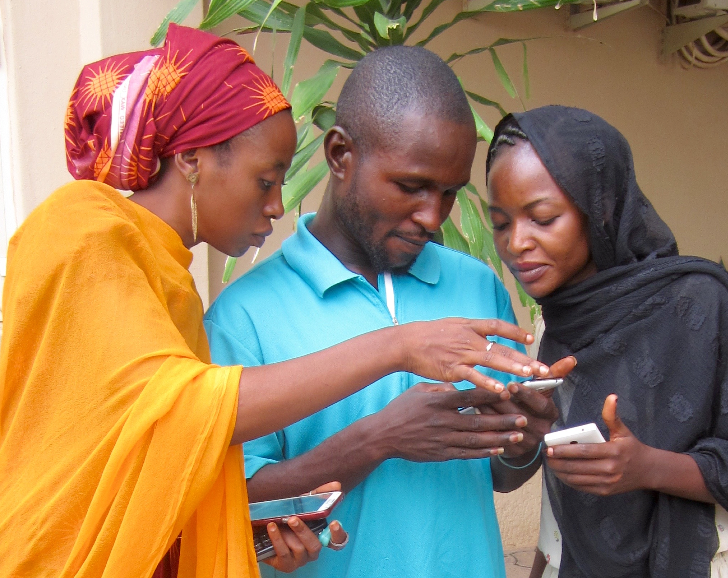
Smart Client and Smart Couple are digital health tools developed by the Health Communication Capacity Collaborative (HC3) that are designed to provide users with entertaining content about family planning (FP) to help them become informed, empowered, and confident users of family planning services and methods. In particular, the tools are intended to give women and men information in order to facilitate more effective FP decision-making communication before, during and after a counselling visit.
The Smart Client and Smart Couple tools consists of 17 voice calls, each of which includes different segments such as a drama, chats by the male and female hosts, a personal story, and sample dialogue. The content is delivered via mobile phone using interactive voice response (IVR) technology which allows users to select the content they want to hear by pressing keys on their phone keypad. In addition, after each call, users receive a short message service (SMS) message either with a reminder about the key message from the previous call or a prompt to discuss content from the previous call with their partner.
These tools are intended to be adopted as an "add-on” component to existing family planning programmes in resource constrained settings. They can be used in both demand generation and service delivery programmes that would like to incorporate a client-focused intervention in improving client-provider communication. As such, the digital health tool would be especially appropriate for use alongside provider-focused interventions aimed at improving provider communication and counselling skills.
The two tools share much of the same content, but there is a slight difference in the intended audience and additional content in the Smart Couple tool. Whereas the Smart Client tool is designed for female users, the Smart Couple tool is intended for couples. As such, the Smart Couple tool features additional content directed toward men and messages encouraging couple communication and equitable participation by both male and female partners throughout the process of deciding about and adopting family planning methods.
The tools consist of four parts:
- Part 1: Background and Description - provides the background for the tools, vision and objectives, details about the audience and behavioural objectives, and information about key aspects of the tools.
- Part 2: Smart Client Scripts: Characters, Scripts, and SMS - These scripts were written for the testing and user study in Kaduna, Nigeria, and therefore include terminology and names appropriate for the local context in Kaduna. The scripts were also translated into Pidgin, Yoruba and French. The content is designed to be adapted for different countries (see adaptation guide below).
- Part 3: Smart Couple Scripts: Characters, Scripts, and SMS - as above.
- Part 4: Adaptation Guide - The purpose of this guide is to share insights with those interested in adapting Smart Client or Smart Couple scripts in another setting, either using the content as is or making modifications.
English, Pidgin, Yoruba and French.
HC3 website on October 30 2017.
- Log in to post comments