










































Humanitarian Futures for Messaging Apps
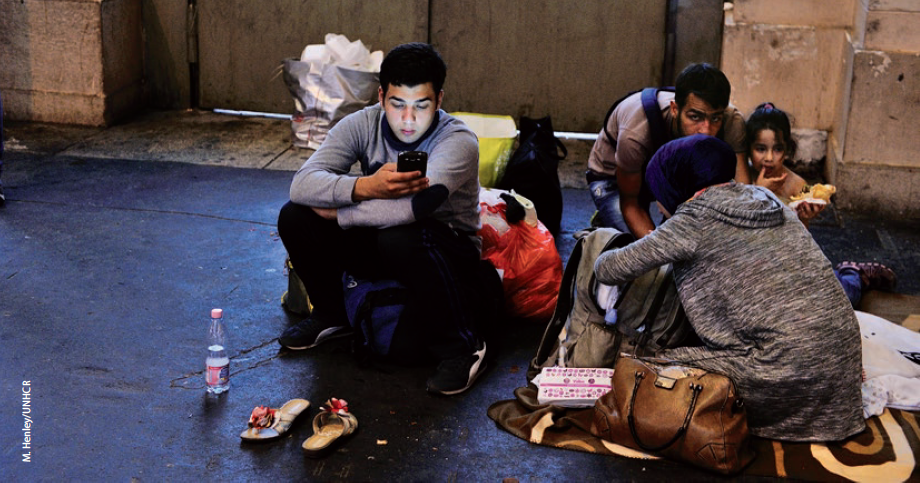
"How and why are people affected by crises or armed conflict actually using messaging apps? When and how is it appropriate to introduce a new technology that not everyone will be able to access? Could communicating with people through these communication channels put them at greater risk?" - Tom Walker, Research Lead
These are some of the questions explored in this report on the current and potential uses of mobile messaging applications (apps) such as Facebook Messenger, WhatsApp, and Snapchat in humanitarian situations. The International Committee of the Red Cross (ICRC), together with The Engine Room and Block Party, undertook research to help humanitarian organisations better understand the opportunities and risks in order to develop responsible, effective, and safe ways to use messaging apps to meet the needs of people affected by armed conflicts around the world - internally displaced people (IDPs), refugees, or migrants. The report was drafted with support from an advisory group including colleagues from the International Federation of Red Cross and Red Crescent Societies (IFRC), the UN High Commissioner for Refugees (UNHCR), the UN Office for the Coordination of Humanitarian Affairs (UNOCHA), and the World Food Programme (WFP).
As the report notes, humanitarian organisations recognise that if their work is to be relevant and effective, it is vital to engage with and make themselves accountable to people affected by crises. Studies have found that timely, actionable, trusted information - provided in the right format, in the right languages, and through appropriate channels - can save lives, help people access the support they need, and improve their resilience in crisis situations. "Although the vast majority of humanitarian responses and funding programmes focus on environments affected by armed conflict, the implications of engaging with communities in these settings are less well-known and documented....In today's armed conflicts, the information environment is increasingly contested and misinformation, propaganda and rumours travel more swiftly than was previously the case. In order to identify relevant approaches for communicating in these situations, humanitarian organizations need to understand more clearly how all these challenges affect their operations." Experience also suggests that humanitarian organisations need to pay more attention to how crisis-affected communities actually find, use, and share information and adjust their activities accordingly. In this context, humanitarian organisations cannot ignore the growth of apps - mobile-phone-based software programmes that allow people to send text, images, audio, and video to their contacts' phones over an internet connection. Today, more than 2.5 billion people around the world use apps, a figure that is expected to rise to 3.6 billion by 2018. These apps have not only become regular communication tools but are even becoming platforms where people can directly access services offered by other organisations, such as receiving news updates.
This report discusses the implications of adding messaging apps as a potential channel for humanitarian organisations to consider as part of the range of communications channels they currently use, which include face-to-face communication, print materials, short messaging service (SMS) messaging, social media, radio, and television. It identifies areas where there is a need for standards for using messaging apps in crisis situations and suggests preliminary steps towards a "responsible data" approach, which can ensure that humanitarian initiatives respect individuals' rights to consent, privacy, security, and ownership. The report is based on a survey of relevant literature, interviews with staff working in humanitarian organisations, representatives of messaging app companies, and organisations that focus on providing technology for humanitarian organisations. In total, researchers spoke with more than 45 people working in Asia, Europe, sub-Saharan Africa, and the Middle East.
Here is an overview of the report's recommendations, which are given in full in Section 5.
- General principles:
- Conduct detailed, locally focused research into factors affecting how crisis-affected groups use and share information. On this basis, organisations can determine whether using a messaging app is appropriate in that situation.
- Systematically include questions on access to and use of mobile telephony into humanitarian needs assessments.
- Ensure that any use of messaging apps forms part of a multi-platform, multi-channel communications strategy rooted in a deep understanding of the local information ecosystem.
- Put in place strategies and processes for using messaging apps well before they are needed in a humanitarian crisis.
- Humanitarian futures for messaging apps:
- Conduct thorough research into factors that affect messaging apps' accessibility and usability. As with any technology, messaging apps can exacerbate inequalities associated with gender, age, literacy, and experience with technology, as well as access to energy, mobile phones, and network connectivity.
- Build in enough flexibility to allow for iteration and adaptation in response to feedback.
- Take note of the fact that deploying messaging apps may be the easy part; building trust with communities is much harder. Developing strong local relationships depends on providing effective on-the-ground support, accompanied by information that is up-to-date, timely, actionable, and trustworthy.
- Privacy, security, and data protection:
- Assess what data and metadata different apps collect and whether the collection of that data could increase risks (and the type of risks) to individuals or groups if a particular app was used in a given country or region.
- Aim to select apps with end-to-end encryption enabled by default, run by organisations that collect and retain minimal amounts of data and that have a strong record of resisting unlawful demands for private data from law-enforcement and other agencies.
- Collect the minimum amount of data needed to conduct operations and emphasise to users that any data they submit is never fully secure. All data collected, generated, and stored by humanitarian agencies is very sensitive and should be given the strongest possible protection.
- Ensure your organisation has and complies with a data protection or responsible data policy. This should proactively address the intersecting issues of consent, data protection, organisations' ethical obligations, and privacy rights and should identify measures to mitigate risks wherever possible.
- Implementation:
- Consider how your organisation will manage and respond to the information it receives. Messaging apps can introduce large quantities of data from many different sources. Without proper planning, this can overwhelm organisations, increase the risk that organisations fail to respect users' privacy, and frustrate local communities who find that their questions and complaints are not being acknowledged or addressed.
- Prepare to invest considerable time and resources in verifying and validating any information received through messaging apps.
- Collaboration with partners:
- Work with local media to tailor messages and promote humanitarian services.
- In urban areas, consider network connectivity as a basic urban service that needs to be restored. Restoring connectivity can enable people to reconnect with their own communities and others (including humanitarian organisations) and better organise their own response.
- Consider collaborating directly with messaging-app companies.
Communication for Development Network and Engine Room website, both accessed on February 3 2017. Image caption/credit: At Keleti Railway Station in Budapest, Hungary, a refugee checks his phone. © M. Henley/UNHCR