










































Young People Today, Time to Act Now
UNESCO
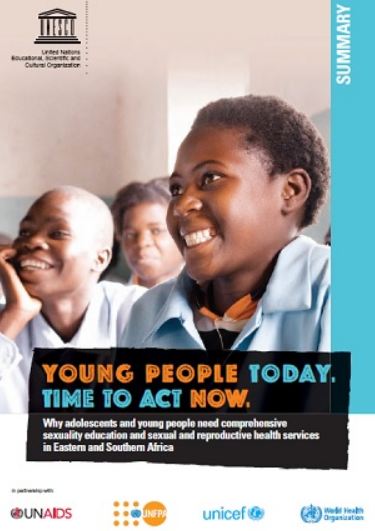
This 96-page report is the summary of an in-depth Regional Report into the education and sexual reproductive health status of adolescents and young people in Eastern and Southern Africa (ESA). This report was developed to provide a regional assessment of the current status of HIV and sexuality education and Sexual and Reproductive Health (SRH) services for adolescents and young people, and to provide an evidence base for discussion related to policy change and programming. According to the publication, better education and public health measures can be hugely beneficial to young people’s health and development.
The report offers a number of different observations:
- Access to education: The official primary net enrolment rate stands at 87% for both boys and girls, although there are regional variations. However, the completion rates of primary schooling remain a concern in a number of countries, and secondary school enrolment rates are not only considerably lower than primary school but show a gender disparity. In the majority of countries, secondary school completion is at very low levels – below 20%. In Angola, only 14% of girls were expected to make the transition to secondary school. This sharp drop-off in school enrolment at secondary level is mirrored in a number of countries, including those where primary school access has improved considerably. As a result, most children and young people in the region are completing less than 6.5 years of education, which is inadequate in terms of the cognitive and other skills needed for the transition to young adulthood or the world of work.
- Children affected by HIV and AIDS: Despite the overall decline in AIDS mortality in the region, there are an estimated 10.5 million children living in the ESA region who have lost one or both parents to AIDS. Despite increased access to treatment, numbers of orphans due to AIDS will continue to increase particularly in parts of sub-Saharan Africa. HIV and AIDS continue to impoverish families, threaten children’s schooling, nutrition, and mental health, and increase children’s risk of abuse and exploitation. Global analysis of HIV related vulnerability show that double orphans usually have worse educational attendance than non-orphans and that poverty intensifies the impact of HIV and AIDS on children’s lives. Research from South Africa shows that children orphaned by AIDS and those living with a parent with AIDS, face greater risks of emotional, physical, and sexual exploitation than other children.
- Child marriage: In Eastern and Southern Africa, the United Nations Population Fund (UNFPA) estimates that 34% of women aged from 20–24 years old were married or in union by the age of 18. Many countries in the region are making some progress towards eradicating child marriage, including Ethiopia, Lesotho, Rwanda, Tanzania, Uganda, and Zimbabwe. Despite this trend, however, the practice remains prevalent in some parts of the region and has direct negative consequences for the health, education, and social status of girls and young women.
- Sexuality, risk, and decision-making: The age at sexual debut is a key indicator when considering health outcomes, particularly when making programming choices about education or services. Significant numbers of girls are childbearing by the age of 15. By the age of 17, at least 10% of young women in 10 countries in the region have started childbearing. The types of relationships that adolescents and young people are engaged in also have an important impact on their sexual and reproductive health. Multiple and concurrent partnerships and inter-generational sexual relationships are both recognised as drivers of the HIV epidemic in the region; in three countries (Lesotho, Madagascar, and Swaziland) more than one in four young men aged 15–24 report being involved in multiple concurrent sexual relationships. Transactional relationships are also common and further disempower the receiving partner, usually girls or young women.
- HIV knowledge levels:A trend in the region has shown that knowledge about HIV prevention is increasing among young women and young men. In Rwanda, for example, the proportion of young women with comprehensive knowledge of HIV prevention rose from 23% in 2000 to 51% in 2009. However, in general, young people’s knowledge levels regarding HIV remain low, with less than 40% of young people in the ESA region having sufficient knowledge about HIV prevention. The regional average of comprehensive knowledge of HIV and AIDS stands at 41% for men and 33% for women. The average for sub-Saharan Africa is 26% for females aged from 15–24, which is still far below the 2010 target of 95% comprehensive knowledge set at the United Nations General Assembly Special Session on HIV/AIDS in 2001.
- Teenage pregnancy:Data from across the ESA region show that adolescent fertility rates remain persistently high at 108.2 live births per 1,000 girls aged 15–19. This is two times higher than the world average, which is 53.4 per 1,000 girls. The rates are especially high in Uganda, Zambia, DRC, Malawi, and Mozambique. In Malawi, for example, more than 50% of women had given birth by the age of 20. Adolescent pregnancy often brings detrimental social and economic consequences for a girl, her family and the broader community, especially if it leads to a girl dropping out of school.
- Maternal mortality: Medical complications from pregnancy and childbirth are among the leading causes of death for girls aged 15–19 globally. By investing in overall strengthening of peri-natal care programmes and, in particular, focusing on the way that adolescents and young women can be reached, rates of maternal mortality and complications such as fistula can be significantly reduced. A combination of factors impacts on adolescent women. For example, in Zimbabwe, 4% of girls are married by the age of 15, which increases to 30% by the age of 18. An estimated 38% of maternal deaths are related to AIDS.
- Sexual and gender-based violence: In most ESA countries, the age of consent for sex is above 16 years and the minimum legal age for marriage is above 18 years. Despite these restrictions, however, over 10% of girls had their sexual debut before the age of 15. By comparison, adolescent girls in developed countries may initiate sexual activity at the same age or younger – the difference is in the protective factors in their environment, including education and health services. A high percentage of women report having experienced sexual violence at some point in their lives: between 15 to 35% in the nine countries for which data are available. The rates are higher for women aged 20–24 than those aged 15–19.
Defined and often labelled in many different ways, sexuality education usually involves teaching and learning on issues relating to human sexuality. Comprehensive sexuality education (CSE) emphasises a holistic approach to human development and sexuality. Evidence has shown that CSE that is scientifically accurate, culturally and age-appropriate, gender sensitive, and life skills-based can provide young people with the knowledge, skills, and efficacy to make informed decisions about their sexuality and lifestyle. In order to fully exercise their right to health, including SRH, all adolescents and young people require safe, effective, affordable and acceptable access to a range of services – particularly services related to pregnancy, HIV and STI prevention, testing and treatment.
The report makes the following recommendations:
- Recognise the changing realities in the lives of adolescents and young people: globalisation, access to new communications technologies, rapid urbanisation, and changes in social norms are all factors confronting the region's adolescents and young people with new realities. These changing realities are reflected in relationships, decisions about sexual behaviour, and the transition to adulthood. Despite a range of policy-level commitments on reproductive health in general, there is value in having an open, frank and evidence-informed discussion that examines the realities facing young people and recognises the opportunities and challenges this brings.
- Scale up comprehensive sexuality education: Just 30% of girls and boys in the region have adequate knowledge of HIV in ESA. Education has the responsibility, authority, and ability to reach every adolescent and young person in the region with a minimum package of good quality HIV and sexuality education that can make a difference to knowledge and skills levels and the uptake of services. Scale up across three critical dimensions makes a difference: coverage (number of schools reached/teachers trained); quality (programme fidelity); and depth (political and community support). It will be important to reach both practising and pre-service teachers with training, support supervision, and the materials they will need.
- Take action early through education: Early adolescence (age 10–14) is a key stage in the life cycle and in terms of the entry points for education that will make a difference to key health and social outcomes. In education terms, this highlights three issues: 1) the necessity of sexuality education at upper primary school level; 2) the importance of reaching adolescents before and during puberty; and 3) before they leave the education system altogether. Successful interventions at this stage have the potential to impact positively on social norms (e.g. gender equality and norms) as well as sexual decision-making (if and when to become sexually active or refusing sex), as well as the skills to protect themselves against HIV transmission or other STIs and prevent pregnancy.
- Maximise the protective effect of education: It is a key determinant of a number of health and social outcomes, including reduced HIV risk, reduced maternal mortality, and improved gender equality. Low completion rates in primary school mean that not all children and young people are being reached with the necessary formal education and many of them will not have access to HIV or sexuality education before they become sexually active. Ensuring that girls complete primary school and make the transition to secondary school has even greater benefits, including delaying sexual debut, preventing early marriage and postponing childbearing.
- Integrate and scale up youth friendly HIV and SRH services: For most young men and women, preventing pregnancy is more of an immediate concern than protecting themselves from HIV infection. However, the high rates of HIV as well as high rates of unintended pregnancy mean that dual protection and programmes that address both SRH and HIV together are critical. The advantages of integration are now beyond doubt: allowing young people access both HIV and SRH services under the same roof or in the same facility increases the opportunities for a continuity of care..
- Eliminate barriers to access for all young people: Identifying those populations that are most marginalised and most at risk is a necessary first step to developing appropriate and accessible services. These groups may include, but are not limited to: rural communities, particularly girls within these communities, where school access and health services are most sparse; married adolescent girls who are often ‘invisible’ to mainstream SRH services; adolescent key populations, including young men who have sex with men, sexually exploited adolescents and young adults who sell sex who have a heightened risk of contracting HIV.
- Strengthen gender and rights within education and services: Deeply held norms around gender in the region are a strong barrier to improving sexual and reproductive health for young people. Early marriage, social expectations of girls’ behaviour, higher school drop-out rates, and inequality within relationships all create a dynamic where girls and women are often not in control of their own sexuality and health. Public leadership (political, religious and cultural) must tackle what is harmful while celebrating what is positive and affirming. Education and health need to intensify their focus on reducing violence in and around school contexts, where it remains a defining feature of life for too many girls and young women. This includes addressing more than sexual violence to tackle the less obvious forms of abuse, harassment or discrimination that makes a classroom or school playground unsafe.
- Work together around a common agenda for adolescents and young people: The education and health sectors must take the joint lead and mobilise their common strengths to develop, plan and deliver CSE and SRH services that will make a decisive change.
UNESCO website on November 12 2013.
- Log in to post comments