







































One Stop Model of Support for Survivors of Gender-Based Violence: Lessons Learnt from CARE Zambia
CARE
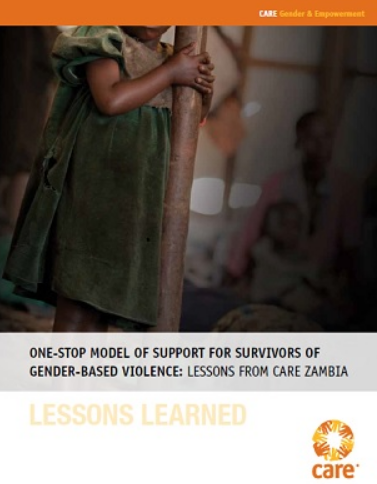
This 12-page case study shares the experiences by CARE International and its partners from the development of a one stop model of service delivery for survivors of gender-based violence (GBV) in Zambia. From 2005-2011, CARE led the development of Coordinated Response Centers (CRCs) where survivors could access medical, psychological, and legal support under one roof. The main goal of the coordinated response model is to increase survivor safety and perpetrator accountability by coordinating and linking core services, including providing immediate to longer term health care, access to police and legal services, and culturally and age appropriate counselling services. According to the case study, coordinated response models, or "one-stop" services represent a promising model for providing comprehensive care to survivors, offering medical, legal, and psychosocial services either within one location — a hospital or a stand-alone centre — or through a referral system that links services.
Building on similar models of comprehensive care in South Africa, Kenya, Malawi, and Uganda, CARE and partners developed a one-stop model of Coordinated Response Centers (CRCs) through a pilot GBV project funded by the European Union from 2005 to 2007. This model was then expanded and further developed through 'A Safer Zambia' (ASAZA), a CARE-led project funded by United States Agency for International Development (USAID). Eight one-stop CRCs were set up in seven districts, embedded into a network of government (health and police) and non-governmental (counselling, legal, shelter) services. CRCs provide direct services which focus primarily on medical services, psychosocial, and paralegal counselling, and also refer clients to social services, support groups, and shelters. According to the report, each model had advantages and disadvantages, i.e the stand-alone setting is more private and more flexible in terms of use of space than hospital settings, and can be located in remote areas where other health centres or hospitals may not be easily accessible. However, in the stand-alone model, medical staff is not available 24 hours a day, and survivors need to be driven and escorted to a health facility for services not available at the stand-alone centres.
Along with providing services, the ASAZA project sought to reduce the incidence of GBV in Zambia through a combination of ensuring a greater knowledge of and changed attitudes towards gender inequalities. The prevention element consisted of an intensive three-year period of media awareness campaigns, community education and mobilisation activities designed to increase knowledge and change attitudes and behaviour regarding gender among men, women, service providers, leaders, youth, and children. Participants found the multi-faceted community mobilisation platforms helped bring attention to GBV issues and reduce stigma for women who reported abuse.
A client satisfaction survey was also conducted in 2011 to collect views from GBV survivors regarding the quality of services at various service points. Five CRCs (Chipata, Kabwe, Mazabuka, Mtendere and Livingstone) were selected for the survey after considering the rural-urban mix and provincial distribution. Areas which were reported to need improvement were as follows:
- In certain CRCs, there were too few rooms for counselling and other services. This contributed to long queues outside the CRC instead of inside seating. Others felt that some counselling rooms were too small.
- Some survivors felt uncomfortable in the counselling sessions and felt that they lasted too long.
- Clients raised the importance of a clear case handover process among counsellors so that clients are not left waiting when their counsellor is not in the office.
Lessons Learned on One-Stop Models of Survivor Services to inform and improve quality of future programming were identified as follows:
- With broad-based awareness-raising on GBV, there also must be commensurate broad-based capacity building of local service providers so that survivors can receive quality care within their localities, without having to travel a significant distance to the nearest CRC. Due to sensitisation activities in the communities, especially through radio and TV, the number of survivors coming to CRCs from distant places increased, and therefore the CRCs did not have adequate resources to follow-up on these cases.
- There is a need for additional training, support, and mentoring for counsellors, particularly on topics such as child counselling, couples counselling, and addressing HIV-related issues. Specialised support tailored to the needs to child survivors is especially important. Consistent with data from other GBV service centres across the region, children make up a large percentage of survivors seeking services at CRCs. Staff should receive on-going and refresher training, mentoring and support to provide the best possible care to survivors, to inform staff of emerging issues and approaches, and to increase staff knowledge and reduce burnout.
- Clearly marked, stand-alone centres offering services exclusively for GBV survivors are likely to be known as such within communities, and thus risk stigmatising people who are seen entering these premises. One-stop centres for GBV support services that are located within government buildings or departments with other functions, such as health clinics and hospitals, and integrated into existing services, such as for sexual and reproductive health, are less likely to expose and thus stigmatise those who access services.
- Evaluations of ASAZA highlighted the problematic reliance on volunteers to provide core services (counselling and paralegal), given the challenges of retaining volunteer staff and keeping them motivated in the face of high time demand, heavy case loads, and potential secondary traumatisation. More research is needed to evaluate promising practices to improve the retention of community health workers, caregivers, and other community volunteers. In addition, there may be opportunities to formalise the role of volunteers by aligning them with the Ministry of Health’s broader plan for sustainable health human resources, e.g. Zambia’s National Community Health Worker Strategy.
- To ensure quality of care in CRCs, quality assurance mechanisms should be built into programme design and adapted or enhanced as necessary during implementation. Examples of quality assurance mechanisms that proved effective in ASAZA include: client satisfaction surveys to assess client experiences of care, CRC Advisory Councils, ongoing training and mentoring of counsellors, developing standard protocols for counselling sessions, and developing safety plans for survivors.
- An on-going challenge is that most CRCs do not provide 24-hour care, which can have negative implications for survivors, particularly with regard to accessing timely medical services. There is a need for greater linkages with the health sector to provide survivors with immediate access to PEP and EC, e.g. by locating GBV services or one-stop centres within hospitals and government health facilities. At a minimum, any centres without 24-hour services should aim to have a counsellor on-call during off hours and/or to offer a safe place where survivors can stay overnight to receive services in the morning.
- The lack of permanently assigned police and other government officers to support CRCs negatively impacted case follow-up. There is need to lobby for permanent personnel from these institutions. To ensure the sustainability of future GBV programming, it is critical to engage with local government ministries as well as non-governmental organisations and community-based organisations to integrate these activities into the national GBV response plan.
Care International website on October 13 2013.