










































Development Ceases When Women Are Silenced
ADRA Denmark
This 48-page development study, published by ADRA Denmark, is a documentation of the methodology and findings of action research carried out by journalists and citizen journalists on gender-based violence and inequality in Burundi and the Democratic Republic of Congo. According to the report, action research is participatory. The involvement of beneficiaries in the development of their own research topics and methods creates ownership over the research, and the prejudices and traditional thinking amongst the beneficiaries themselves are being challenged. Both countries have been greatly affected by armed conflict for decades, and violence, not least towards women, is used as the main means of conflict resolution.
ADRA Denmark and local ADRA partners in Burundi and the Democratic Republic of Congo focus on the empowerment of women and community solutions primarily through the means of media and communication, especially radios which are widely used in the region. To strengthen the civil society in the two countries the organisations build 'Listening Committees', where women and men can make their voices heard inside their communities and among a wider public and the authorities. The project is using multiple communication channels to ensure that the lessons learned will be rooted and benefit practitioners at local, national, and international levels. One of the efforts to ensure shared and in-depth learning is action oriented research, which took place in the second half of 2012. This report shares the action research methods developed, lessons learned, suggested advocacy themes inspired by the action research, as well as summaries of the overall findings from all research teams in Burundi and the Democratic Republic of Congo.
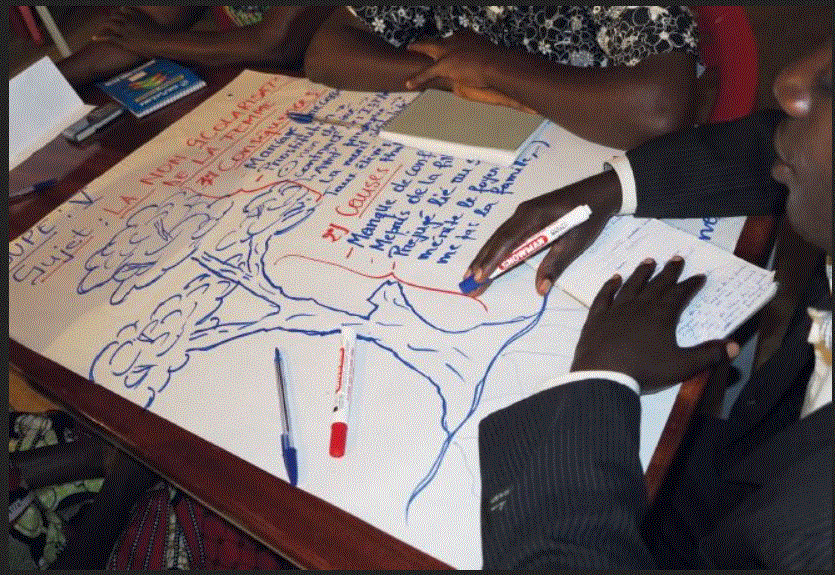
The methodology included a workshop, interview training, and the action research itself, as well as the development of a facilitator's manual with a variety of exercises and analytical tools. Ahead of the workshop the four research teams were established based on their geographic location, and the professional journalists were distributed into the teams. The action research workshops were carried out in dual languages. While translations from English to local languages and vice versa took time, it guaranteed optimum understanding by all participants. The workshop was largely participatory, and included exercises such as a SWOT analysis on the strengths and weaknesses of using mass media and problem trees, as well as identifying thematic research areas. The report explain that action research is a confusing concept to most, and that while it should be as participatory as possible, if you make the whole process participatory, there is no clear direction to provide to the participants from the beginning, and many people resist this insecurity. As well, when working in a country with several languages, and when the participants have very different educational levels, it is important to communicate in a language understood by all at the same time. It is also very important to be aware of the needs of all and pay special attention to those who risk becoming excluded. All participants should be encouraged to ensure that all of their team members understand and are equally engaged.
The study found that many inequalities in Burundi revolve around Burundians having been married in churches in neighbouring countries during the war. When these couples return to Burundi, the Burundian authorities do not recognise these ‘religious weddings’ as legally binding. As a result the women and their children are not protected by the Burundian family law. Many domestic conflicts concern the right to influence what to buy and sell in the household and situations where men have removed all belongings from their original household to those of their mistresses. When the women bring property cases, violence and rape cases for justice, they are rarely taken seriously, because the legal system and the authorities are male dominated. The research findings underline how dependent women are on their husbands in Burundi. When a husband leaves his wife, she and her children have no means for survival. In addition, children react with fear, repulsion, and anger when they see their mothers being beaten up on a regular basis, and they themselves learn the language of violence. In spite of all of this, one action research team concludes that there has been a positive development for women after 2008. By looking into official statistics the team found that there appears to be less polygamy today, and domestic violence seems to have decreased a little. Civil society organisations and institutions working in the field of women's rights have helped the women develop a more powerful voice in the public sphere; and Burundian women have finally got access to employment in the administration and are, thereby, breaking the male domination in public offices.
The report offers several suggested advocacy activities, which arose from the action research teams in Burundi:
- Advocate for women's rights towards the different levels in the decentralised system, which offers many opportunities for effective advocacy towards policy-makers, decision-makers, and law-enforcing agencies.
- Advocate for equal rights to property and inheritance among men, and especially young men who are not yet married.
- Advocate towards authorities to influence them to raise awareness of the necessity of registration, and to make them lower or eliminate the fee for marriage registration.
- Advocate towards the government to automatically turn religious marriages already entered in Tanzania and other places into legal marriages.
- Advocate towards women to make them aware of their rights – legally and as women.
- Advocate towards the legal system to influence it to take cases filed by women – married as well as unmarried – seriously.
- Advocate for a revision of the Code Personnes et de la Famille from 1993 to make it update with increased sanctions against men who break the law.
- Advocate that inheritance for women is being covered by Burundian law.
The finding in the Democratic Republic of Congo show that much of the differential treatment of women in the eastern part of the country happens due to values, norms, and practices. According to the research, a woman from the Ituri Province cannot take a decision during a family meeting; women in this province cannot eat chicken, eggs, termites, grasshoppers, the meat of wild animals, pork, and fish; a woman cannot be the head of local administrative units; she cannot decide to sell household goods; men feel free to have several women as men are considered superior; and a woman is not allowed to interfere when her daughter is getting married. A woman is considered an object and inferior to men, thus she is forced to work non-stop without a break. She risks domestic violence and sexual intercourse without consent; she is not allowed insight into financial matters; underage girls are being married for money, as the bride price brings money to the girl's family; and some women engage in prostitution in order to gain some financial stability. The consequences are, amongst others, that women feel humiliated, become sick, receive less food, have no money at their disposal, and face early marriages and early pregnancies. Most of the interviewees agree that poverty is a factor in the oppression of women, and the main means to combat poverty is education. However, young girls are not always sent to school. According to a Congolese nurse, the lack of family planning and the many unwanted pregnancies also hinder development. The women themselves play a role too, concludes one Congolese government official: "Organisations working in favour of women really have a lot of work to do. This is all about convincing women that they themselves have to combat the customs that prevent their development."
The report offers several suggested advocacy activities, which arose from the action research teams in the Democratic Republic of Congo:
- Advocate for women's rights towards the different levels in the decentralised system, which offers many opportunities for effective advocacy towards policy-makers, decision-makers and law-enforcing agencies. Advocate for equal rights to property and inheritance towards men, and especially young men who are not yet married.
- Advocate towards authorities to influence them to raise awareness of the necessity of registration, and to make them lower or eliminate the fee for marriage registration. Advocate towards the government to automatically turn religious marriages already entered in Tanzania and other places into legal marriages.
- Advocate towards young unmarried men and women, that men and women have the right to the same types of food, to inheritance if the spouse dies, etc and advocate towards the authorities that men, who continue to practice behaviours aiming at sustaining inequality and gender based violence are punished.
- Advocate that laws maintaining gender inequality are changed and become in keeping with the constitution as well as advocate that women are encouraged to take on the responsibility as Chef in local authorities, and that men are supportive of this.
- Advocate against forced and early marriages, against child prostitution, including the harmful effects of such practices and the importance of secondary education and free education for all, including girls.
Email from Lotte Ladegaard on January 30 2013 and Refugee Archives website on July 6 2013.
- Log in to post comments