










































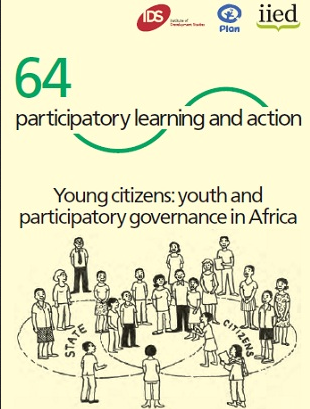
Young Citizens: Youth and Participatory Governance in Africa
Plan UK
This issue of Participatory Learning and Action (PLA) highlights how young Africans are driving change by challenging the norms and structures that exclude them, engaging with the state, and demanding accountability. PLA is an ongoing series sharing field experiences, conceptual reflections, and methodological innovations in participatory learning. This issue comprises contributions from practitioners across Africa, and is intended to demonstrate the persistence, passion and enthusiasm that youth bring to governance processes, driving change in creative and unexpected ways. It highlights how young Africans are addressing the documentation gap that surrounds youth and governance in Africa and enabling other participatory practitioners – young and old – to learn from their experiences.
Published by the International Institute for Environment and Development (IIED), Plan UK, and the Institute of Development Studies (IDS) this edition of PLA was largely developed during a workshop in March 2011, which brought together a group of adults and young people involved in youth and governance initiatives across Africa to take part in a "writeshop" in Nairobi, Kenya. The idea behind the week-long meeting was to share learning and experiences, build writing skills, form new relationships, and develop a set of articles for this issue of PLA. Participants also worked closely together to define the key messages and objectives of this special issue.
According to the publication, participants at the Nairobi workshop expressed that young people's experiences with governance processes often lack depth, being treated as a ‘token’ young person, condescended to by adults and not treated with respect, which leads to frustration of being present but not being heard and having no real influence on decisions. Yet, it has become increasing evident that organised citizens play vital roles in governance by articulating concerns, mobilising pressure for change, and monitoring government fulfilment and performance of services. As existing, formal institutions of accountability often fail them, a growing range of citizen-led mobilisation, activism and demands, known as social accountability, is developing.
Such forms of citizen engagement and social accountability are particularly promising for those whose voices are not easily heard in formal policy and governance processes, including young people. However, experience so far suggests that some voices, including those of young people, often get left out, just as they do from formal, electoral, political representation processes. Contributors to this issue argue that children and young people, despite their demographic weight, are traditionally, culturally, legally, and structurally marginalised from decision-making processes. Seeing like a young citizen is crucial to the task of youth advocates. This means understanding how young people perceive and experience engagement with governance processes and structures. Through dialogue and exercises, participants at the Nairobi workshop identified four key themes, which are the 4 sections that the writers’ contributions are organised around.
- From youth presence, voice and visibility to youth influence and rights - The publication states that even when approached from the least political, most technocratic angle, there is a strong argument for involving young people in governance. If policies, plans, and budgets are to be relevant to youth, they need to be informed by their realities, priorities, and perspectives. However, many initiatives designed to involve young people have increased young voices in governance spaces, but not young people’s influence over decision-making – so their participation may be tokenistic. Contributors emphasise opportunities presented through You Tube, digital and social media, and call attention to gender considerations and self-confidence to promote effective participation.
- Rejuvenating spaces for engagement - There is a need to look at how the status of adults and young citizen actors within it differ, as well as differences in status between young citizens of different ages. Seeing like a young citizen reveals that there are some governance and accountability spaces that youth tend to be ‘naturally’ shut out of. In others they have little interest in participating. Then there are youth spaces, where older people are rare visitors, but which lack ‘teeth’ or influence. The question is: what kind of space is most promising for young people's participation? Contributors share experiences in creating new youth-focused structures or platforms, as well as advocating for the inclusion of youth in governance processes.
- Learning citizenship young - Policy and governance spaces are learning spaces. In them young people can acquire a set of expectations about their right to participate and their power to bring about change by doing so. They can also acquire the skills and experience required to operate effectively in these spaces, ensuring they are better placed to participate as adult citizens in the future. Many of the experiences documented in the publication are cases of ‘learning by doing’. Groups of young people experiment with ways of engaging in and influencing decision making, and more formal or adult-dominated organisations support them and learn alongside them. While young people often need training to engage successfully, they also need to build confidence. Successful engagement can embolden them to engage further, as many of the articles show.
- Power to young people? - All contributors agree that social accountability is inherently political because it seeks to redress power imbalances. Even making services more accessible and their providers more accountable means a re-negotiation of power relations, which is a political act. However, the political context often poses serious challenges for social accountability work. In the politically charged environments in much of Africa today, youth are continually co-opted by the politically powerful. The publication explains that the processes of social activism and citizen engagement described by contributors seem to suffer from political cycles, and particularly elections. Some articles suggest that elections actually had served as obstacles to democracy, if democracy is understood as democratic practices of citizenship at the local, everyday level.
The publication concludes that contributions show that participating in governance and policy processes is re-shaping the way young people perceive and exercise citizenship in powerful ways. There is vibrancy, energy, persistence, passion, and enthusiasm of youth that can be capitalised on to drive change in creative and unexpected ways. It is particularly valuable in governance work, where the context is often rapidly evolving.
International Institute for Environment and Development website on December 5 2012.
- Log in to post comments