










































Connected Agriculture: The Role of Mobile in Driving Efficiency and Sustainability in the Food and Agriculture Value Chain
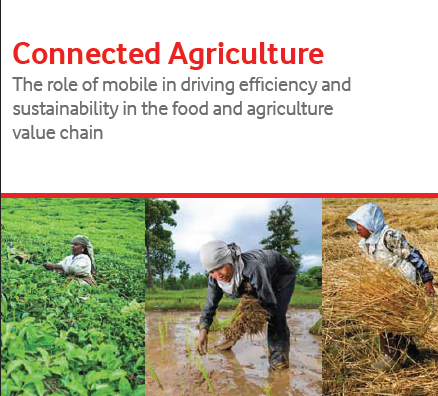
In this 39-page report, Vodafone and Accenture, working in collaboration with Oxfam GB, identify 12 opportunities for mobile phone technology to increase agricultural income and productivity. According to the report, mobile communications can help to meet the challenge of feeding an estimated 9.2 billion around the globe by 2050. The 12 specific opportunities explored in this study could increase agricultural income by around US$138 billion across 26 of Vodafone's markets in 2020. This report was produced to stimulate the engagement between mobile operators, governments, non-governmental organisations, and businesses to realise these opportunities and explore others.
The report suggests that mobile services can enable companies to access and interact directly with different participants in the value chain, helping to build visibility of issues, capacity, and quality. The greatest potential benefits can be generated by enabling mobile financial payments and mobile information provision, each delivering almost 40% of the total estimated increase in agricultural income. This study focuses on 12 opportunities that deliver broad socio-economic and environmental benefits, in four key areas.
Improving access to financial services
- Mobile payment system: a low-cost, secure and quick way to transfer money to other individuals or businesses and accrue savings to invest in better agricultural inputs.
- Micro-insurance system: a convenient and affordable way to buy micro-insurance against crop failure when buying seeds and fertiliser, and to receive payouts.
- Micro-lending platform: a platform to secure loans from distant investors to buy seeds, tools, machinery or animals to improve output.
Provision of agricultural information
- Mobile information platform: farmers receive text alerts direct to their mobile phone, tailored to their location and the crops that they grow.
Farmer helpline: farmers use their mobile phone to call a helpline staffed by agricultural experts, giving them immediate advice.
Improving data visibility for supply chain efficiency
- Smart logistics: using mobile devices to collect data on the location, speed, and route of food distribution trucks, helping distributors improve fleet management.
- Traceability and tracking system: using mobile to record movements of items through the agricultural supply chain, from farms to shops.
- Mobile management of supplier networks: agricultural field agents visiting farms can use mobile phones to record data on farm conditions and expected yields.
- Mobile management of distribution networks: retailers can use mobile phones to keep records of sales of agricultural inputs like seeds, fertiliser, and chemicals.
Enhancing access to markets
- The agricultural trading platform: an online marketplace for farmers to trade directly with buyers via their mobile phone.
- The agricultural tendering platform: a mobile platform for agricultural customers and suppliers to post and respond to tenders for work and agree contracts.
- The agricultural bartering platform: a mobile platform where community members can exchange goods and services with each other.
The reccomendations outline how mobile network operators have a leading role to play in the successful realisation of the benefits outlined in this study, but they will need the collective support of key stakeholders across the agricultural supply chain. NGOs, private enterprises, and governments must also contribute their knowledge and expertise to bring critical elements together. Building local relationships will be crucial in helping smallholder farmers to access and benefit from mobile services. Engaging local stakeholders will help to ensure that both the content provided and the services used to deliver this content are tailored to their markets. Some services will need to be adapted for specific regions and, in some cases, specific crops to maximise the benefits.
Pilot projects are important for testing new products and services with customers in local markets, helping mobile operators improve knowledge and understanding, as well as gaining credibility with diverse stakeholders. The successful delivery of these opportunities will also require a supportive regulatory environment. Governments have a vested interest in providing such support, with potential tax revenues from successful initiatives and the social and economic benefits generated which could, for example, alleviate pressure on support systems.
Vodaphone website on July 11 2012.