










































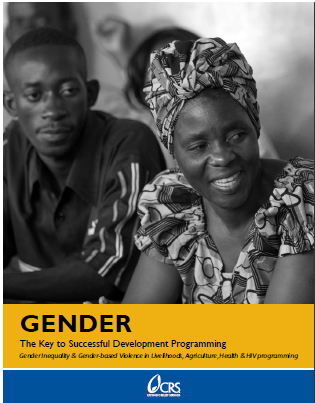
Gender: The Key to Successful Development Programming
Catholic Relief Services
The purpose of this study is to understand how the gender dynamics in communities served by Catholic Relief Services in Southern Africa (CRS) are related to the organisation's programming. It is intended to inform practitioners how to address gender in their programming to achieve specific programmatic objectives and those of the wider agency mission. The paper argues that the collective experience within the world of international development has shown that in order for the wider goals of poverty reduction and economic development to be achieved, men and women must be engaged in the quest for gender equality. In fact, gender equality is not merely an intrinsic objective alone. The consistent engagement of men and women is an essential component objective. As stated in the report: "Gender programming must not become monopolized by a focus on women, but understand the role of men and masculinity, and the impact that gender norms and relations has on men and women as well as boys and girls."
The Integral Human Development (IHD) framework is a tool to help design programmes that address gender inequality. This framework recognises that the ability of individuals, households, and communities to realise their full potential "is determined by the assets available to them as well as the systems and structures that control the environment in which those assets can be used... A person can be advantaged or disadvantaged, constrained or strengthened, by virtue of being male or female in any given circumstance."
The ultimate goal of the IHD framework is to provide the level of analysis needed to develop appropriate strategies for improved outcomes. Different approaches to address disparities are referred to as gender justice, gender equity, or women's empowerment: addressing historical exclusion and bias, accountability of institutions, and women's participation in leadership are key.
Below are recommended responses and good practices for programming in three development areas, several which address communication issues such as advocacy, engagement and participation, decision-making, and education.
Gender-Based Violence
- Design programmes to prevent and respond to gender-based violence;
- Promote state reform in health, justice and education sectors;
- Engage and enlist civil society and local leaders; and
- Design community-based interventions specific to key target groups.
Gender Livelihoods and Agriculture
- Conduct analysis of gender and livelihoods;
- Balance household resource allocation for overall wellbeing;
- Promote and link to social protection, state and communal;
- Promote broad-based state policies and programmes to assist women;
- Improve access to extension messages and gender responsive agricultural technologies;
- Build collaborative support for improving productivity for women’s crops and activities;
- Enable women farmers to reach national and international markets;
- Enable institutions to secure women's access to and ownership of land;
- Build collaborative gender-balanced decision-making in farmer organisations; and
- Support and strengthen women's farmer groups.
Gender, Health, and HIV
- Ensure that HIV programmes respond to practical gender needs and strategic interests;
- Foster understanding of masculinity and femininity and engage on gender norms;
- Address key factors - economic opportunities, food security, education and health;
- Integrate gender messages into education;
- Ensure that health programmes meet the comprehensive needs of women and men; and
- Global health initiatives should improve policies and funding to improve gender equity.
Key findings of a 2009 CRS process in Southern African further help to define programme and strategy vis-à-vis gender equality:
- Gender is contextual but not static – gender analysis is crucial;
- The family is the centre of change and progress in gender equality;
- Communities require space for sensitisation and reflection on norms;
- Ensuring equitable participation of men and women, and the leadership of women, are still critical challenges in programming;
- Understanding the role of men and boys is an imperative in achieving gender equality;
- Children and youth can develop new approaches to gender roles and relations;
- Vulnerable women and children require protection to prevent recurring cycles of violence and poverty; and
- Integration and coordination of services in all programmes can collectively respond and transform gender relations towards development objectives.
CRS Technical Resources website on January 6 2012.
- Log in to post comments