










































NetWorks
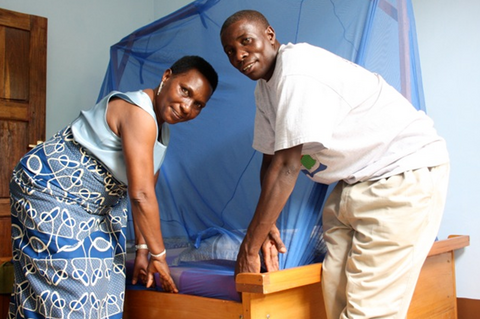
Key components of the NetWorks programme include an initial analysis of the country context, stakeholder coordination, policy refinement, strengthened distribution networks, demand creation and promotion, and monitoring and evaluation. These components are designed to mutually reinforce each other and create a sustainable system for ensuring increased access and use of LLINs at the household level. Strategies differ between countries, but overall there are three key strategic programme areas:
Net Distribution
According to Networks, the programme strongly supports a mixed-methods approach to LLIN distribution, dependent on local circumstances and the country context. A strategy may include a combination of mass distribution to scale up rapidly to universal coverage coupled with a continuous distribution system to sustain high coverage. In most cases, a mix of public sector distribution via health facilities for pregnant women and young children, combined with some form of civil society partnership for increased community-wide access is preferred for long-term sustained access. NetWorks is helping to identify clear roles for public and non-public sector partners such as the private sector and faith-based organisations (FBOs). NetWorks partners provide training where needed to break bottlenecks, strengthen supply chains and community reporting mechanisms for improved management monitoring, and identify subsidy opportunities for expanded private sector roles where appropriate.
Behaviour Change Communication (BCC)
NetWorks is working to strengthen demand creation using behaviour change communication to close the gap between ownership and use. This includes producing and disseminating mass media messages on LLIN use. For example, in Senegal, NetWorks is leading BCC activities for the universal coverage distribution; training and providing job aids to UC volunteers; producing and disseminating radio and television spots on LLIN use; and developing a net care and repair toolkit. This includes using community radio and local celebrities as a central medium for communicating messages. NetWorks is also conducting research on the impact of BCC and BCC programmes in the key countries, as well as facilitating consultations. In February 2011, NetWorks facilitated an expert consultation meeting for Roll Back Malaria to examine ways that the malaria BCC community can ensure high quality BCC activities are well-described in countries' global fund applications, documented in a brief note on the impact and contribution of BCC to malaria control with best practices for developing strategic BCC and a set of sample indicators.
Research, Policy, and Advocacy
NetWorks is establishing a regular process of evaluating results and implementation strategies to feed new information into decision-making via regular review process, coordinated dissemination of results, and use of results in advocacy. According to Networks, national decision-makers need credible information and a supportive advocacy environment in order to establish policies for effective distribution and use. For example, the NetWorks project has collaborated on the design and implementation of mass and continuous distribution systems, and with the National Malaria Control Programme in Nigeria on post-campaign evaluations that build the evidence base around integrated and stand-alone campaigns. In Tanzania, NetWorks is conducting formative research in Kagera and Zanzibar on messaging to encourage community members to use nets in the context of reduced malaria transmission settings.
The NetWorks website provides updates about the programme, as well as materials for download.
Malaria
In Senegal, The NetWorks project, in partnership with the National Malaria Control Program (NMCP), PMI and other partners, has successfully achieved Universal Coverage in six regions of Senegal. A total of 1,362,141 nets were distributed between June 2010 and April 2011. Mass distribution will continue in two additional regions, Diourbel and Fatick, between April and June 2011, delivering 1,360,000 nets. The next phases will continue until every household at risk in Senegal has a net to cover every sleeping space.
Johns Hopkins Bloomberg School of Public Health Center for Communication Programs (JHUCCP), Malaria Consortium, Catholic Relief Services, Mennonite Economic Development Association (MEDA), London School of Hygiene and Tropical Medicine (LSHTM), International Procurement Agency (IPA), and the United States Agency for International Development
NetWorks website and JHUCCP website on September 20 2011.
- Log in to post comments