










































Enviromobile Bus
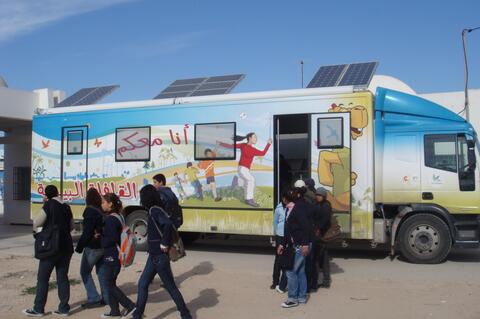
The Enviromobile is a multi-coloured bus with the Arab slogan "El Kafila el Biîa - Ena Maakom" (The environmental caravan - count me in) painted on the side, which drives around Tunisia visiting schools. The communication concept is based on action learning and uses the AIDA principles: Attention, Information, Desire, and Actions. Inside the bus, students work on environmental topics interactively. Around the bus, environmental workshops take place in which children learn simulations with teaching aids. The trainers illustrate topics related to water resources, energy, biodiversity or the relationship between energy consumption and climate change, waste management, waste water treatment, climate change, or biodiversity in different regions in Tunisia.
According to GIZ, both cognitive knowledge about the environment and individual experiences for responsible action are at the centre of the Enviromobile experience. The individual experience is undertaken through the implementation of a 6-month microproject by environmental clubs in each of the visited schools. The environmental clubs are headed by teachers who themselves are trained and informed on environmental topics and in the use of the "Enviro-mallette". The Enviro-mallette contains a set of documents, CDs, posters, games, and paedagogic factsheets dedicated to help the teachers responsible for the environmental clubs animate it throughout the year. All materials are in classic Arabic, and the animations take place in Tunisian Arabic.
NGOs help initiate the environmental school clubs and implement micro projects, as well as prepare for the visit of the Enviromobile. Pupils can follow the route of the Enviromobile and download Enviro-mallette materials from the Arabic-French Enviromobile website.
According to GIZ, a key part of the project strategy is the integrated implementation strategy, which combines action learning, partnership with local NGOs, implementation of micro projects involving the community, and media coverage. This strategy also includes cooperation of diverse actors (led by a steering committee and a management unit ), a well-planned process (with a preparatory and an implementation phase), as well as a will to innovate and learn (through the use of interactive paedagogic instruments, the strengthening of local NGOs, and the integration of environmental contents in curricula through extracurricular activities). GIZ adds that these principles form the key factors of the organisation's change management process, entitled the Capacity Works model: strategy, cooperation, steering structure, processes, learning, and innovation.
Environment
Between April 2008 and April 2011, the Enviromobile visited more than 300 schools across Tunisia, reaching over 30,000 pupils with information on environmental topics. Around 8,000 pupils have implemented over 270 micro projects, while over 780 teachers of relevant matters as well as about 100 teachers responsible for the environmental clubs have been trained. In each of the visited schools, an Enviro-mallette was distributed and is in use by the environmental school clubs.
For more information contact:
Dominique Thaly
Tunisian German Programme for Environmental Protection, Deutsche Gesellschaft für
Internationale Zusammenarbeit (GIZ)
Dominique.Thaly@giz.de
Deutsche Gesellschaft für Internationale Zusammenarbeit (GIZ) GmbH, Tunisian Ministry of Environment, Tunisian Ministry of Education and Academics, Spanish Agency of Cooperation and International Development (AECID).
Email from Dominique Thaly to Soul Beat Africa and the Enviromobile website on May 3 2011.
- Log in to post comments