










































Condoms and CFLs: Environmental Behavior Change Lessons from Public Health

Population Action International (PAI)
This 16-page paper explores ways in which public health behaviour change strategies can inform environmental behaviour change communication (BCC) on individual, community, and policy levels. Specifically, examples of health behaviour strategies frequently used in HIV/AIDS literature are highlighted to draw parallels between HIV/AIDS prevention and climate change mitigation.
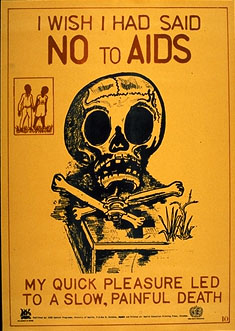
The authors examine messaging schemes employing the Grim Reaper used briefly in Australia in 1987 and a 1980s-era advertisement from Uganda illustrating the conflation of AIDS with death. "Both the Australian and Ugandan campaigns were intended to scare the public into safer behaviors and also to show that HIV was a non-discriminating killer....However, neither campaign provided information about HIV/AIDS nor suggested new behaviors effective in preventing HIV acquisition or transmission, and essentially only increased fear."
Based on evidence presented here, the claim is made that fear-based messages are ineffectual; "[s]uccessful HIV/AIDS interventions, therefore, are often based on health behavior theories which inform skill and capacity building associated with disease prevention..." The authors explain the following theories that have been developed based on this perspective, and provide relevant examples from HIV/AIDS literature.
Individual-Level
- According to the Health Belief Model (HBM), a health-promoting behaviour will either be enacted (or not) based upon: the degree to which an individual feels susceptible to a specific health threat; the level of severity attributed to the threat; the degree to which the behaviour is believed to be beneficial in preventing or ameliorating the threat; the ease with which the behaviour can be carried out; and an individual's belief in his or her capacity to enact the behaviour ("self-efficacy"). In the HIV/AIDS research context, the HBM has been used most frequently to predict protective behaviours such as condom use.
- Within the Theory of Reasoned Action (TRA) and the Theory of Planned Behavior (TPB), a behaviour is predicted by: an individual's intention to perform the behaviour; positive or negative attitudes towards the behaviour; behavioural beliefs (an individual's appraisal of the outcomes of the behaviour); and normative beliefs (an individual's subjective evaluation of the social acceptability of the behaviour). The authors cite a study comparing the HBM and the TRA that showed that the TRA better predicted men's consistent condom use due to its consideration of peer influence ("normative beliefs construct"). Further, they explain, perceived behavioural control has been shown to be a significant factor in predicting condom use, supporting the TPB as a better model than the TRA in this context.
- The Stages of Change Model assumes that behaviour change proceeds through these steps: pre-contemplation (not planning to perform a given behaviour within the immediate future); contemplation (intending to enact a behaviour in the near future and considering the costs and benefits of that specific behaviour); preparation (planning to enact a behaviour in the immediate future and creating a plan to do so); action (enacting behaviour change); and maintenance (continuing a specific behaviour for at least six months). Additional constructs such as self-efficacy and "decisional balance" (the positive and negative aspects of performing a behaviour) help explain and predict movement through these stages. The authors assert that this model "is particularly useful for grouping individuals based on similar personal characteristics in relation to HIV preventive behaviors (e.g., level of current condom use). In this way interventions can be tailored to specific group needs."
Community-Level
- Diffusion of Innovations Theory focuses on the process by which an innovation - a new idea, behaviour, or object - is adopted and spread throughout a given population. On this theory, new practices are spread through 5 steps: innovation development; dissemination; adoption; implementation; and maintenance. The theory also recognises various categories of innovation adopters, from innovators and early adopters to more change-resistant groups or individuals termed "laggards". The STOP AIDS campaign among gay men in San Francisco, California, United States during the 1980s provides an example of this theory in practice. The programme disseminated information on HIV risk and preventive measures (e.g., monogamy and condom use) through small group informational sessions. Early adopters began implementing the recommended prevention behaviours, which then spread throughout the gay community. The programme also turned to opinion leaders (respected community figures) to further the spread of knowledge and preventive behaviours.
- Social Marketing is the application of general marketing strategies to the promotion of healthy behaviours, attitudes, and health-related commodities (e.g., condoms), with the main objective of effecting voluntary changes in the behaviours of a population. This goal is achieved through mass media; information, education, and communication (IEC); subsidised prices for health goods; and commercial brand promotion. Furthermore, Social Marketing attempts to remove the barriers or costs preventing the enactment of a behaviour (including product price and access to services). In contrast to the Grim Reaper campaign (referenced above), the authors point to programmes such as the "100% Jeune" social marketing campaign in Cameroon, which is built around a perceived need to provide accurate information as well as substitutes to risky behaviours. Designed to reach adolescents, this programme used both mass media and interpersonal communication methods to promote consistent condom use with sexual partners. In addition to Social Marketing, this programme incorporated constructs from both the HBM and the TRA.
Policy-Level
- Structural interventions can be implemented to indirectly change individuals' behaviour by directly changing the environment in which those behaviours occur. Examples of harm reduction strategies for injecting drug users are syringe exchange programs (SEPs) and safer injection facilities (SIFs). These interventions require policies removing barriers to syringe access; for example, in the United States, removing government restrictions on the acquisition of syringes without a prescription. "Both interventions have been shown to increase safe-injecting practices, most importantly for HIV/AIDS, the use of a sterile syringe for each injection." Another example is the "100% Condom Programme" implemented in Thailand during the 1990s, which required all sex workers to use a condom with every client in every sex work establishment. The programme also used Social Marketing techniques.
A simple behaviour, the replacement of standard light bulbs with compact fluorescent light bulbs (CFLs), provides an example of the ways BCC can be integrated into environmental behaviour change. On the individual level, promotion of CFLs focuses on direct individual benefits in terms of cost-effectiveness and reduced annual electricity expenditure. To expand the practice of this behaviour, Social Marketing strategies could be used to inform the public about the benefits of CFLs and to provide access to these products. Furthermore, Diffusion of Innovations Theory could help identify opinion leaders and change social norms related to light bulb use and, ultimately, energy expenditure. At a policy level, incorporating CFLs into building regulations would be a potential structural intervention to decrease energy consumption.
Other lessons from HIV/AIDS communication are also relevant to this example, the authors argue. For instance, based on the recognition that behaviour promotion aligned with dominant cultural norms will be more effective in eliciting change, communicators may recognise the predominant cultural value of consumerism in the United States. Therefore, strategies that emphasise smarter consumption (e.g., substitution of a CFL for a standard bulb) rather than reduced consumption may be more effective in that country. BCC in the public health context also points to the fact that effective communication strategies must be geared toward specific group needs. For example, various geographic locations have differing greenhouse gas contributions as well as commitment to climate change mitigation activities. According to the authors, the Stages of Change Model would be helpful for classifying individuals and groups; for example, individuals with no intention of changing their light bulb choice within the near future require very different behaviour change strategies than individuals who have made the decision to "go green" and need support to maintain this choice.
Moreover, if one of the most significant barriers to behaviour change is the perception that mitigation strategies will require drastic changes in individual lifestyles and will require considerable personal effort, it is suggested here BCC practitioners should focus on behaviours that are perceived as easily achievable and personally important. Focusing BCC on a behaviour like recycling, then, in a particular context has the potential to maximise the impact of behavioural messages.
Communicating the seriousness of climate change to the general public has also proven difficult; as the authors point out here, just as with HIV/AIDS, appeals based on fear have had inconsistent results. They point to the movie The Day After Tomorrow (2004), which portrayed catastrophic effects of global warming. A study showed that viewers were only marginally more concerned about catastrophic climate change after the movie. "This may be a result of viewers questioning the likelihood of the events in the movie, undermining the credibility of the film's message....Fatalism, or the perception that the magnitude of climate change is so great that mitigation efforts are futile, presents a significant barrier to public engagement in behavior change..."
Lastly, the authors highlight that strengthening existing and future programmes (both for HIV/AIDS and climate change) so that changes are maintained over time requires community involvement and strong political will in addition to individual commitment towards behavioural change.
In conclusion, "public health behavior change communication can support the adoption and sustained performance of mitigation behaviors....Utilizing knowledge and best practices garnered from other fields, including public health, will strengthen the effectiveness and reach of current mitigation campaigns as well as inform future interventions."
PAI's Research Commentaries, volume 3, issue 4. Image credits: first image © Ugandan Ministry of Health; second image © Greenpeace, 2004

- Log in to post comments