










































Community Media Index (CMI)
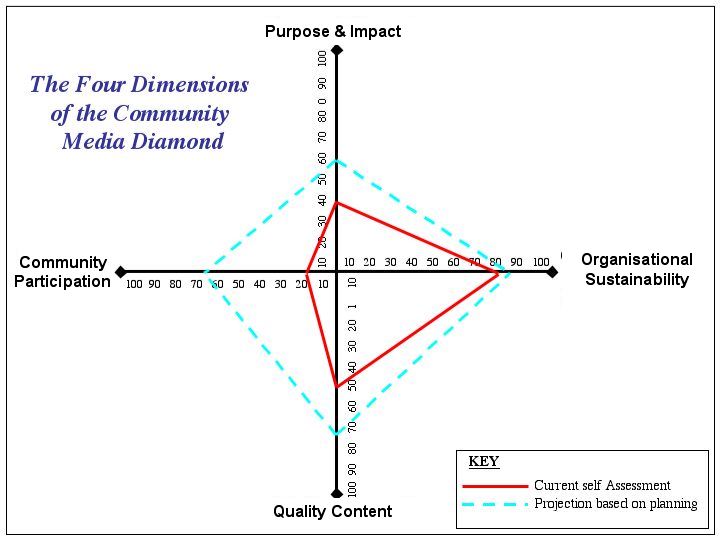
According to the developers, CMI can be seen as a lens - a common language or perspective. It can be applied once-off in specific contexts (as a strategic planning tool) or over periods of time (for planning and evaluation).
According to the producers, the CMI measures 4 dimensions of a media project that need to be assessed in order for a full and balanced picture of the state of the project to emerge.
- Purpose and Impact: This looks at a project's strategic assessment of its environment, the development of a vision and strategic goal, the extent to which the vision informs the project's activities, and the extent to which the project has actualised its vision in the period under review.
- Ownership and Control: This addresses the degree to which community stakeholders participate at all levels of the project. It reviews the ownership model, participation in management, planning, reporting, reflecting, and editorial/programming.
- Organisational and Financial Sustainability: This assesses the strength and functionality of an organisation's systems, including governance and decision-making, human resource development, financial management, and the ability of the project to develop and grow different income streams.
- Quality Content: This dimension assesses the extent to which the project's editorial/programming meets the information and expression needs of its community.
The CMI comprises 3 components or tools:
- Framing & Measuring Tools: According to the project website, a number of dimensions of organisational life will be identified to frame the Index and ensure that the assessment is holistic and does not privilege one critical aspect above another. For each dimension, a number of sub-dimensions will be developed to focus data gathering and deliberation. Within each of these sub-dimensions, a set of indicators will be developed against which stakeholders can assess the project's state and plan its growth.
- Data Gathering & Analysing Tools: This involves participatory processes for gathering information and making the assessments, facilitating consensus building, and including multiple voices and perspectives in the assessment.
- Reporting Tools: Reporting formats that communicate the Index assessment - the project's current state, movement from previous assessments, and new goals - in a clear and easily understandable way. These reporting formats will be critical to the extent that the CMI becomes a point of reference and learning guide for the project and stakeholders.
Click here to access these tools.
CMI was tested at 5 community radio stations in Limpopo province in May and June 2008: Botlokwa Community Radio, Mohodi Community Radio, and Zebediela Community Radio. Click here to access the reports, which offer a picture of these stations though the CMI lens.
Media Development.
According to the organisers, this process is not an academic initiative, nor is it intended primarily for national policy makers or institutions engaged in creating an enabling environment for the community media sector. While the information generated may well be of value to policy makers, service providers, and development planners, the primary beneficiaries of the initiative are the media projects and the communities they serve.
National Community Radio Forum (NRF), Alternative Information Development Centre (AIDC)
CMI website on April 3 2009 and May 18 2010.
Comments

Journalism
highly helpful. Wonderful work.
- Log in to post comments