










































Time to read
less than1 minute
Community Mobilisation: Degrees of Community Participation
From the United States Agency for International Development (USAID)-supported ACCESS-FP Program:
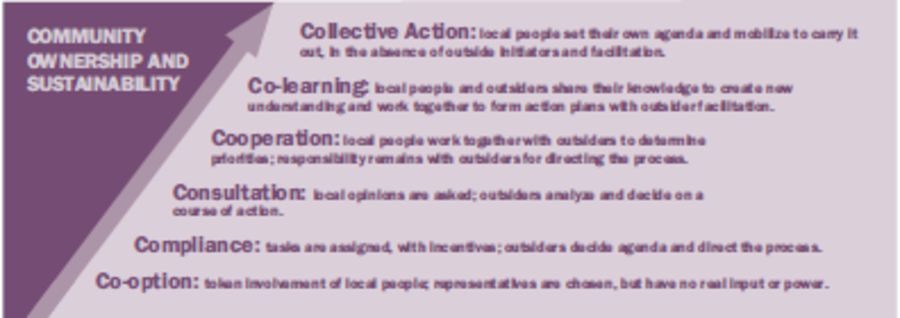
Co-Option: token involvement of local people; representatives are chosen, but have no real input or power.
Compliance: tasks are assigned, with incentives; outsiders decide agenda and direct the process.
Consultation: local opinions are asked; outsiders analyse and decide on a course of action.
Cooperation: local people work together with outsiders to determine priorities; responsibility remains with outsiders for directing the process.
Co-learning: local people and outsiders share their knowledge to create new understanding and work together to form action plans with outsider facilitation.
Collective Action: local people set their own agenda and mobilise to carry it out, in the absence of outside initiators and facilitation.
"All participation is not equal. Figure 1 shows increasing degrees of community participation, from the low end of co-option to the high end of collective action. As community participation increases, community ownership and capacity increase, with the result that community action and continuous improvement in the quality of community life are more likely to be sustained over time."
Click here to download the full source document as a PDF, and then scroll to page 6.
Co-Option: token involvement of local people; representatives are chosen, but have no real input or power.
Compliance: tasks are assigned, with incentives; outsiders decide agenda and direct the process.
Consultation: local opinions are asked; outsiders analyse and decide on a course of action.
Cooperation: local people work together with outsiders to determine priorities; responsibility remains with outsiders for directing the process.
Co-learning: local people and outsiders share their knowledge to create new understanding and work together to form action plans with outsider facilitation.
Collective Action: local people set their own agenda and mobilise to carry it out, in the absence of outside initiators and facilitation.
"All participation is not equal. Figure 1 shows increasing degrees of community participation, from the low end of co-option to the high end of collective action. As community participation increases, community ownership and capacity increase, with the result that community action and continuous improvement in the quality of community life are more likely to be sustained over time."
Click here to download the full source document as a PDF, and then scroll to page 6.
Source
"Demystifying Community Mobilization: An Effective Strategy to Improve Maternal and Newborn Health" [PDF], USAID/ACCESS, February 2007, pg. 6 - retrieved June 3 2008.

- Log in to post comments