










































Do Adolescent Girls' Education and Friendships Have Independent Effects on Early Pregnancy? Results of a Mediation Analysis from a Longitudinal Cohort Study in Nairobi, Kenya
University of California (Misunas); independent consultant (Soler-Hampejsek); Population Council (Kangwana, Haberland)
"By untangling the pathways between education and sexual and reproductive health, we can illuminate how education protects the health and well-being of young people, especially girls; understand the intersections with other multi-sectoral determinants; and better define the implications for policies and programs."
Few studies have examined whether the effect of education on pregnancy and childbearing is due to the academic skills acquired or the social environment that schooling provides. This paper explores whether adolescent girls' learning skills, school enrollment, grade attainment, and friendships affect risk of pregnancy, and whether friendships mediate the relationship between education and pregnancy. It does so by drawing on three waves of longitudinal data from the Adolescent Girls Initiative-Kenya (AGI-K) study conducted in Kibera, an urban informal settlement in Nairobi, Kenya between 2015 and 2019.
AGI-K was a randomised controlled trial (RCT) that delivered interventions over a two-year period to girls aged 11-15. To assess if and how intervening in early adolescence impacts outcomes for girls, the study tested different packages of a multi-sectoral intervention: Arm 1: violence prevention; arm 2: violence prevention + education; Arm 3: violence prevention + education + health; and Arm 4: violence prevention + education + health + wealth creation (the full programme package). Data were collected at baseline (prior to intervention) in 2015, after the intervention ended in 2017, and in 2019 (two years after the intervention had ended). For the current study, the analytic sample includes girls who were interviewed at all three time points (n = 1,993). The researchers used fixed effects regression models to estimate effects of girls' learning skills, school attendance, grade attainment, and friendships on their probability of experiencing a pregnancy. They conducted mediation analyses to assess whether friendships mediate the relationship between education and pregnancy.
By round one (2015), 0.1% of girls reported having experienced a pregnancy; by round three (2019), 6.3% did so. Even after adjusting for friendships, the researchers found that attending school decreases the probability of pregnancy by nine percentage points; an additional year of schooling decreases probability of pregnancy by three percentage points; and a one standard deviation increase in numeracy decreases probability of pregnancy by one percentage point. Having any male friends who do not attend school increases girls' probability of experiencing a pregnancy by four percentage points; this association remains after adjusting for girls' education. However, out-of-school girls are far more likely to report out-of-school male friends. There was no evidence that other types of friendships (e.g., female friends who were married or had given birth) affect girls' probability of becoming pregnant. That is, it appears that peer group norms or behaviours did not increase or decrease risk.
Overall, in this context, adolescent girls' schooling, learning skills, and friendships with out-of-school males independently influence their risk of pregnancy - with education being protective and out-of-school males being a potential risk. Per the researchers, the longitudinal nature of the data and the results of fixed effects regression analyses suggest that these relationships are causal.
Thus, the study's findings imply that keeping girls in school and ensuring they learn are not only important outcomes in and of themselves, but they have direct sexual and reproductive health benefits. At the same time, numeracy and grade attainment do not remove sexual and reproductive health risks that out-of-school male friendships bring, especially for out-of-school girls. These risks may need to be addressed through other interventions that address vulnerabilities and disparities in other dimensions of girls' lives. For example, in Kibera, qualitative research might shed light on the dynamics of out-of-school girls' relationships with out-of-school males and therefore help to inform choice of intervention (e.g., interventions that address power inequalities in relationships and sexual and reproductive health, shift inequitable gender norms, eliminate child marriage, or reduce girls' economic vulnerability).
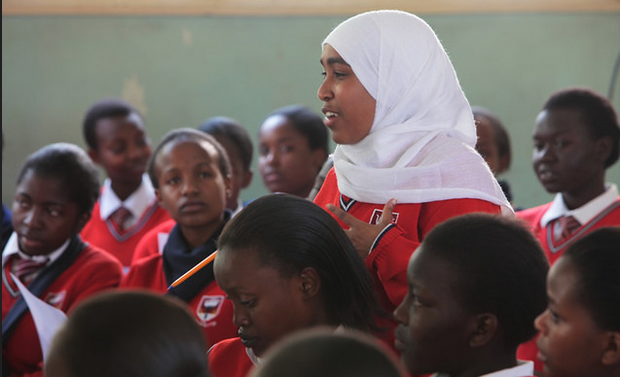
SSM - Population Health 25 (2024) 101618. https://doi.org/10.1016/j.ssmph.2024.101618. Image credit: Camerapix/Chiba Yasuyoshi/UN Women via Flickr (CC BY-NC-ND 2.0 Deed)
- Log in to post comments