










































Using Responsive Feedback in Scaling a Gender Norms-Shifting Adolescent Sexual and Reproductive Health Intervention in the Democratic Republic of Congo
University of California San Diego (Barker, Lundgren); Save the Children Federation (Gayles); independent consultant (Diakité); Save the Children International (Diantisa)
"As this case study demonstrates, RF approaches are vital to norms-shifting programs such as GUG, which seek to catalyze change within complex, dynamic systems."
It has been argued that dominant models of global health intervention programmes do not account or allow for the complexity and unpredictability inherent in implementation in dynamic environments. Thus, a number of complementary approaches have been established to guide implementers in how best to respond and adapt to complexity. One such approach, responsive feedback (RF), involves the use of responsive feedback mechanisms (RFMs), which are tools that support the learning process and adaptive thinking. This paper documents the RF approaches applied to the Growing Up GREAT! (GUG) intervention (known locally as Bien Grandir!) in Kinshasa, Democratic Republic of the Congo (DRC). It describes the RFMs used to adapt, pilot, and scale this gender norms–shifting intervention for very young adolescents (VYAs) aged 10-14 years over 6 years and draws conclusions about the value of applying RF to programme adaptation and scale-up efforts.
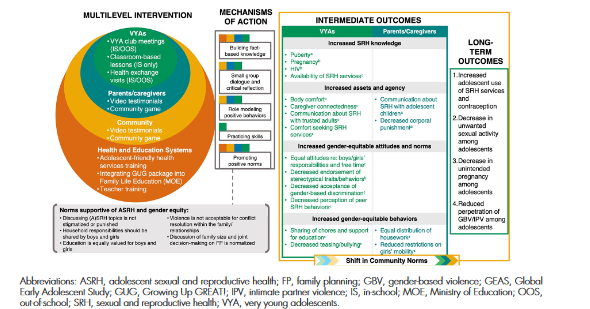
As explored at Related Summaries, below, GUG was designed as a scalable gender norms–shifting approach to foster a critical examination of inequitable gender norms, increase adolescent sexual and reproductive health (ASRH) knowledge and assets, and cultivate gender-equitable and nonviolent attitudes and behaviours among VYAs. From September 2017 to May 2018, Save the Children, in partnership with 8 local community-based organisations (CBOs), implemented the multilevel intervention by engaging VYAs, their caregivers, communities, teachers, and health providers.
- More than 2,300 VYAs participated in school and community-based adolescent groups that used a toolkit with interactive, age-appropriate materials to learn about ASRH and explore related social norms during weekly mixed-sex group sessions.
- More than 2,000 parents and caregivers participated in 6 hour-long reflective group discussions prompted by testimonial videos featuring positive norms-driven behaviours.
- More than 2,200 community members, including traditional and religious leaders, joined discussions about ASRH and norms as part of the community game during community-wide sessions.
- Teachers received training to integrate GUG materials into the national Family Life Education (FLE) curriculum, which reinforced information for school club members, reached VYAs who were not members of school clubs, and provided a path to scale-up and sustainability within government systems.
- Facility-based health providers received training to provide adolescent-friendly services and hosted facility visits for VYAs.
From project inception, the GUG team purposefully established values, systems, and processes to support a learning culture. This culture was grounded in systems thinking, which recognised the complex, interconnected social and institutional factors that influenced project activities and outcomes. GUG design, piloting, and scale-up were informed by a theory of change (TOC - above) and RFMs that were operationalised in each phase of the project life cycle to maximise opportunities for learning. For example, starting in 2017, a Youth Advisory Council comprising in-school and out-of-school VYAs participating in GUG, alongside members of the Kinshasa Youth Parliament, provided feedback on project implementation and results from a community and youth-based perspective and helped the consortium ensure accountability to primary beneficiaries (i.e., VYAs). Save the Children developed monitoring tools to track participation and use of materials by VYAs and parent and community groups, as well as qualitative tools to document challenges, lessons, and norms-shifting mechanisms. Data were reviewed regularly, such as during multistakeholder learning meetings that saw implementing partners discussing and proposing solutions (adaptations) for improved implementation.
As reported here, development of a learning culture and application of RFMs resulted in concrete programme adjustments that enhanced the effectiveness and scalability of GUG. These changes included: efforts to address community concerns by intensifying orientation activities with parents and schools; expansion to include engagement (first directly and then indirectly, through organised diffusion) of male caregivers; revisions to implementation materials to increase caregiver comfort and confidence with raising and discussing sensitive topics such as puberty and adolescent sexuality; increases in facilitator training length to improve facilitation quality; and the ability to respond rapidly to changes in the environment, such as election-related instability and COVID-19-related school closures. Using RFMs during scale-up prompted further adaptations for programme sustainability, including recommendations for task-shifting from non-governmental organisation (NGO) facilitators to community health workers. Another success due, at least in part, to this RF approach includes incorporation of the programme into DRC's national adolescent health strategy.
The programme commissioned rapid research on specific intervention elements to improve implementation and documented scale-up learnings using the World Health Organization/ExpandNet framework. Selected lessons include:
- Creating a culture of learning that embraces and learns from failure starts with staff who model this approach. The core team internalised this culture and created open, transparent, and 2-way communication with local partners and stakeholders. This process required both an initial investment and continued support.
- Donors, researchers, and implementing institutions fostered a culture of learning at all levels in the programmatic ecosystem to ensure that those most knowledgeable about needed course corrections were able to voice them.
- The commitment to including implementer perspectives and participation in RF was not only an important opportunity for capacity-building but also motivated partner engagement and ownership.
- The GUG project team's frequent sharing of results with stakeholders provided additional opportunities to engage in dialogue and provided confirmation of issues emerging from monitoring and practice-based data sources.
- RF itself must remain flexible. Certain aspects of the GUG RF approach, such as learning meetings and the commitment to collecting and triangulating multiple sources of data, were consistent throughout all phases of programme implementation, but others changed over the programme cycle.
- The project team would advise improving monitoring by tracking participation of youth and their parents in different programme components, which would require a unique code for each child-parent dyad and a tracking system such as stickers, bar codes, or a participation card. They also recommend adopting automated approaches for rapidly gathering, collating, and presenting monitoring data, such as using tablets or digital approaches (resources permitting).
- To understand and improve multilevel norms-shifting interventions, such as GUG, monitoring should be strengthened at all levels of the socioecological system implicated in the programme's TOC. In the case of GUG, that would mean gathering monitoring data from caregivers and children and tracking the diffusion of new ideas to the broader community.
On the whole, "RF resulted in an environment where stakeholders had access to the data, skills, and processes to determine whether GUG met scalability criteria, as well as provide critical insight into how to improve the approach for scale....In the GUG experience, RF approaches were critical to actively monitor and adjust norms-shifting program processes and effects without delay.....As compared to traditional research efforts, these RFMs supported a more immediate identification of and responses to both the expected and unexpected consequences of program activities. These systematic and timely course corrections ensured programmatic feasibility and acceptability in Kinshasa and helped foster policy support for scale-up efforts and project sustainability. The lessons learned from this project can be extended to other country settings."
Global Health: Science and Practice 2023;11(Suppl 2):e2200208. https://doi.org/10.9745/GHSP-D-22-00208.
- Log in to post comments