










































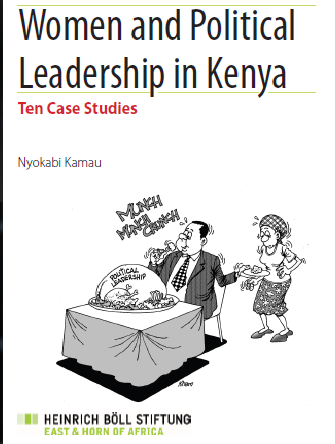
Women and Political Leadership in Kenya: Ten Case Studies
Heinrich Boll Foundation
This 100-page study, published by the Heinrich Boll Foundation, examines the perceptions, experiences, and achievements of ten female Kenyan politicians. The study reveals that women political leaders face challenges that include competing family demands, inadequate resources, politics of exclusion in political parties, lack of security, and lack of positive media coverage. The study identifies the need for well-organised mentoring programmes, and for a better understanding by female politicians on how to engage with the media and get acquainted with issues of local, national, and international concern.
According to the report, Kenyan women continue to be socialised along traditional gender roles that prioritise the domestic over the political sphere. A woman who enters into politics therefore faces stigma and may be labelled as an unfit mother or wife, a divorcee or a "man-basher." Following from this, women in the study were asked about the private challenges they face in order to identify ways that female politicians could be supported to overcome these hurdles. The support of partners ranked high in terms of women's success, which could partly explain why the majority of women in politics are either widowed, divorced, or were never married. Those who are married tended to choose to delay their entry into politics until their children had grown and the support of husbands was a critical factor. In contrast, their male peers tended to enter politics early when their families were fairly young. Wives were expected not only to support them but also continue looking after children.
Following from these pervasive gender norms, the study found that a lack of media visibility also works against female politicians. While the study says that Kenyan media have devoted significant time to covering women's issues, it notes that the media has encouraged negative perceptions and stereotyping of women along the lines of aforementioned traditional gender roles. Only on rare occasions does the media go out of its way to present women as able leaders positively contributing to national development. Engaging with the media was cited as a major challenge for the female politicians interviewed.
The study concludes with recommendations, including that women learn how to work with the media to achieve not only national profiles in politics but also to highlight their achievements. The study suggests that women link with journalists who are friendly and work with them to get themselves profiled long before election. Women should seek out the media, rather than hoping the media will come to them. In addition, women should be more vocal on issues of national concern, perhaps projecting innovative development issues. Their comments to the media should be well informed to not only give themselves but women leaders in general more visibility.
The study also mentions that voters needs to begin to judge candidates for political office more by what they stand for and their accomplishments than on how much money they can distribute. This would make the ground more level for women candidates, and is much more likely to produce quality leadership. However, it requires joint effort by government, NGOs, faith-based organisations, media, civil society, and human rights organisations to educate Kenyans that by accepting to be bribed, they are selling away their right to vote for good leaders, be they men or women.
Apart from training, NGOs should also continue giving logistical support to women aspirants in their campaigns, in recognition that campaigns are expensive to run, and most women are financially disadvantaged when compared to their male counterparts. The idea of employing community mobilisers for the women candidates is a good approach, but other support mechanisms such as assisting aspirants with transport and security arrangements can also be explored. As well, NGOs should continue working with communities to sensitise voters against vices that work against fair and transparent elections.
Heinrich Boll Foundation website on February 6 2012.
- Log in to post comments