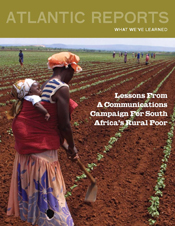
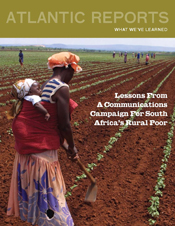
What We've Learned: Lessons from a Communications Campaign for South Africa's Rural Poor
The Atlantic Philanthropies
This 36-page report describes the Farm Life Project in South Africa, a multi-pronged communications campaign that Atlantic Philanthropies and more than a dozen grantee organisations pursued from 2004 to 2006 to raise awareness of the plight of the rural economically poor in the changing economy. The campaign sought to inform government officials, media, and the general public about the plight of farm dwellers. It involved a quantitative survey that exposed the scale of farm dweller evictions and a photography book and exhibit designed to put a "face" on the issue. This report describes the planning and execution of the campaign, identifies the continuing challenges and work needed in the area of rural poverty, and encourages a discussion about potential policy solutions. In particular, the campaign revealed a number of lessons that may be useful to funders and advocates around the world interested in using communications to support advocacy campaigns for social change.
According to the report, prior to the surveys conducted during the project, information that families were being thrown off farms, as well as the extent of the evictions, had been solely anecdotal. In this sense, the project helped to fill an important information gap. This, in combination with the photographs taken for the exhibition, gave project participants the tools to disseminate information to government agencies, the general public, and the media, thereby putting the issue of farmworkers on the public agenda. The author states that in the five months after the release of the survey, more than 60 articles about components of the project appeared in the print media. The issue was covered on television by South African current affairs programme Special Assignment. Although coverage was largely positive and sympathetic, it was more event-focused than analytic. The report also states that the project sparked national government debate; however, it acknowledges that not much has actually changed in real terms for rural farmworkers and farm dwellers.
The report outlines key lessons or recommendations learned from the project: firstly, that a coalition can be extremely effective through a multifaceted campaign that integrates many tactics and that effective advocacy requires strong coalitions and local voices. The second lesson is that communication campaigns must be sustained if they are to produce long-term benefits. In this case, a six-month campaign was too short, and once it was over, the issue faded from public view. Organisers learned that coordinating a successful communications campaign also requires active involvement from participants and that the timing of communications and advocacy efforts is crucial to success. The report recommends that the communications budget should not only be adequate, but also strategically allocated, in order to accomplish its goals effectively.
The report offers some suggestions for coalitions considering using communication to support advocacy work. These include:
- getting informed about the policy background;
- identifying existing research or developing an evidence base where research does not exist;
- ensuring communication strategies to maximise impact;
- considering all possible communication tactics for reaching various audiences;
- testing messages with key audiences;
- identifying decision makers in a policy reform effort and considering who and what influences them;
- setting achievable and measurable goals; and
- planning for worst-case scenarios.
Atlantic Philanthropies website, May 4 2009.